England · Restored
Sudeley Castle
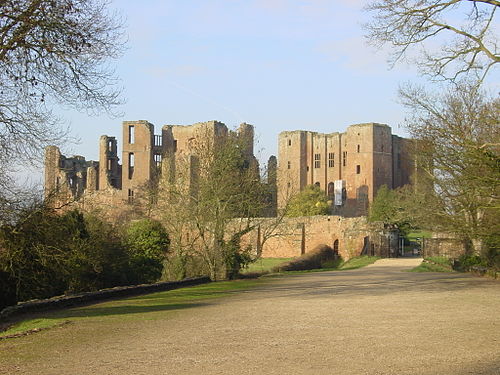
Sudeley Castle is a Grade I listed country house-castle set in the Cotswold hills near Winchcombe, Gloucestershire. Built from 1443 and remodelled in the 16th century, it has historic royal associations and an enclosed church within its grounds where Catherine Parr was buried; the house was later slighted in the Civil War and restored in the 19th century and is today open with extensive gardens.
First raised
1443
Its prime
1592
Today
Restored
As it stood in 1592
What Sudeley Castle looked like in its prime.
A long, crenellated limestone castle composed of linked residential ranges forming an inner and an outer courtyard; square and rectangular towers punctuate a continuous battlemented roofline. Tall mullioned and oriel windows face the inner court and gardens; the Great Hall projects as a long gabled range with prominent oriels. The castle sits amid rolling Cotswold parkland, veteran oaks and formal parterres to one side, with a small church set close within the castle precincts.
Its story
The story of Sudeley Castle.
Goda's Manor and the Anarchy
The name is a corruption of the Anglo-Saxon Sudeleagh, the south-lying pasture or clearing in forest. By the turn of the eleventh century Sudeley had grown into a manor house set in a royal deer park, given by Æthelred the Unready to his daughter Goda as a wedding gift, and despite William the Conqueror's policy of stripping Saxon nobles of their estates after 1066 the family kept it; Goda's descendants held Sudeley for another four centuries.
During the Anarchy, John de Sudeley took the side of the Empress Matilda against her cousin Stephen of Blois, and the first castle here is believed to have been raised in those years as an adulterine castle; whether a fortification of the existing manor house or an entirely new structure is unknown. After Matilda's forces sacked Worcester in 1139, Waleran de Beaumont, 1st Earl of Worcester, retaliated by attacking and capturing both Sudeley and Tewkesbury, and its defences were probably pulled down in the process, since Roger, Earl of Hereford, soon built a replacement motte-and-bailey castle at Winchcombe.
Boteler Builds, Gloucester Takes, 1443-1485
By the start of the fifteenth century the Sudeley name was believed extinct and the castle had come to the Botelers through the marriage of Joan, sister of the last de Sudeley. Ralph Boteler, who had risen in the Hundred Years' War and sat on Henry VI's Regency Council from 1423 as Baron Sudeley, is believed to have begun the present castle in 1443, around the time he became Lord High Treasurer of England. He laid it out on a double courtyard plan, the outer court for servants and men-at-arms, the inner court kept for his own family, and, having failed to obtain royal permission to crenellate, had to seek Henry VI's pardon for it.
In 1469, out of favour as a Lancastrian, Ralph was compelled to sell Sudeley and six other manors to the crown. Edward IV granted the castle to his brother Richard, Duke of Gloucester, who used it as a military base before the Battle of Tewkesbury in 1471; Richard exchanged it for Richmond Castle in 1478 and took it back on his accession in 1483. He is credited with building the great banqueting hall, with a ground-floor hall for feasting guests and an upper great hall reserved for the king and his chosen company. After Richard's death at Bosworth in 1485 the castle passed as crown property to Henry VII, who presented it to his uncle Jasper Tudor.
Catherine Parr's Last Year, 1548
Henry VIII stayed at Sudeley only once, on his royal progress of 1535 with Anne Boleyn, in the year he began the Dissolution of the Monasteries and executed Bishop John Fisher and Sir Thomas More. After his death the "unfulfilled gifts" clause of his will let his executors award themselves lands and titles: Edward Seymour became Lord Protector of the Realm and his brother Thomas was made Baron Seymour of Sudeley, who months later secretly married the king's widow, Catherine Parr, without Edward VI's permission.
In 1548 Catherine, by then pregnant, moved to Sudeley with a retinue of 120 Yeomen of the Guard and Gentlemen of the Household as well as her ladies-in-waiting; Seymour had already spent "vast amounts of money on the Castle, to fit it for a Queen". Among her attendants was his ward Lady Jane Grey, queen for nine days in 1553. Catherine died at Sudeley on 5 September 1548 of what was described as childbed fever, five days after giving birth to her daughter Mary Seymour, and was buried two days later at St Mary's Church within the grounds, the first Protestant funeral conducted in English, with Lady Jane Grey as chief mourner. Her tomb was mutilated and defaced over the next two centuries and its location lost, until a coffin was found in 1782 bearing a lead plate naming "Quene Kateryne wife to Kyng Henry the VIII". Sudeley is the only privately owned castle in the world with a Queen of England buried in its grounds.
Thomas held the castle six months more until he was executed for treason. Catherine's brother, William Parr, 1st Marquess of Northampton, inherited it and kept it until 1553, when he too was accused of treason and the crown seized it.
The Chandos Years and the Slighting of 1649
On 8 April 1554 John Brydges was raised to Baron Chandos of Sudeley by Mary I, almost certainly for his part in suppressing the Wyatt rebellion; as Lieutenant of the Tower of London he had befriended Lady Jane Grey while she was in his care, and had led her to her execution. His son Edmund heavily remodelled the castle through the 1560s and 1570s, all but rebuilding the outer courtyard. Elizabeth I stayed three times, in 1574, on the progress of 1575, and most famously in 1592, when Giles Brydges, 3rd Baron Chandos, landscaped the grounds and threw a three-day party of banquets, plays and dances, remembered as a celebration of the defeat of the Spanish Armada; it reputedly came close to bankrupting the family.
George Brydges, 6th Baron Chandos, took the Royalist side in the Civil War. In January 1643, while he was away supporting Prince Rupert at the siege of Cirencester, Sir Edward Massey attacked Sudeley with some five hundred soldiers and two cannon; the small garrison soon fell and the castle was plundered, then abandoned on news that the Royalist army had taken Cirencester and was turning towards it. Later that year, after the Royalist failure at the siege of Gloucester, Charles I camped at Sudeley and made it his base of operations in Gloucestershire. The castle changed hands several times, holding out most famously against cannon bombardment by Sir William Waller until an officer of its own garrison betrayed it and let the attackers in.
In 1649 Parliament ordered Sudeley slighted so that it could never serve as a military post again. The work took some five months and largely dismantled the inner courtyard and the royal apartments, though much of the outer courtyard was left standing. Buried in debt, George Brydges could not rebuild and died in 1655 after years of imprisonment in the Tower of London; the castle passed to his widow, Lady Jane Savage, parting it from the Chandos title for the first time in over a century, and stood a neglected ruin for almost two hundred years.
The Dent Brothers Buy a Ruin, 1837
Through the eighteenth century Sudeley was let to tenants, one of whom, John Attwood, turned it into a public house called the Castle Arms and worked it as a quarry, breaking it up and selling off the stone, timber and lead. Antiquarians and artists came to draw the romantic ruin from the early 1700s, and George III visited in 1788 while taking the waters at Cheltenham Spa. In 1837 the brothers John and William Dent of Worcester, wealthy glove manufacturers whose father had founded Dents Gloves in 1777, bought a castle that was "ruinous, but partly occupied by tenants".
Their restoration was a careful one: rather than rebuild everything they left part of it standing as ruin, and the work is said to have been directed by George Gilbert Scott, who went on to restore the free-standing chapel of St Mary between 1859 and 1863 and to design the neo-Gothic canopied tomb in which Catherine Parr's remains were finally laid. Both brothers were dead by 1855, and the castle passed to their nephew John Croucher Dent and his wife Emma, who attempted a re-creation of a historic garden in 1859 and substantially enlarged the house from 1885.
Death duties on the death of Henry Dent-Brocklehurst in 1932 forced the family to sell much of the land the castle depended on for its upkeep. During the Second World War the Tate Gallery used Sudeley to store art moved out of London to escape the Blitz, and Camp 37, a prisoner-of-war camp for captured Italian and German soldiers who worked the local farms, stood where the visitors' car park is now; it closed on 20 January 1948. The castle opened to the public in May 1970, and after the death of Mark Dent-Brocklehurst in 1972 it survived a third round of heavy death duties in under fifty years under his widow Elizabeth, Lady Ashcombe, who kept it open and began a major restoration.
Step inside
10 places to explore in 1592.
The record describes 10 distinct spots at Sudeley Castle, including 2 interiors: great hall, interior (upper and lower halls), royal bedchamber (catherine parr's chamber as recorded). Create your own photoreal reconstruction and explore every one, more scenes means more rooms, more angles, and more of the place to stand in.
Build Your Own Castle
Recreate Sudeley Castle with AI to explore it.
The artist rebuilds it as it stood in 1592, a photoreal reconstruction that belongs to you alone. Pay with coins, no subscription needed.
Recreate this castle →Defend this castle →Whose castle
Clans who held Sudeley Castle.
The families that held Sudeley Castle for a decade or more across its history, follow a name to its clan.
Boteler
Built from 1443 for Ralph Boteler, Lord High Treasurer of England, before the castle was seized by the crown.
Chandos
Home of the Chandos family in the 16th century, when Elizabeth I visited the castle on three occasions.
Dent
Purchased in 1837 by the Dent family, who restored the slighted castle and made it a family home again.
From the archive
Sudeley Castle on paper: the measured plan and period views.
The survey plan and photographs below are the ground truth this page's reconstructions are checked against, drawn and photographed while the castle was still a working garrison. Every image is public-domain or openly licensed, with its source named.
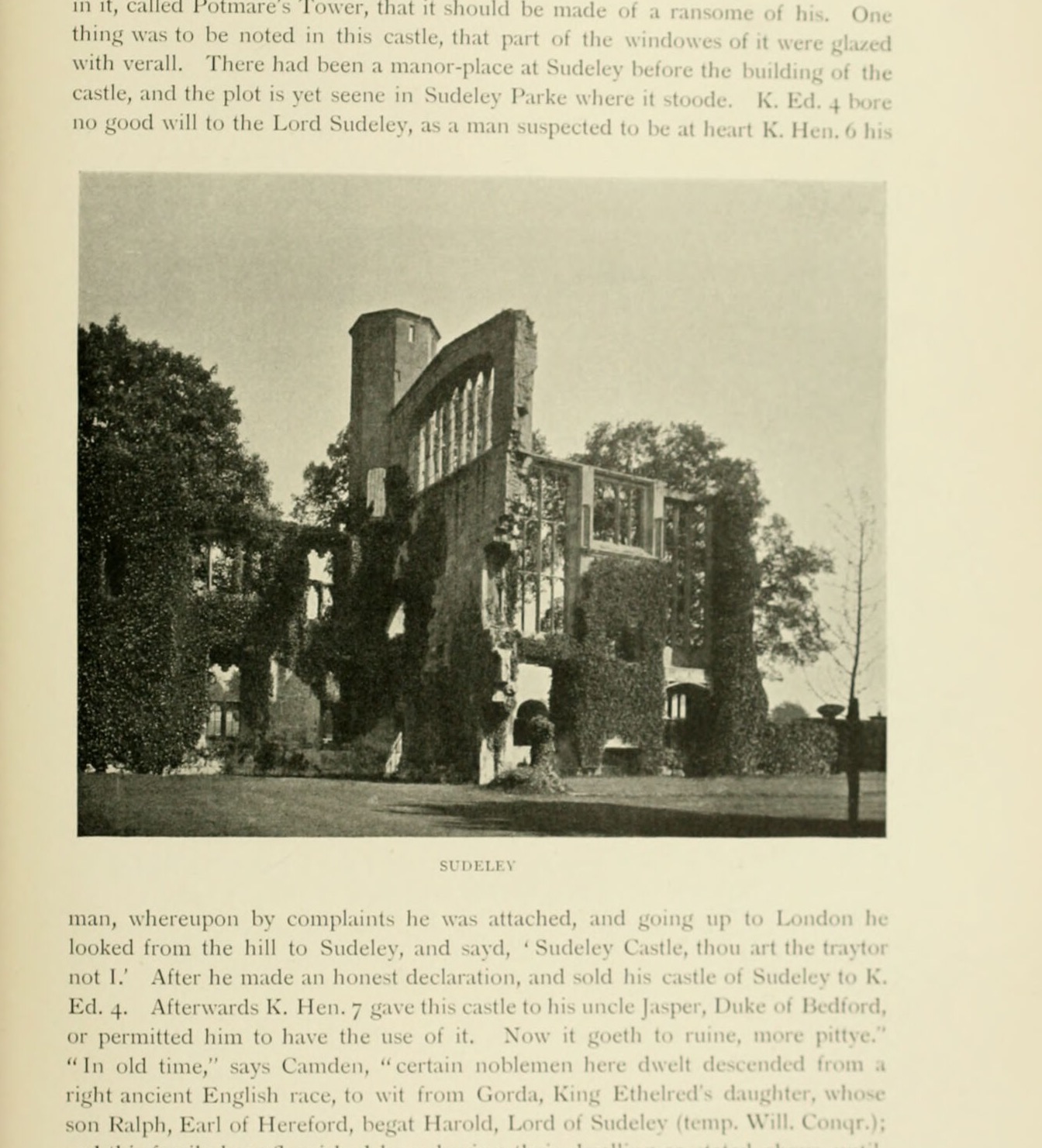
SUDELEY
1897 · J. D. Mackenzie, The Castles of England, vol. 1 (1897)
Public domain
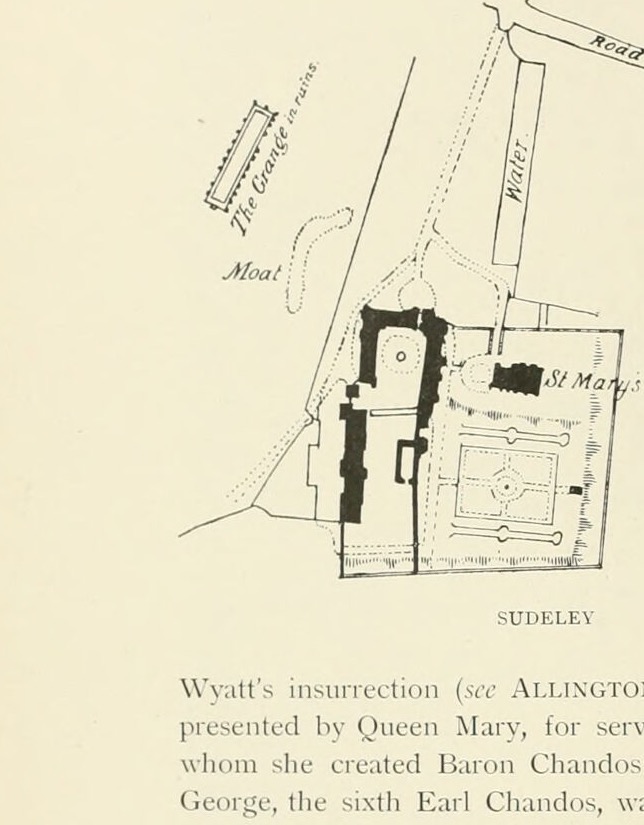
SUDELEY
1897 · J. D. Mackenzie, The Castles of England, vol. 1 (1897)
Public domain
Nearby