England · Still standing
Berkeley Castle
Berkeley Castle is a Norman-origin castle in the town of Berkeley, Gloucestershire, continuously occupied and owned by the Berkeley family since the 12th century. Much of the visible fabric dates from 12th- and 14th-century building campaigns, and the site retains a shell keep, curtain walls, towers and extensive domestic interiors open to visitors.
First raised
1067
Its prime
1360
Today
Still standing
As it stood in 1360
What Berkeley Castle looked like in its prime.
Large red-brown sandstone castle set on a raised terrace above a broad lawn, dominated by a circular shell keep and crenellated curtain wall with rectangular towers and a prominent multi-chimneyed residential block. Stone retaining terraces and gardens rise to the base of the walls; the roofline is a mix of battlements and pitched roofs behind parapets. At its prime the walls and keep were complete, with gatehouse access, towered angles and domestic ranges adjoining the inner bailey.
Its story
The story of Berkeley Castle.
FitzOsbern's Motte and Fitzharding's Charter, 1067–1190
The first castle at Berkeley was a motte-and-bailey built around 1067 by William FitzOsbern, shortly after the Norman Conquest. Three generations of the first Berkeley family, every one of them a Roger de Berkeley, held it and rebuilt it in the first half of the 12th century. The last Roger was dispossessed in 1152 for withholding his allegiance from the House of Plantagenet during the Anarchy, and the feudal barony of Berkeley went instead to Robert Fitzharding, a wealthy burgess of Bristol who had backed the Plantagenets. He and Eva fitz Harding founded the family that owns the castle still.
In 1153–54 Henry II gave Fitzharding a royal charter permitting him to rebuild. The circular shell keep went up between 1153 and 1156, probably on the site of the former motte, and the curtain wall followed, probably between 1160 and 1190, begun by Robert and continued by his son Sir Maurice Berkeley. Much of the rest of the castle is 14th-century work built for Thomas de Berkeley, 3rd Baron Berkeley.
Five Months' Custody of a Deposed King, 1327
Berkeley was ransacked in 1326 by the forces of Hugh Despenser, the favourite of Edward II. Within a year the king himself was the prisoner in it. Deposed by his wife Queen Isabella and her ally Roger Mortimer, Edward was placed in the joint custody of Mortimer's son-in-law Thomas de Berkeley and de Berkeley's brother-in-law John Maltravers, who brought him here and held him for five months, from April to September 1327.
The custody was not a quiet one. A band of the king's supporters attacked, entered the castle and rescued him, only for him to be recaptured soon afterwards. It is possible that his captors then moved him between several castles to make a further rescue harder, before returning him to Berkeley in September.
The Death Reported to Parliament as an Accident
Historical sources record that Edward was murdered at Berkeley on 21 September 1327, and the castle is traditionally held to be the scene of it. Parliament was told at the time that the king had met with a fatal accident, while the chroniclers record that great effort went into keeping the murder secret. Even the death is disputed: some commentators have claimed that the earlier escape in fact succeeded, and that someone else was murdered later in his place.
The detail everyone remembers comes down through Raphael Holinshed, whose Chronicles of 1587 drew on earlier sources for a close account of the murder; Marlowe staged the scene in his Edward II of 1594 using props Holinshed had named, and popular stories of a red-hot poker or of suffocation have circulated ever since. Holinshed also has the keepers trying first to kill the king slowly, lodging him over "a foule filthie dungeon, full of dead carrion" so that the stench might finish him, "but he bearing it out stronglie" continued in life.
The body was embalmed and lay in state at Berkeley for a month, in the Chapel of St John within the keep, before Thomas de Berkeley escorted it to Gloucester Abbey for burial. Thomas was later charged with being an accessory to the murder; his defence was that Roger Mortimer's agents had done it while he was away from the castle, and in 1337 he was cleared of all charges.
Lady Berkeley's School, Nibley Green and the Tudor Visits
In 1384 Katharine, Lady Berkeley, founded Katharine Lady Berkeley's School, one of the first fully endowed small schools in England at a time when such colleges were unusual. The Great Hall was given a new roof in the same century, and it was from its minstrels' gallery that Dickie Pearce, held to have been the last court jester in England, fell to his death.
A dispute between Thomas Talbot, 2nd Viscount Lisle, and William Berkeley, 2nd Baron Berkeley, over the ownership of Berkeley Castle led to the Battle of Nibley Green. For a period under the Tudors the castle passed out of the family altogether and into royal hands. Henry VIII and Anne Boleyn came here in August 1535, after staying at Gloucester, and late in the 16th century Elizabeth I visited and played bowls on the castle's bowling green.
Rainsborough's Guns from the Church Roof, 1645
In the First English Civil War Berkeley was held by a Royalist garrison. A Parliamentarian force under Colonel Thomas Rainsborough took it in 1645 after a short siege in which cannon were fired at point-blank range from the roof of the adjacent church of Saint Mary the Virgin. As was usual the walls were left breached afterwards, and the family were allowed to keep the castle only on condition that they never repaired the damage to the keep and outer bailey. The breach has been no more than partly filled since, by a later rebuild amounting to a low garden wall that stops anyone falling twenty-eight feet from the Keep Garden, the original motte. Between 1748 and 1753 the tower of St Mary's was demolished and rebuilt beside the church so that it would not impede the castle's clear line of fire.
The barony had separated from the earldom in 1882, and on his death in 1942 the 8th and last Earl left the ancestral seat to his 13th cousin, Captain Robert Berkeley of Spetchley Park; it passed down through Major John Berkeley to his son Charles Berkeley, High Sheriff of Gloucestershire for 2019/20. Berkeley is the third-oldest continuously occupied castle in England, after the royal fortresses of the Tower of London and Windsor, and the oldest to be continuously family-owned and occupied.
Step inside
12 places to explore in 1360.
The record describes 12 distinct spots at Berkeley Castle, including 5 interiors: great hall, chapel of st mary / morning room, chapel of st john (within the keep) and more. Create your own photoreal reconstruction and explore every one, more scenes means more rooms, more angles, and more of the place to stand in.
Build Your Own Castle
Recreate Berkeley Castle with AI to explore it.
The artist rebuilds it as it stood in 1360, a photoreal reconstruction that belongs to you alone. Pay with coins, no subscription needed.
Recreate this castle →Defend this castle →Whose castle
Clans who held Berkeley Castle.
The families that held Berkeley Castle for a decade or more across its history, follow a name to its clan.
Berkeley
Held by the Berkeley family since the 12th century, one of England's longest continuous family seats.
FitzHarding
Granted to Robert Fitzharding, founder of the Berkeley line, in 1153.
From the archive
Berkeley Castle on paper: the measured plan and period views.
The survey plan and photographs below are the ground truth this page's reconstructions are checked against, drawn and photographed while the castle was still a working garrison. Every image is public-domain or openly licensed, with its source named.
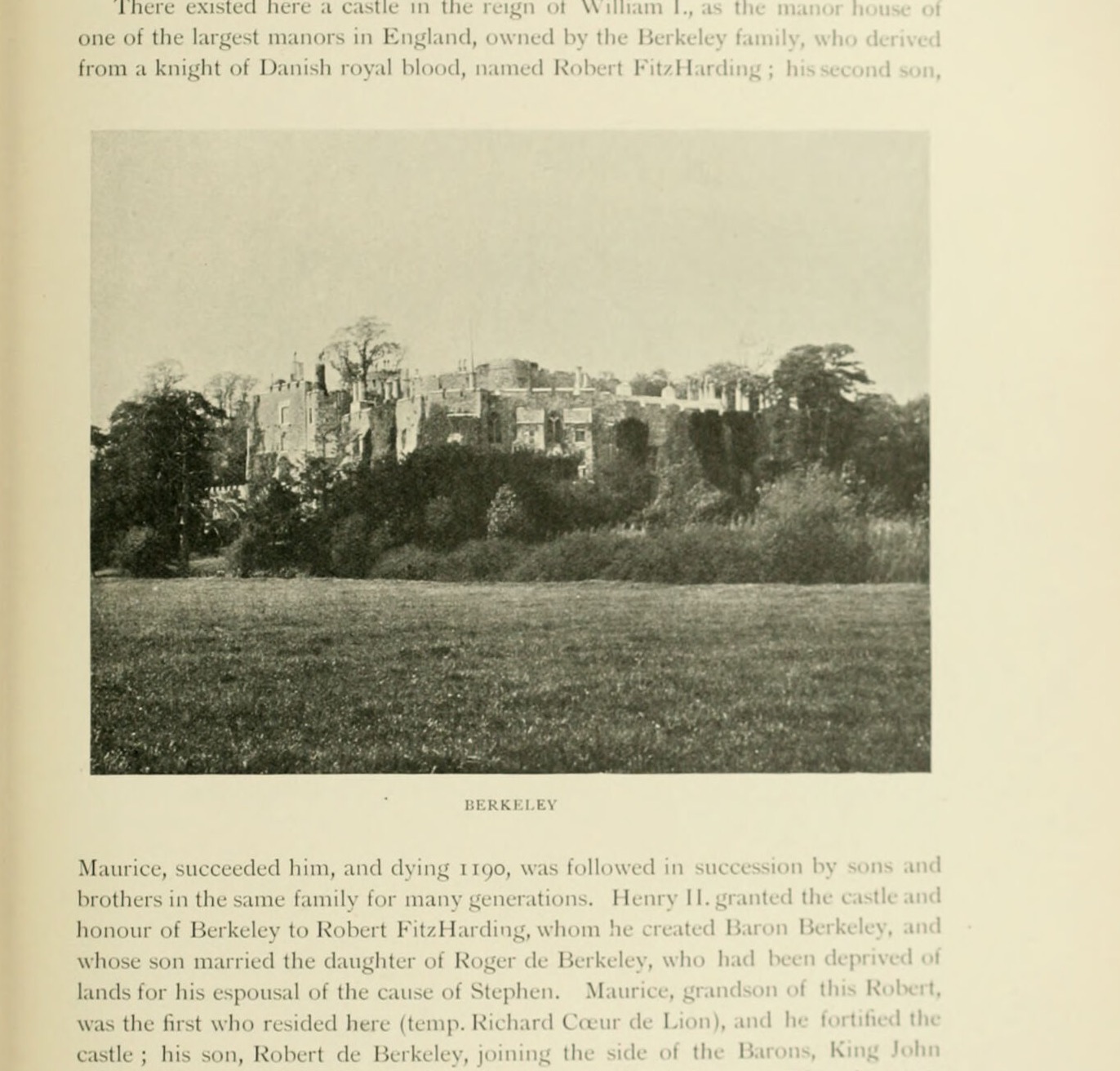
BERKELEY
1897 · J. D. Mackenzie, The Castles of England, vol. 1 (1897)
Public domain
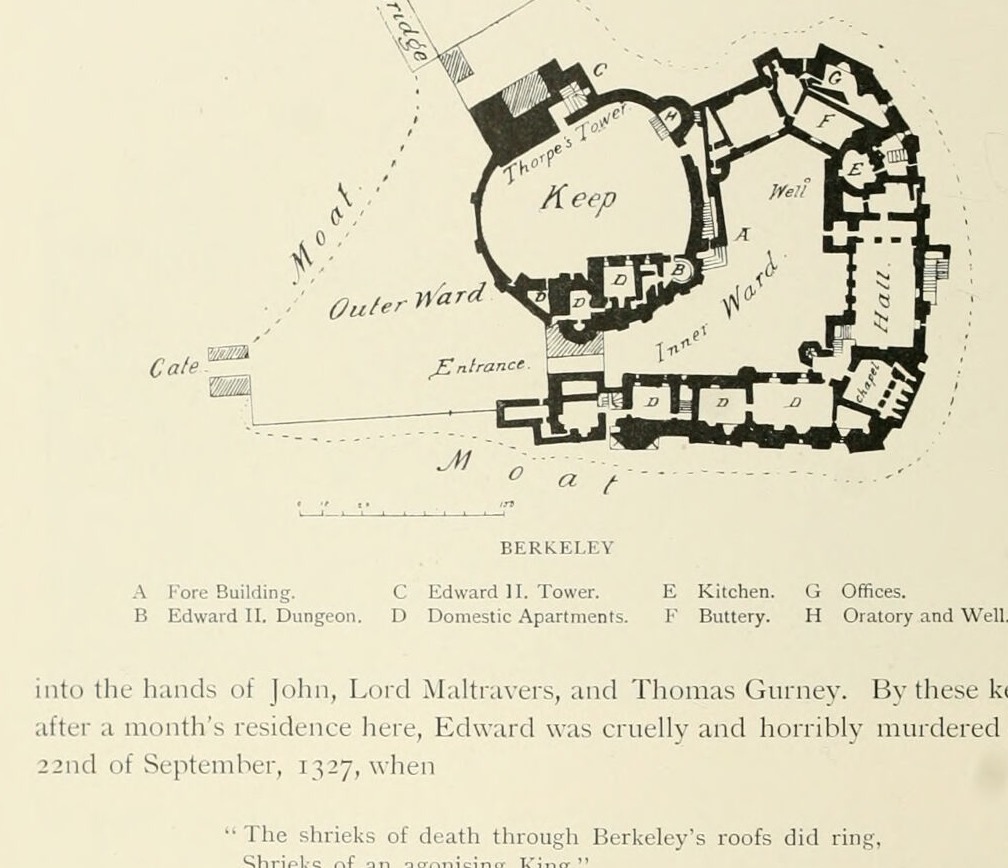
BERKELEY (plan). Legend: A Fore Building. B Edward II. Dungeon. C Edward II. Tower. D Domestic Apartments. E Kitchen. F Buttery. G Offices. H Oratory and Well.
1897 · J. D. Mackenzie, The Castles of England, vol. 1 (1897)
Public domain
Nearby