
England · Restored
Raby Castle
Raby Castle is a large medieval palace-fortress near Staindrop in County Durham, England, originally built by the Neville family in the late 14th century. The stone castle sits within a broad moat and deer park and has served as a private family seat since the 17th century, with later alterations and restorations while retaining medieval plan elements such as its gatehouse, curtain walls, towers, great hall, chapel, kitchen and keep.
First raised
1378
Its prime
1390
Today
Restored
As it stood in 1390
What Raby Castle looked like in its prime.
A sprawling, irregular-plan stone castle with nine towers and crenellated parapets, set within a broad moat and open deer park. A continuous curtain wall rises directly from the water, punctuated by towers and a four-storey west gateway; tall mullioned windows and a variety of tower shapes break the roofline. Built of pale ashlar and coursed stone, the ranges enclose a central courtyard and present a fortified palace silhouette at its medieval height.
Its story
The story of Raby Castle.
Summoned to Parliament as Barons of Raby, 1295
The House of Neville held the manor of Raby from the thirteenth century. The family carried no formal title, but from 1295 they were summoned to Parliament as barons of Raby, Ralph Neville, 1st Baron Neville de Raby, being the first called. His heir John, who died in 1335, entered the household of Thomas, 2nd Earl of Lancaster, beginning the attachment to the earls of Lancaster that would later decide Neville politics. Raby was the seat of their power, and there may have been a fortified house on the site from about 1300.
A Licence to Fortify, 1378
In the second half of the fourteenth century the Nevilles set about rebuilding several of their properties in northern England. Raby was reconstructed between roughly 1367 and 1390 for John Neville, 3rd Baron Neville de Raby, to the design of John Lewyn, and in 1378 Thomas Hatfield, Bishop of Durham, granted him a licence to fortify the house. John died in 1388 and was succeeded by his son Ralph. Almost none of the family's papers survives from these years, so the building is dated chiefly by its architectural detail; in the judgement of the historian Anthony Emery, the work “converted it from a defendable house into a palace-fortress”.
What went up was a castle of irregular plan with nine towers around its perimeter. The main approach lay west through the four-storey Neville Gateway, reached by a drawbridge and closed by three portcullises. Behind the moat, the first line of defence, the curtain wall rose thirty feet from the water, stiffened at intervals by buttress towers and carrying a walk along which the guard was posted.
Ralph Neville and the Fall of Richard II
Richard II created Ralph Neville Earl of Westmorland on 29 September 1397, a reward for loyalty in a season of political unrest. The reward did not bind him. When Henry Bolingbroke of the House of Lancaster invaded in July 1399, the family's old association with the earls of Lancaster told, and Neville sided with the invader; he helped persuade Richard to abdicate, was made Earl Marshal of England on the day Bolingbroke was crowned Henry IV, and became a Knight of the Garter in 1403. By the close of the century the Nevilles were becoming one of the most powerful families in northern England, comparable to the Percys, who had been made earls of Northumberland in 1377. Cecily Neville, mother of the kings Edward IV and Richard III, was born at Raby.
The Rising of the North, 1569
Henry Neville, 5th Earl of Westmorland, died in 1564 and was succeeded by his son Charles. The Nevilles were Catholics, and in 1569 Charles was one of the leaders of the failed Rising of the North in favour of Mary, Queen of Scots and against the Protestant Elizabeth I. The Crown judged the threat severe: more than 800 rebels were executed, while Charles Neville and the other leader, Thomas Percy, 7th Earl of Northumberland, fled into exile. An attainder was issued against Neville in 1571 and his lands were forfeited, Raby among them.
Sir Henry Vane's Purchase, 1626
The castle stayed in Crown hands for more than forty-three years, until Sir Henry Vane the Elder bought it, along with neighbouring Barnard Castle, from the Crown in 1626. He was drawn by Raby's size and its lands, where Barnard was hemmed in by the town around it. The Vanes modernised the interior, renovating the medieval chapel and the drawing room, and drove a carriageway through the castle that did much damage to its medieval fabric; as earls of Darlington and dukes of Cleveland they added a Gothic entrance hall and an octagonal drawing room, and between 1843 and 1848 William Burn re-roofed the great hall and chapel and added a Jacobean-style drawing room to one of the towers.
When the 4th Duke of Cleveland died in 1890 the succession to Raby and its estates was unclear. The Committee of Privileges of the House of Lords settled it in 1891 in favour of his relative Henry Vane, who took the estates as 9th Baron Barnard; the dukedom became extinct. The castle remains the family's home, and the 11th Baron began an extensive programme of renovation and restoration after inheriting the barony in 1964. Among the pictures the family gathered there are portraits of Sir Henry Vane the Elder and of Sir Henry Vane the Younger, at one time governor of Massachusetts.
Step inside
10 places to explore in 1390.
The record describes 10 distinct spots at Raby Castle, including 4 interiors: great hall (baron's hall), interior, medieval kitchen, keep (interior) and more. Create your own photoreal reconstruction and explore every one, more scenes means more rooms, more angles, and more of the place to stand in.
Build Your Own Castle
Recreate Raby Castle with AI to explore it.
The artist rebuilds it as it stood in 1390, a photoreal reconstruction that belongs to you alone. Pay with coins, no subscription needed.
Recreate this castle →Defend this castle →Whose castle
Clans who held Raby Castle.
The families that held Raby Castle for a decade or more across its history, follow a name to its clan.
Neville
Built by John Neville, 3rd Baron Neville de Raby, c.1367–90; seized by the Crown after the 1569 Rising of the North.
Vane
Bought by Sir Henry Vane in 1626; seat of the Vane Barons Barnard ever since.
From the archive
Raby Castle on paper: the measured plan and period views.
The survey plan and photographs below are the ground truth this page's reconstructions are checked against, drawn and photographed while the castle was still a working garrison. Every image is public-domain or openly licensed, with its source named.
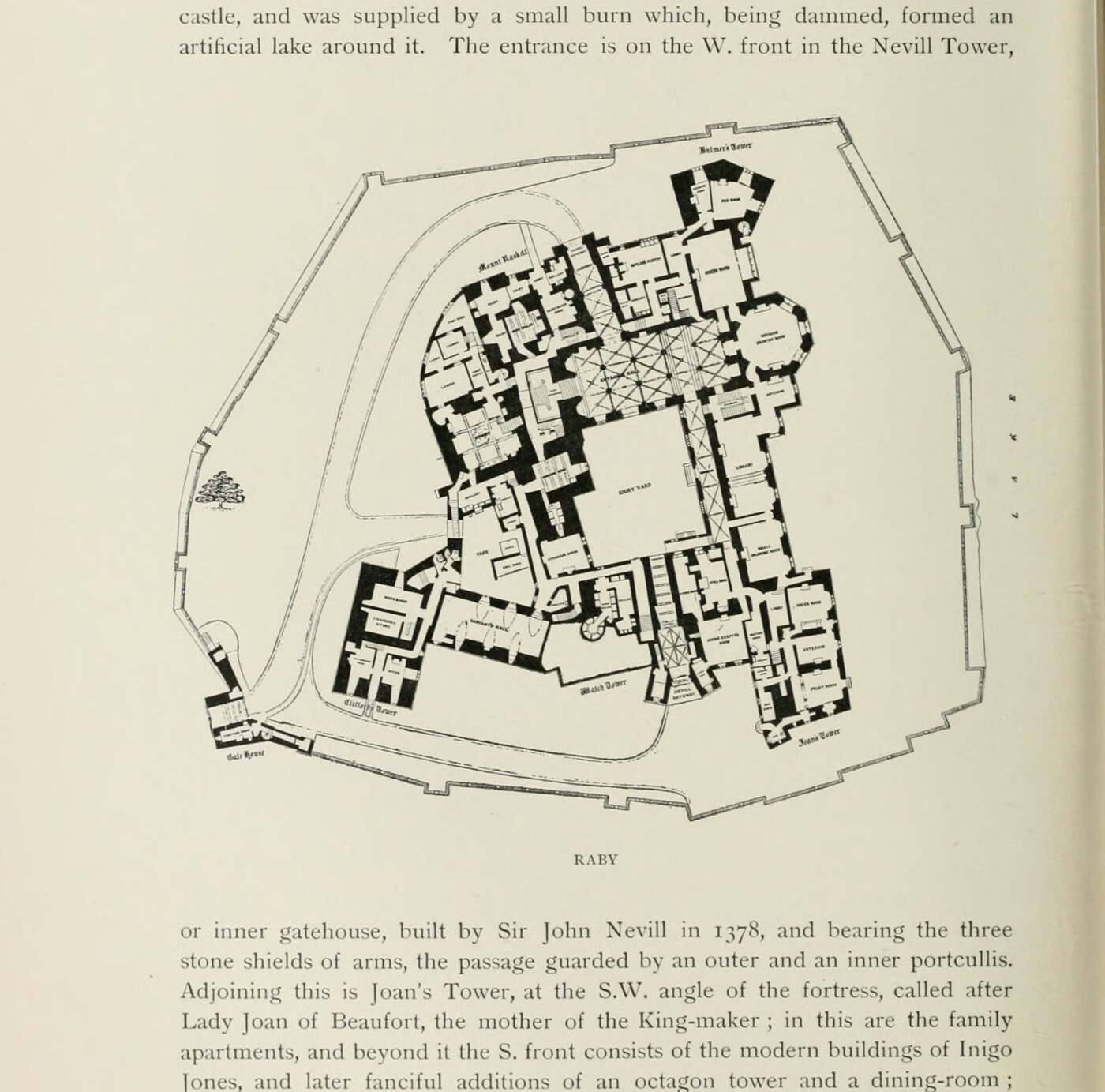
RABY
1897 · J. D. Mackenzie, The Castles of England, vol. 2 (1897)
Public domain
Nearby


