Cathedral · England · Still standing
Durham Cathedral
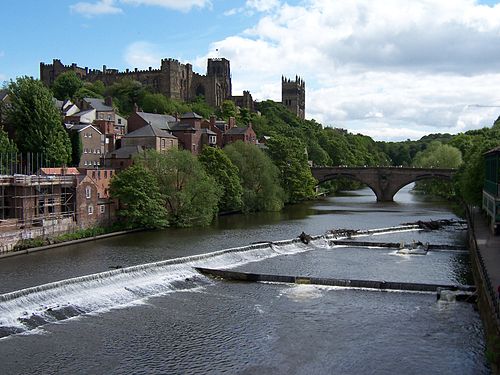
Durham Cathedral is a Norman-built Church of England cathedral in the city of Durham, serving as the seat of the Bishop of Durham. The surviving fabric dates largely from the late 11th to 13th centuries, with later medieval additions; it houses the historic shrines of Saint Cuthbert and the Venerable Bede and forms part of a castle-and-cathedral World Heritage Site.
First raised
1093
Its prime
1500
Today
Still standing
As it stood in 1500
What Durham Cathedral looked like in its prime.
A massive Romanesque west front dominated by three square towers rises from a broad, articulated façade of rounded arches and grouped window openings; a large traceried west window sits above a recessed central bay. The building is of pale, weathered ashlar with crenellated parapets and vertical paired openings in the towers. The west end includes the low, multi-aisled Galilee porch; the long nave is roofed with a high pointed rib vault and extends east to an apsidal termination.
Its story
The story of Durham Cathedral.
From Lindisfarne to the White Church, c. 635–1018
The see takes its origins from the diocese of Lindisfarne, founded by Saint Aidan at the behest of Oswald of Northumbria in about 635 and translated to York in 664, then reinstated at Lindisfarne by the Archbishop of Canterbury in 678. Of the many saints who came out of Lindisfarne Priory the greatest was Cuthbert, bishop there from 685 until his death in 687, and he stands at the centre of the cathedral's development. After repeated Viking raids the monks fled Lindisfarne in 875, carrying Cuthbert's relics with them. The diocese remained itinerant until 882, when the community resettled at Chester-le-Street, sixty miles south of Lindisfarne and six miles north of Durham; it stayed there until 995, when further Viking incursions moved the monks and their relics once again.
Where they went next is told two ways. The local legend of the Dun Cow, which the saint's hagiography also carries, has the monks follow two milk maids searching for a dun-coloured cow and find themselves on a peninsula formed by a loop in the River Wear, whereupon Cuthbert's coffin became immovable and the community took that as the sign that the new shrine should stand there. A more prosaic set of reasons is also given for the choice: the peninsula was highly defensible, and a community established on it would enjoy the protection of the Earl of Northumbria, with whom Bishop Aldhun had strong family connections. The street running from The Bailey past the eastern towers up to Palace Green is still called Dun Cow Lane, after the miniature dun cows that once grazed the pastures nearby.
A very simple temporary structure of local timber was put up first to house the relics, and the shrine then moved to a sturdier building, probably still wooden, known as the White Church. That was replaced three years later, in 998, by a stone church of the same name, which by 1018 was complete except for its tower. Durham became a site of pilgrimage as the cult of Cuthbert grew, and King Canute was among the early pilgrims, granting the monks many privileges and estates. The defensible position, the flow of money from pilgrims and the power embodied in the church all drew a town around the cathedral, and that town established the core of the city.
William de St-Calais Lays the Foundation Stone, 1083–1140
The present cathedral was designed and built under William de St-Calais, also known as William of St Carilef. In 1083 he founded the Benedictine Priory of St Cuthbert at Durham, ejecting the secular canons who had been in charge of the church and shrine, along with their wives and children, and replacing them with monks from the monasteries of Wearmouth and Jarrow. He divided the church's extensive lands between his own bishopric and the new priory, and appointed Aldwin as the first prior.
St-Calais demolished the old Saxon church, and on 11 August 1093, with Prior Turgot, Aldwin's successor, he laid the foundation stone of the great new cathedral. The bishop took responsibility for completing the cathedral while the monks went on building the monastic ranges at their own expense; stone was cut from the cliffs below the walls and moved up using winches. The primary reason for the building was to house the bodies of Cuthbert and the Venerable Bede, and most of the structure is still the Norman work begun then, for all the additions and reconstructions since.
Construction started at the eastern end, and the choir was completed by 1096. When William de St-Calais died on 2 January 1096 the chapter house was ready enough to be used as his burial place, and responsibility passed to his successor Ranulf Flambard, who also built Framwellgate Bridge, the earliest crossing of the Wear from the town. In 1104 Cuthbert's remains were transferred with great ceremony to the new shrine in the new cathedral, and the monks looked after that shrine until the dissolution of the monasteries. The walls of the nave were finished by 1128 and the high vault by 1135, and the chapter house was built between 1133 and 1140.
The Galilee Chapel, the Nine Altars and the Dissolution of 1540
In the 1170s Hugh de Puiset added the Galilee Chapel at the west end, after a false start at the eastern end where subsidence and cracking prevented work from continuing. It functioned as a Lady chapel, the great west door being blocked during the medieval period by an altar to the Virgin Mary and now by the tomb of Bishop Thomas Langley; the main entrance is on the northern side, facing the castle, and the chapel holds the remains of Bede. Puiset lies in the chapter house, as do William de St-Calais and Ranulf Flambard. In 1228 Richard le Poore, Bishop of Salisbury, who had just rebuilt Salisbury Cathedral in the Gothic style, was translated to Durham. The eastern end was in urgent need of repair and the proposed eastern extension had failed. Le Poore employed the architect Richard Farnham to design an eastern terminal in which many monks could say the Daily Office simultaneously: the result was the Chapel of the Nine Altars. In 1250 the cathedral's original roof was replaced by a vault that is still in place. The towers date from the early thirteenth century, but the central tower was damaged by lightning and replaced in two stages in the fifteenth century, the master masons being Thomas Barton and John Bell.
The bishop of Durham was the temporal lord of the County Palatine of Durham, and he competed for power with the prior of Durham, himself a great landowner who held his own courts for his free tenants. An agreement of about 1229, known as Le Convenit, was entered into to regulate the relationship between the two magnates. The shrine of Saint Cuthbert stood at the eastern apsidal end of the cathedral, where the line of the inner wall of the apse is marked on the pavement and the tomb is covered by a simple slab. An unknown monk, writing in 1593, remembered that the shrine "was estimated to be one of the most sumptuous in all England, so great were the offerings and jewells bestowed upon it, and endless the miracles that were wrought at it, even in these last days".
During the English Reformation Henry VIII seized the churches, monasteries, priories and convents owned by the Roman Catholic Church, and Durham became an Anglican house of worship. Cuthbert's tomb was destroyed in 1538 by the king's order and the monastery's wealth handed over to the Crown. The saint's body was exhumed and, according to the Rites of Durham, was found to be uncorrupted; it was reburied under a plain stone slab, since worn smooth by the knees of pilgrims, with the ancient paving around it left intact. On 31 December 1540 the Benedictine monastery at Durham was dissolved, and the last prior, Hugh Whitehead, became the first dean of the cathedral's secular chapter.
Dunbar's Prisoners, Cosin's Refurnishing and the Victorian Restorations, 1650–1892
After the Battle of Dunbar in September 1650, Parliamentarian forces used the cathedral as a makeshift prison holding up to 3,000 Scottish prisoners of war. An estimated 1,700 died in the building, kept in poor conditions and lacking food, water or heat. The prisoners destroyed much of the cathedral woodwork for firewood, though Prior Castell's Clock, which featured the Scottish thistle, was spared. The dead were buried in unmarked graves, and the survivors were transported to the American colonies as indentured servants. Bishop John Cosin, in office from 1660 to 1672 and previously a canon of the cathedral, set about restoring the damage and refurnishing the building with new stalls, the litany desk and the towering canopy over the font, and an oak screen was added to carry the organ in place of a stone screen pulled down in the sixteenth century. On the remains of the old refectory, Dean John Sudbury founded a library of early printed books.
Through the eighteenth century the deans of Durham often held another position in the south of England and, after serving the statutory time in residence, would depart southward to manage their affairs, so that after Cosin's refurnishing there was little restoration or rebuilding. When work did resume it was not always of a sympathetic nature. In 1777 the architect George Nicholson, having completed Prebends' Bridge across the Wear, persuaded the dean and chapter to let him smooth off much of the outer stonework, considerably altering the building's character, and his successor William Morpeth demolished most of the chapter house. In 1794 James Wyatt drew up plans to transform the cathedral, including the demolition of the Galilee Chapel, but the chapter later decided against many of the intended changes; Wyatt renewed the fifteenth-century tracery of the Rose Window, inserting plain glass to replace what a storm had blown out.
In 1829 the dean and chapter authorised the engraving of a meridian line on the floor and wall of the north cloister, constructed by William Lloyd Wharton of Dryburn and Mr Carr, then head master of Durham School. Anthony Salvin removed Cosin's wooden organ screen in 1847, opening up the view of the east end from the nave, and restored the cloisters in 1858. George Gilbert Scott restored the tower in 1859–60 with Edward Robert Robson, who went on to serve six years as clerk of works, and in 1874 was responsible for the marble choir screen and pulpit in the crossing; in 1892 Scott's pupil Charles Hodgson Fowler rebuilt the chapter house as a memorial to Bishop Joseph Barber Lightfoot. The great west window depicting the Tree of Jesse was the gift of Dean George Waddington in 1867. A statue commemorates William Van Mildert, bishop from 1826 to 1836, the last to hold palatine powers and the driving force behind the foundation of Durham University.
Cuthbert's Shrine Restored and World Heritage Status, 1930s–2024
In the 1930s, under the inspiration of Dean Cyril Alington, work began on restoring the Shrine of Saint Cuthbert behind the high altar as a focus of worship and pilgrimage; it was resumed after the Second World War, and the four candlesticks and overhanging tester of about 1950 were designed by Ninian Comper. In 1986 the cathedral, with the neighbouring castle, became a World Heritage Site: the UNESCO committee classified it under criteria (ii), (iv) and (vi), reporting that "Durham Cathedral is the largest and most perfect monument of 'Norman' style architecture in England". Historic England's summary of the site's significance that year rested on the relics and material culture of the three saints buried there, a thousand years of continuous use and ownership as a place of worship, learning and residence, the archaeological remains, the traditions and historical memories attached to Cuthbert and Bede, and the site's role "as a political statement of Norman power imposed upon a subjugate nation, as one of the country's most powerful symbols of the Norman Conquest of Britain". The cathedral has been a grade I listed building since 1952.
The chapter, chaired by the dean, governs the cathedral. Durham is a "New Foundation" cathedral in which, apart from the dean and the Van Mildert Professor of Divinity, the offices of sub-dean, precentor, sacrist, librarian and treasurer are elected annually by the members of the chapter. In November 2009 the cathedral admitted female choristers for the first time; the girls and boys serve alternately rather than as a mixed choir, except at major festivals such as Easter, Advent and Christmas. That same month the North Front was lit for the Lumiere festival with "Crown of Light", a fifteen-minute presentation telling the story of Lindisfarne and the foundation of the cathedral through illustrations and text from the Lindisfarne Gospels; Lumiere has been repeated biennially since, most recently in 2023.
A plaque commemorating the Scottish soldiers who died as prisoners after Dunbar was first installed in 2011 and rededicated in 2017, and the remains of some of those prisoners have since been identified in a mass grave uncovered during building works in 2013 just outside the cathedral precinct near Palace Green. Two of the altars in the Nine Altars Chapel were rededicated at the start of the century to Saint Hild of Whitby and Saint Margaret of Scotland. In 2016 the former monastic buildings around the cloister, including the Monks' Dormitory and Prior's Kitchen, reopened to the public as Open Treasure, an exhibition of the cathedral's history and possessions; a new Open Treasure area followed in 2017 with Saint Cuthbert's coffin and various relics, and the Mapping the World display of material from the cathedral archive was added in 2019. Durham University and the cathedral have been digitising the priory's manuscripts, which run from the sixth century to the sixteenth. The church and cloister are open to visitors for part of each day unless closed for a special event, daily Church of England services continue, and the cathedral received 393,090 visitors in 2024.
Step inside
10 places to explore in 1500.
The record describes 10 distinct spots at Durham Cathedral, including 8 interiors: galilee chapel (west end), nave under the rib vault, choir and chancel and more. Create your own photoreal reconstruction and explore every one, more scenes means more photos, more angles and more of the immersive experience.
Build Your Own Castle
Recreate Durham Cathedral with AI to explore it.
The artist rebuilds it as it stood in 1500, a photoreal reconstruction that belongs to you alone. Pay with coins, no subscription needed.
Recreate Cathedral to Explore →Nearby
Castles within reach of Durham Cathedral.


Landmarks within reach of Durham Cathedral.


More landmarks of England


Explore the city