England · Restored
Brancepeth Castle
Brancepeth Castle is a large stone castle in the village of Brancepeth, County Durham, England, notable for its extensive 19th-century rebuilding on a medieval site. The present building reflects major early 19th-century reconstruction by Matthew Russell with mid-19th-century improvements by Anthony Salvin and is a Grade I listed building.
Its prime
1841
Today
Restored
As it stood in 1841
What Brancepeth Castle looked like in its prime.
A long ashlar stone curtain wall with crenellated parapets fronts a grassy approach and drive; the wall is punctuated by a tall rectangular projecting tower with narrow slits and battlements and by massive round drum towers with corbelled, machicolation-like overhangs and crenellations. Masonry is warm yellow-brown sandstone with regular coursing. Window openings are narrow and arched; the roofline behind the parapet is pitched and covered in lead at the time of prime condition. The whole complex sits amid parkland and mature trees.
Its story
The story of Brancepeth Castle.
Bulmers, Nevilles and the Rising of the North
A succession of buildings has stood on the site, some five miles south-west of Durham. The first was a Norman castle raised by the Bulmer family, rebuilt in the late 14th century by the Nevilles, who held Brancepeth for many years until 1569, when the Crown confiscated it for the family's part in the Rising of the North.
From Poisoning Scandal to the Russell Rebuilding
The Crown granted the estate in the early 17th century to Robert Carr, 1st Earl of Somerset, then confiscated it back after his involvement in a poisoning scandal. Three men who had bought the castle from the King's Commissioners in 1633 sold it in 1636 to Ralph Cole of Newcastle, whose grandson Sir Ralph Cole, 2nd Baronet, sold it on 9 April 1701 to Sir Henry Belaysyse, whose daughter was involved with Bobby Shafto and was said to have inspired the famous song.
In 1796 the castle was acquired by William Russell of Newbottle, a wealthy banker and mine owner. His son Matthew Russell, Member of Parliament for Saltash in 1818, spent lavishly on its reconstruction in the 1820s to the designs of the architect John Paterson, and the present building is largely his work. It was improved in the mid-19th century by Anthony Salvin for a later William Russell, High Sheriff of Durham in 1841.
Convalescents, the Durham Light Infantry, and a Publisher's Books
During the First World War the castle served as a hospital for convalescents from Newcastle General Hospital. In 1939 it became the regimental headquarters of the Durham Light Infantry, who put up a military camp of over 100 huts south of the village during the Second World War and remained at the castle until 1962.
In 1978 Margaret Dobson, wife of the publisher Dennis Dobson, bought the Grade I listed castle to store the firm's stock of books when the lease on its Notting Hill premises expired; her husband died that same year. She restored the fabric and interior (including the lead roof, stripped by an earlier tenant) refurbished function rooms for auctions and twice-yearly craft fairs, staged Shakespeare in the main courtyard, and let rooms. She died on 19 October 2014, aged 86, and the castle remains with the Dobson family.
Step inside
8 places to explore in 1841.
The record describes 8 distinct spots at Brancepeth Castle, including 2 interiors: cellar and vaulted store rooms, interior function rooms (large reception room). Create your own photoreal reconstruction and explore every one, more scenes means more rooms, more angles, and more of the place to stand in.
Build Your Own Castle
Recreate Brancepeth Castle with AI to explore it.
The artist rebuilds it as it stood in 1841, a photoreal reconstruction that belongs to you alone. Pay with coins, no subscription needed.
Recreate this castle →Defend this castle →Whose castle
Clans who held Brancepeth Castle.
The families that held Brancepeth Castle for a decade or more across its history, follow a name to its clan.
Bulmer
Builders of the first Norman castle at Brancepeth.
Neville
Held by the Nevilles, who rebuilt the castle in the late 14th century, until confiscation by the Crown in 1569 after the Rising of the North.
Held by the Coles from Ralph Cole's purchase in 1636 until Sir Ralph Cole, 2nd Baronet, sold it in 1701.
Belaysyse
Bought by Sir Henry Belaysyse on 9 April 1701.
Acquired by the banker William Russell in 1796; Matthew Russell rebuilt the castle in the early 19th century.
Dobson
Owned by the Dobson family since Margaret Dobson bought the castle in 1978.
From the archive
Brancepeth Castle on paper: the measured plan and period views.
The survey plan and photographs below are the ground truth this page's reconstructions are checked against, drawn and photographed while the castle was still a working garrison. Every image is public-domain or openly licensed, with its source named.
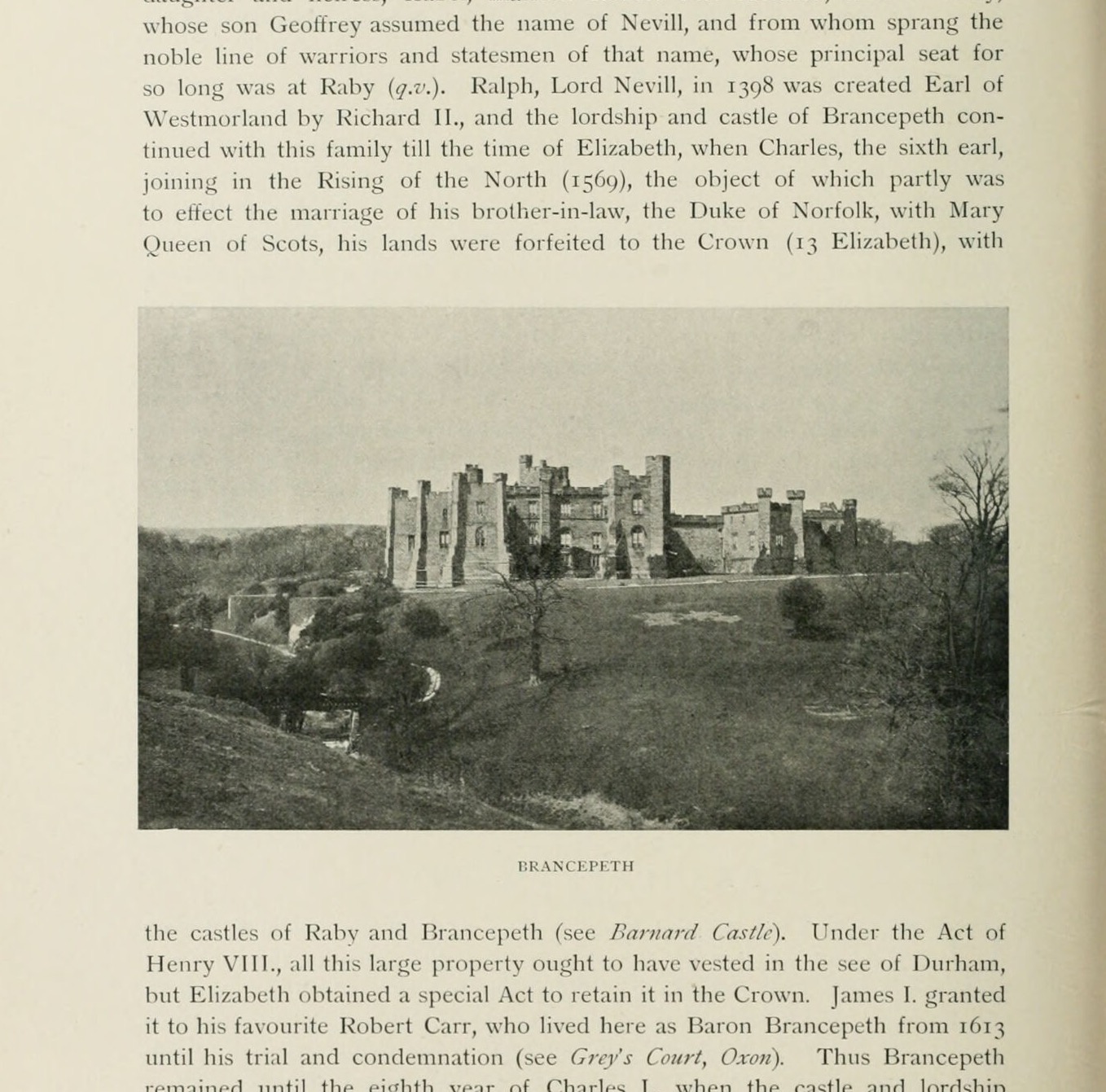
BRANCEPETH
1897 · J. D. Mackenzie, The Castles of England, vol. 2 (1897)
Public domain
Nearby
Landmarks within reach of Brancepeth Castle.


Questions about Brancepeth Castle
What is the history of Brancepeth Castle?
What is inside Brancepeth Castle?
Who owns Brancepeth Castle?
Where is Brancepeth Castle?
Which family or clan held Brancepeth Castle?
What did Brancepeth Castle look like in its prime?
Is Brancepeth Castle still standing?
More castles of England

Explore the city