England · Restored
Durham Castle
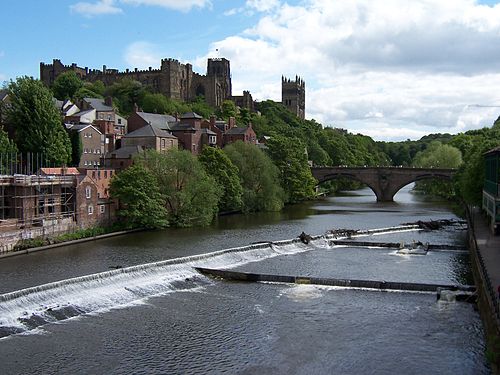
Durham Castle is a Norman fortress and former bishops' palace standing on a hill above the River Wear in Durham, England. Built from the late 11th century and altered through the medieval period, it became the home of University College, Durham in 1837 and is part of the Durham UNESCO World Heritage Site alongside the cathedral.
First raised
1072
Its prime
1325
Today
Restored
As it stood in 1325
What Durham Castle looked like in its prime.
Broad, warm-toned sandstone ranges and a massive multi-sided keep with crenellated parapet dominate the silhouette, set on a raised grassy keep-mount within inner and outer baileys. The west range carries a sequence of tall, arched mullioned windows; the entrance gatehouse and curtain walls are battlemented. Rooflines are low behind parapets; windows are narrow and deeply set in thick stone. In its prime the castle appears complete and occupied, with uninterrupted defended walls and a clear motte-and-bailey arrangement.
Its story
The story of Durham Castle.
William the Conqueror's Motte on the Wear, 1072
Construction of Durham Castle began in 1072 on the orders of William the Conqueror, six years after the Norman conquest and soon after the Normans first came to the North. It took the motte-and-bailey form the Normans favoured, set on the hill above the River Wear on Durham's peninsula, and the work was supervised by Waltheof, Earl of Northumbria, until he rebelled against William and was executed in 1076. Stone for the new buildings was cut from the cliffs below the walls and moved up by winch.
Walcher and the Prince-Bishops
The castle was the seat of the Bishop of Durham, whom the king appointed to exercise royal authority on his behalf. Bishop Walcher added to his status by purchasing the Earldom of Northumbria, beginning a line of prince-bishops that endured until the Durham (County Palatine) Act stripped the bishops of their temporal powers in 1836. They were entitled to raise an army, levy taxes and mint their own coinage, a remit wide enough to make the castle a defence against both Scottish incursions from the north and internal rebellion.
Walcher carried the building forward as a combination of bishop's palace and defensive stronghold, with inner and outer baileys and a keep. The earliest structures may have been of wood, but there is evidence of building in stone from the end of the eleventh century. In May 1080 the castle was attacked and besieged for four days by rebels from Northumbria, and Bishop Walcher was killed.
Henry II's Seizure and the Bishops' Rebuilding
In the twelfth century Bishop Hugh de Puiset built the castle's Norman archway, and in 1177 King Henry II seized the castle after a disagreement with him. Bishop Antony Bek created the Great Hall, originally a dining hall, in the early fourteenth century, and Bishop Thomas Hatfield made major alterations in the 1300s, rebuilding the keep, enlarging the keep mount and adding a wooden minstrels' gallery to the hall. Successive bishops enlarged and then reduced the hall; today it is 14 metres high and over 30 metres long. Bishop Cuthbert Tunstall added a second chapel in the sixteenth century, modified in the seventeenth by Bishop Cosin.
The Norman Chapel, from Worship to Bike Shed
The Norman Chapel is the oldest accessible part of the castle, built either in 1075 or shortly after 1080; the exact date is unclear. Its architecture is Anglian in nature, possibly because forced Anglian labour was used to build it, and its ceiling rests on six columns with carved capitals. When the keep was expanded in the fifteenth century, the chapel's three windows were all but blocked and it fell into disuse; from 1841 it served merely as a corridor to the keep. During the Second World War it became a command and observation post for the Royal Air Force, then spent the rest of the 1940s as a bike shed. Re-consecrated in the 1950s, it is still used for weekly services by the college.
From Bishop's Palace to University College, 1832–1837
The castle remained the bishops' palace until Auckland Castle was made their residence in 1832. Bishop William Van Mildert donated it to the University of Durham, and University College occupied it from 1837, once the next bishop, Edward Maltby, had completed renovations. During the Second World War the neighbouring cathedral was targeted for a Baedeker bombing raid, but escaped when fog rolled in and blocked the pilots' view. In 1986 castle and cathedral, facing one another across Palace Green, were jointly designated a UNESCO World Heritage Site; seventeen elements of the castle (the keep, the north and west ranges, the entrance gatehouse, a bastion and twelve sections of the walls) are listed at Grade I. The castle remains a working building, home to over 100 students and open to visitors by guided tour.
Step inside
9 places to explore in 1325.
The record describes 9 distinct spots at Durham Castle, including 2 interiors: great hall (interior), norman chapel (interior). Create your own photoreal reconstruction and explore every one, more scenes means more rooms, more angles, and more of the place to stand in.
Build Your Own Castle
Recreate Durham Castle with AI to explore it.
The artist rebuilds it as it stood in 1325, a photoreal reconstruction that belongs to you alone. Pay with coins, no subscription needed.
Recreate this castle →Defend this castle →Nearby
Landmarks within reach of Durham Castle.


Questions about Durham Castle
What is the history of Durham Castle?
What is inside Durham Castle and what can you see?
Why was Durham Castle built, and what was it used for?
Does anyone live in Durham Castle now?
Where is Durham Castle?
When was Durham Castle built?
Was Durham Castle ever attacked or besieged?
What did Durham Castle look like in its prime?
Is Durham Castle still standing or is it a ruin?
Can you visit Durham Castle?
More castles of England


Explore the city