England · Restored
Lumley Castle
Lumley Castle is a 14th‑century quadrangular stone castle at Chester‑le‑Street in County Durham, England. Originally built by Sir Ralph Lumley in 1389 it retains its four-sided plan with corner towers and has served as a residence, college hall, and today operates as a hotel.
First raised
1389
Its prime
1603
Today
Restored
As it stood in 1603
What Lumley Castle looked like in its prime.
Long rectangular quadrangular castle of warm sandstone ashlar with a low central range flanked by two taller, square corner towers capped with crenellated parapets. The façade shows regular rows of rectangular windows set in ashlar, a continuous crenellated parapet along the roofline, and a dark pitched roof over the central block. The building sits back from a broad clipped lawn and occupies the banks above the Lumley Park Burn, retaining its complete four-sided silhouette.
Its story
The story of Lumley Castle.
Sir Ralph Lumley's Castle, 1389
Lumley Castle takes its name from its creator, Sir Ralph Lumley, who returned from the wars in Scotland and in 1389 converted his family's manor house at Chester-le-Street into a quadrangular castle, licensed to crenellate and credited to the architect John Lewyn. It stands on the banks of the Lumley Park Burn, a tributary of the River Wear, near Durham.
Lumley did not enjoy it long. Implicated in a plot to overthrow Henry IV, he was imprisoned and ultimately executed, his lands forfeited to the Earl of Somerset. In 1421 the castle reverted to his grandson, Thomas.
Baron Lumley's Remodelling and a Royal Caller, 1603
John Lumley, 1st Baron Lumley, remodelled the castle, altering the windows to let in more light and installing a new great-hall fireplace and a lavabo of black and white marble adorned with the pelican of the Lumley crest. When James VI and I rode south in 1603 to take the English throne, he stopped briefly at the castle on 13 April as Lord Lumley's guest, en route from Newcastle to Durham, though he did not stay the night, pressing on to sleep at Durham Castle.
The castle's Georgian alterations, particularly the library, are attributed to Sir John Vanbrugh, though no documents survive to prove his hand.
Bishops, Castlemen and the Lily of Lumley
By the 19th century Lumley had become the residence of the Bishop of Durham, after Bishop Van Mildert gave Durham Castle to the newly founded University of Durham. It then served as a hall of residence for University College (whose students, known as Castlemen, spent their first year at Lumley before moving to the castle in Durham), until the college sold it in the 1960s to fund the Moatside halls in the city. In 1976 its management passed to No Ordinary Hotels, which converted it into a 73-bedroom hotel; it remains in the possession of the present Lord Scarbrough, and since 1995 has formed the backdrop to Durham's Riverside cricket ground.
The castle carries a famous ghost story, the Lily of Lumley: a tale in which Sir Ralph's supposed first wife was thrown down a well in the grounds by two priests for rejecting the Catholic faith. In truth Ralph Lumley married Eleanor Neville, and no such lady appears in the family pedigrees, yet visiting cricketers lodged at the castle in 2000 and 2005, among them the Indian captain Sourav Ganguly, claimed to have witnessed paranormal activity.
Step inside
8 places to explore in 1603.
The record describes 8 distinct spots at Lumley Castle, including 4 interiors: great hall with fireplace and lavabo, chapel (later king james suite), library (attributed to vanbrugh) / later black knight room and more. Create your own photoreal reconstruction and explore every one, more scenes means more rooms, more angles, and more of the place to stand in.
Build Your Own Castle
Recreate Lumley Castle with AI to explore it.
The artist rebuilds it as it stood in 1603, a photoreal reconstruction that belongs to you alone. Pay with coins, no subscription needed.
Recreate this castle →Defend this castle →Whose castle
Clans who held Lumley Castle.
The families that held Lumley Castle for a decade or more across its history, follow a name to its clan.
Lumley
Built by Sir Ralph Lumley in 1389 and remodelled by John, 1st Baron Lumley; still a property of the Earl of Scarbrough.
From the archive
Lumley Castle on paper: the measured plan and period views.
The survey plan and photographs below are the ground truth this page's reconstructions are checked against, drawn and photographed while the castle was still a working garrison. Every image is public-domain or openly licensed, with its source named.
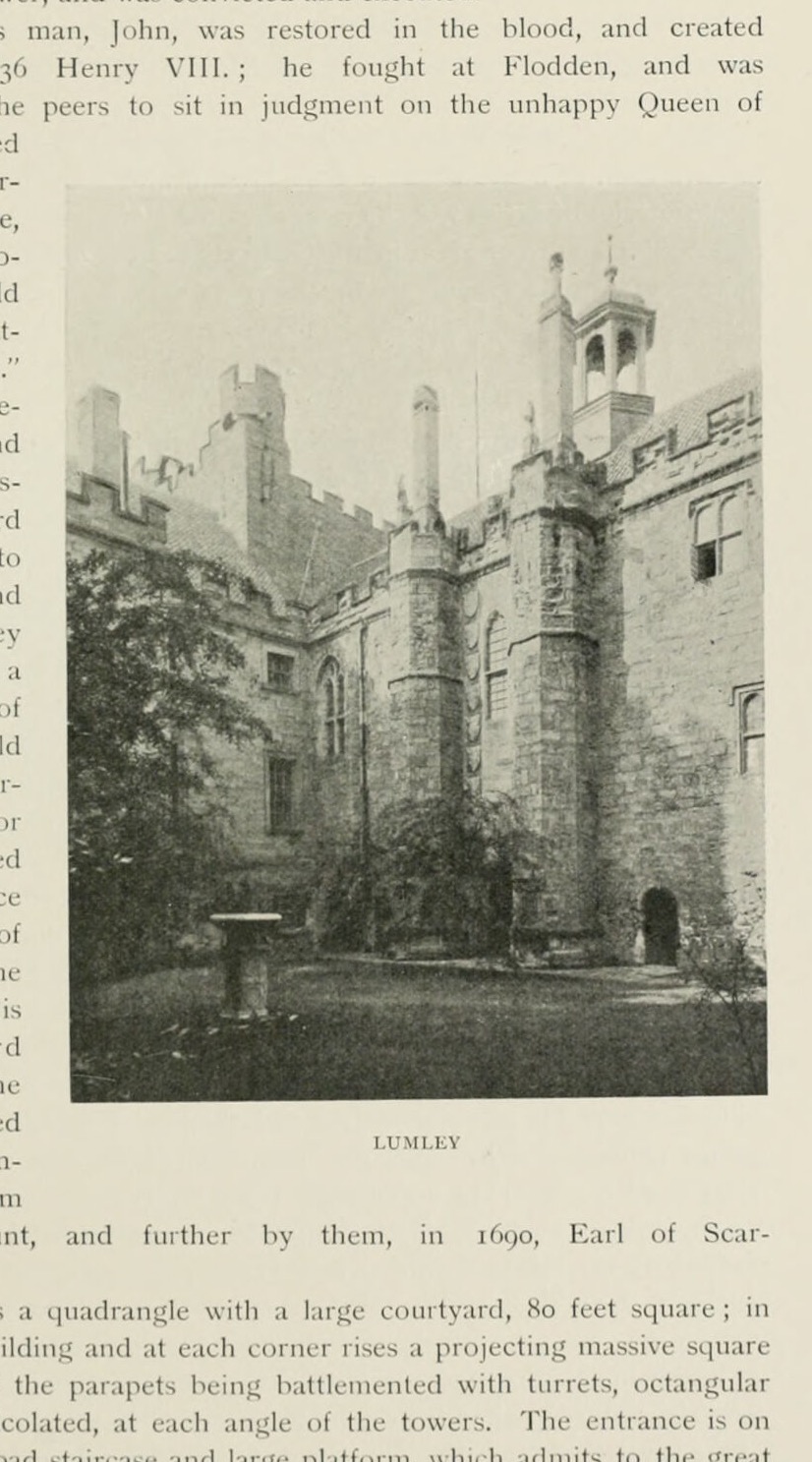
LUMLEY
1897 · J. D. Mackenzie, The Castles of England, vol. 2 (1897)
Public domain
Nearby
Landmarks within reach of Lumley Castle.


Questions about Lumley Castle
What is the history of Lumley Castle?
What is inside Lumley Castle?
Why was Lumley Castle built, and what was it used for?
Who owns Lumley Castle now?
Where is Lumley Castle?
When was Lumley Castle built?
Which family or clan held Lumley Castle?
What did Lumley Castle look like in its prime?
Is Lumley Castle still standing, or is it a ruin?
Who built Lumley Castle?
More castles of England


Explore the city