Clan Rising
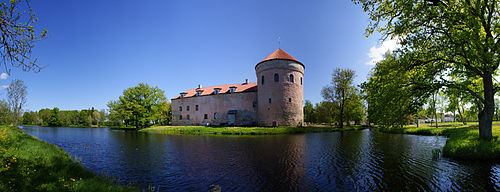
Viljandi Castle today

Estonia · Ruin

Viljandi Castle

Viljandi ordulinnus

Viljandi Castle is a 13th-century castle in Viljandi, Estonia, built by the Livonian Order. The castle was badly damaged in the early 17th-century Polish–Swedish wars and today survives as extensive brick-and-stone ruins that form a public park near the town centre.

Photograph via Wikimedia Commons

First raised

1224

Its prime

1400

Today

Ruin

As it stood in 1400

What Viljandi Castle looked like in its prime.

A tall, largely rectangular red-brick wall rises from a broad irregular fieldstone plinth; the brickwork includes rows of blind arches and regularly spaced window and arrow-slit openings. Several large breaches and arched voids interrupt the wall face, exposing the interior. The ruin sits on a grassy, tree-lined hill overlooking the town, and the former central courtyard is open at ground level; the stone base is composed of rough glacial boulders with smaller masonry infill.

Its story

The story of Viljandi Castle.

Viljandi Castle was built by the Livonian Order, construction starting in 1224 on the site of a former hillfort, and it grew into one of the strongest castles in Livonia. Viljandi was chosen as the high seat of the order.

The castle was finally destroyed in the Polish–Swedish wars of the early 17th century. Its extensive brick-and-stone ruins still stand near the town centre, where they now form a public park.

Step inside

7 places to explore in 1400.

The record describes 7 distinct spots at Viljandi Castle, including 2 interiors: lower arched entrance in the façade, interior range of the convent house. Create your own photoreal reconstruction and explore every one, more scenes means more rooms, more angles, and more of the place to stand in.

Approach from the town slopeSurviving brick façade with blind arcadingFieldstone plinth and foundation archesLower arched entrance in the façadeCentral courtyard of the convent houseInterior range of the convent houseHilltop view over Viljandi

Build Your Own Castle

Recreate Viljandi Castle with AI to explore it.

The artist rebuilds it as it stood in 1400, a photoreal reconstruction that belongs to you alone. Pay with coins, no subscription needed.

Recreate this castle →Defend this castle →
Questions about Viljandi Castle

What is the history of Viljandi Castle?

Viljandi Castle is a 13th-century fortress built by the Livonian Order on the site of a former hillfort. Construction of its stone fortifications began in 1224, and Viljandi became the high seat of the order. The convent house was built around the turn of the 13th and 14th centuries, while the castle was badly damaged in the Polish–Swedish wars and left unrepaired.

What is inside Viljandi Castle?

Inside Viljandi Castle, visitors can see the former central courtyard and the interior range of the convent house. The convent house included a chapel and a chapter house, both described as two-aisled rooms. Surviving remains also include a lower arched entrance in the façade and parts of the convent house's external perimeter.

Why was Viljandi Castle built, and what was it used for?

Viljandi Castle was built as a stronghold and the high seat of the Livonian Order. It replaced a former hillfort and grew into one of the strongest castles in Livonia. Its convent house provided the principal institutional complex, while the surrounding fore-castles formed part of the wider fortified site.

Where is Viljandi Castle?

Viljandi Castle is in Viljandi, Estonia, near the town centre. It stands on a hill overlooking the town, and the castle ruins and surrounding park lie just outside central Viljandi. The site is within Viljandi City.

When was Viljandi Castle built?

Viljandi Castle was first raised in the 13th century, with construction beginning in 1224. The main convent house was built later, around the turn of the 13th and 14th centuries, and was probably completed by the middle of the 14th century. It was enlarged and fortified further in later centuries.

Was Viljandi Castle ever attacked or besieged?

Viljandi Castle was besieged several times. In 1481, Russian forces failed to capture it, while a 1560 siege during the Livonian War succeeded, partly because of mercenary treachery. The castle changed hands repeatedly during the Polish–Swedish wars after the Swedes captured it in 1600, and it was destroyed by 1611.

What did Viljandi Castle look like in its prime?

In its prime, Viljandi Castle had tall, largely rectangular red-brick walls rising from a broad, irregular fieldstone plinth. The brickwork included blind arches and regularly spaced windows and arrow slits. The fortified complex comprised a main convent house and three fore-castles, with two gates in the third fore-castle.

Is Viljandi Castle still standing, or is it a ruin?

Viljandi Castle is a ruin, but extensive brick-and-stone remains are still standing. Large breaches and arched voids interrupt the surviving façade, while the former central courtyard is open at ground level. The ruins were excavated extensively in the late 19th century and now form a public park near the town centre.

Can you visit Viljandi Castle?

Viljandi Castle can be visited as a public ruin and park area. Its ruins form a resort area just outside central Viljandi, with an open-air stage in the former central courtyard. Concerts and sports events have also been held among the ruins.
All castles of Estonia · Castles of Europe · the best castles in Europe · explore the finished reconstructions.