
Finland · Partial ruin
Kastelholm Castle
Kastelholman linna
Kastelholm Castle is a medieval Swedish-built stronghold on Åland, Finland, first documented in 1388. The complex combines a rectangular stone keep, adjoining residential ranges and defensive walls, and served military and administrative roles; today it is a partially restored museum site. The castle originally stood on a small island protected by water-filled moats and retains visible ruins alongside restored buildings.
First raised
1400
Its prime
1560
Today
Partial ruin
As it stood in 1560
What Kastelholm Castle looked like in its prime.
A compact cluster of thick, rough fieldstone ranges and a rectangular keep grouped behind a low curtain wall, with sections of red brick infill visible alongside pale, limewashed stone. Buildings rise to simple pitched roofs and small, deeply set rectangular windows with wooden shutters; one wing shows an exposed ruin with ragged masonry and missing upper walls. The ensemble sits on a raised grassy bank formerly surrounded by moats, with trees and a nearby fjord in the background.
Its story
The story of Kastelholm Castle.
Bo Jonsson Grip's Castle and Queen Margaret, 1380s–1418
A wooden kastell stood on the island before the stone castle, begun in the 1380s on the southern side. Kastelholm first appears in 1388, in a charter of Margaret I of Denmark transferring a large part of the estate of Bo Jonsson Grip, its first recorded occupant, to the queen; since Grip's own will of four years earlier does not name it, the historian Reinhold Hausen dated its founding to between 1384 and Grip's death in 1386.
The island, about 1.7 hectares, was ringed by two or three rows of poles against landings. With Kastelholm in Margaret's hands Åland became an administrative district of its own with the castle as its centre, and in 1418 Åland was made an independent fief and given to the Dane Bengt Pogwisch.
Engelbrekt's Men and the Danish Commanders, 1434–1523
When Pogwisch died his widow Ida Königsmarck kept the fief, to the annoyance of the Swedes, says the Karl Chronicle. During the Engelbrekt rebellion the rebels besieged the castle on behalf of Erik Puke and took it in September 1434; Puke was beheaded in the late winter of 1437.
The Danish naval commander Søren Norby seized Kastelholm early in the 16th century, and Sten Turenpoika was carried off a prisoner to Denmark. Hemming Gadh, who held the castle from 1514 or 1515 for four years, claimed to have “built” it, probably repairing Norby's damage. The Danes took Kastelholm again in September 1520 and Christian II installed Lyder van Offensen, who held Åland until the summer of 1523, when he sailed to Stockholm and surrendered on 18 July; the Swedes occupied the empty castle.
Vasa Bailiffs and Eric XIV's Cell, 1523–1621
Gustav Vasa, king from 1523, granted Åland to Ivar Fleming, who held it until 1537 as Kastelholm's last fief-holder; thereafter the king took it under his own household and bailiffs governed. The first of them, Olof Trottenpoika, reported in 1543 that the castle was badly damaged, and repairs ordered by Gustav Vasa probably ran into the 1550s. The castle kept a shipyard employing about 50 shipwrights in the 16th century, and its records of 1559 carry the first documented presence of Roma in Finland.
John III, who had stayed at the castle as duke of Finland, held his deposed brother Eric XIV and Eric's wife Karin Månsdotter prisoner there in the autumn of 1571; tradition places Eric's room on the third floor of Kurtornet. He had granted Kastelholm for life to the queen dowager Catherine Stenbock, a political rival of Eric, whose tenure ran to 1621.
Stålarm, Scheel and the Last Rebuilding, 1599–1634
In January 1599, with Duke Charles's governor Hans Klasson away in Stockholm, Arvid Stålarm crossed the ice with 18 sledges and 40 men and took Kastelholm for King Sigismund without a fight, installing Salomon Ille as commander. Charles sent Klasson back in April with 400 men; that siege failed completely, as did a second attempt in mid-July. The decisive day was 31 July, the duke's attack led by Admiral Joakim Scheel, who had told Ille the day before that he had brought four heavy guns. By some accounts the castle surrendered without a fight; by others Charles's men took it with artillery and left it heavily damaged. The officers were taken to Turku and beheaded.
Fire damaged the castle in late autumn 1619, and Gustav II Adolf told the Åland governor Stellan Otto von Mörner to put it right; the master builder Hans Esslinger was engaged and the accounts show work running until 1631. The rebuilt castle soon lost its purpose: in 1634 Åland was attached to Turku county, and Kastelholm ceased to be an administrative centre.
Decline, the 1745 Fire and Åland's Museum, 1642–1990s
In 1642 the highest responsibility for the castle lay with a clerk and a caretaker. It served for a time as a prison (Claes Bielke, condemned in the Linköping bloodbath, was banished here), and the Kastelholm witch trials were held in the 1660s. During the Great Wrath the defences were raised once more with wooden palisades, but no enemy came. A fire in 1745 destroyed much of the structure; the north wing came through best and became a grain store, and the castle was abandoned in the 1770s.
The ruins were first conserved in the 1890s, while the north wing served as a grain store until the 1930s, when it was made Åland's first cultural-historical museum. The provincial government began a restoration programme in 1979, and excavation and restoration ran from 1982 to 1989. Since the 1990s the partly restored castle has been a museum, one of five surviving medieval castles in Finland reckoned architecturally significant with Hämeenlinna, Olavinlinna, Raseborg and Turku; the Jan Karlsgården open-air museum stands beside it.
Step inside
11 places to explore in 1560.
The record describes 11 distinct spots at Kastelholm Castle, including 6 interiors: gate passage (barbican) and entrance, kurtornet (donjon), entrance and base, great hall and more. Create your own photoreal reconstruction and explore every one, more scenes means more rooms, more angles, and more of the place to stand in.
Build Your Own Castle
Recreate Kastelholm Castle with AI to explore it.
The artist rebuilds it as it stood in 1560, a photoreal reconstruction that belongs to you alone. Pay with coins, no subscription needed.
Recreate this castle →Defend this castle →Whose castle
Clans who held Kastelholm Castle.
The families that held Kastelholm Castle for a decade or more across its history, follow a name to its clan.
Stenbock
Held by Queen Dowager Catherine Stenbock, 1568–1621.
From the archive
Kastelholm Castle on paper: the measured plan and period views.
The survey plan and photographs below are the ground truth this page's reconstructions are checked against, drawn and photographed while the castle was still a working garrison. Every image is public-domain or openly licensed, with its source named.
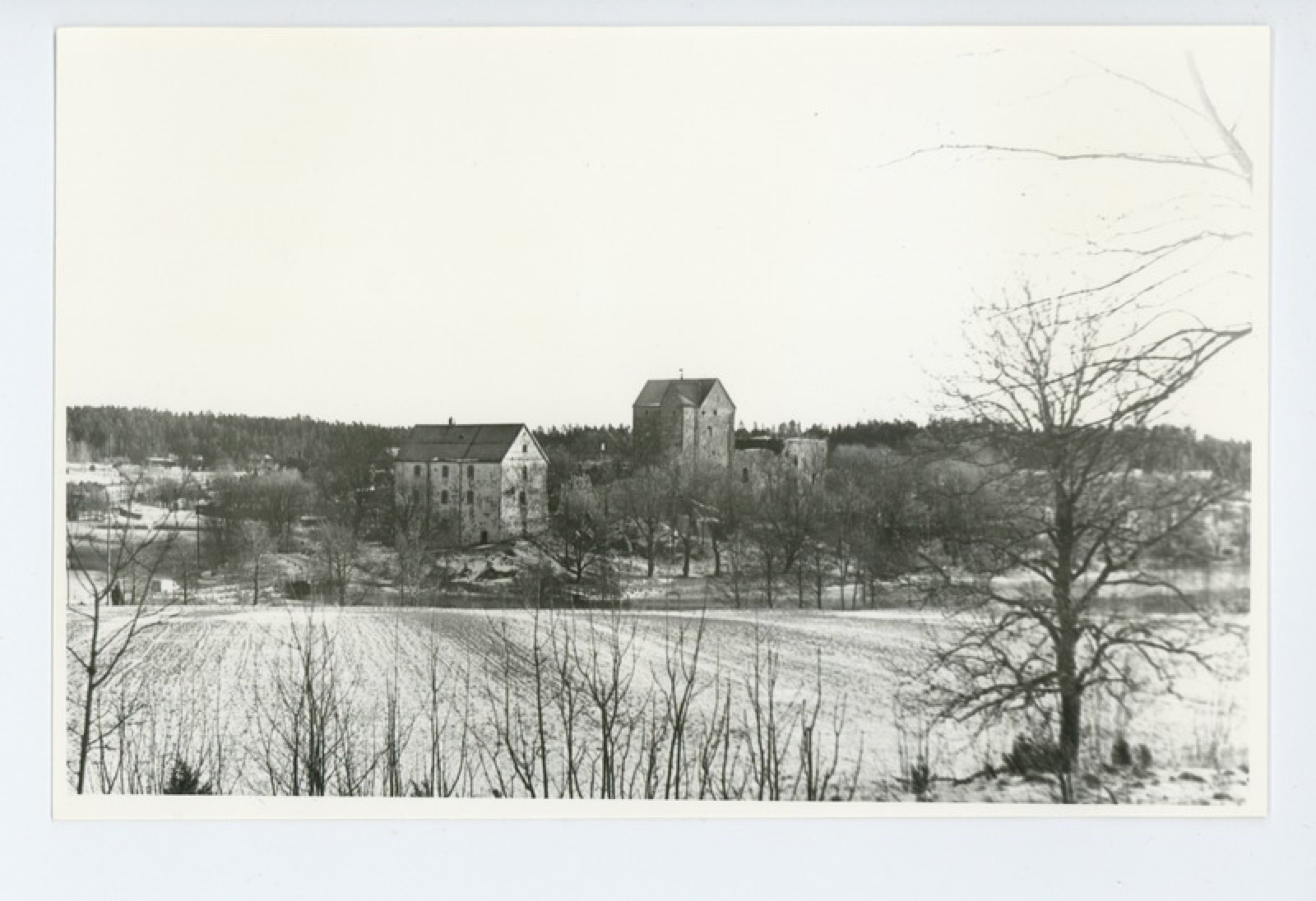
Åland Kastelholm Castle
1980 · Under and Tuglas Literature Centre (via Europeana)
CC0 (no rights reserved)
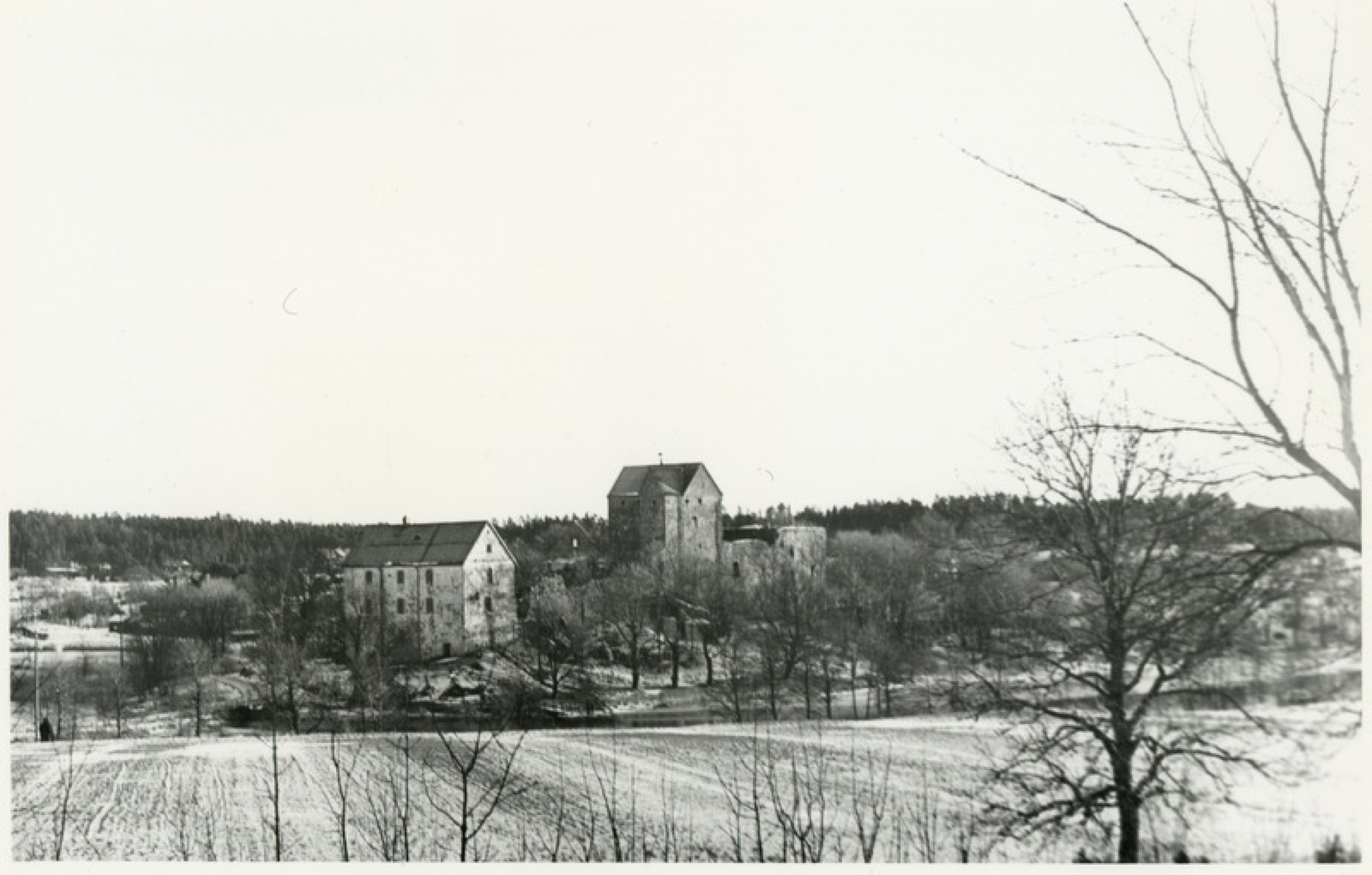
Åland Kastelholm Castle
1980 · Under and Tuglas Literature Centre (via Europeana)
CC0 (no rights reserved)


