
France · Restored
Castle of Pierrefonds
Château de Pierrefonds
The Château de Pierrefonds is a large medieval-style castle in Pierrefonds, Oise, France, rebuilt in the late 14th century and extensively restored in the 19th century by Eugène Viollet-le-Duc under Napoleon III. It combines massive cylindrical towers, high slate roofs and crenellated curtain walls and is managed today by the Centre des monuments nationaux. The exterior restoration recreated a fortified silhouette while many interior decorations reflect 19th-century invention rather than strictly documentary restoration.
First raised
1393
Its prime
1885
Today
Restored
Ranked among Europe’s castles
As it stood in 1885
What Castle of Pierrefonds looked like in its prime.
Wide fortified façade dominated by several huge cylindrical drum towers with corbelled machicolations and crenellated parapets, linked by high curtain walls and a central arched gatehouse with iron portcullis. Pale cream ashlar limestone faces contrast with steep, dark slate conical and pyramidal roofs and smaller corner turrets. A flagged causeway and low forecourt lead to the gate; the silhouette reads as a compact complex of towers, battlements and high rooflines set on the forest edge.
Its story
The story of Castle of Pierrefonds.
Louis d'Orléans and the Watch on Burgundy
A castle stood here in the twelfth century, built by the Nivelon lords of Pierrefonds; it passed to Philip Augustus at the end of that century and stayed in the royal domain. In 1392 Charles VI granted the county of Valois, Pierrefonds among its castellanies, to his brother Louis, Duke of Orléans, who set about an almost complete rebuilding. The architect is not recorded, though the design is usually attributed to Raymond du Temple.
The castle commanded the passage between the forests of Compiègne and Villers-Cotterêts, watching the traffic between Flanders and Burgundy, both of them held by the dukes of Burgundy, rivals of the house of Orléans. Building stopped when the duke was assassinated in 1407, the ranges round the courtyard still standing no higher than their two enormous levels of cellars, and was never finished.
Agincourt and the Surrender of 1420
In 1411 partisans of the duke of Burgundy under the count of Saint-Pol occupied the castle in the name of Charles VI. The new duke of Orléans, Charles, recovered his lands after making peace with the king in 1412, but Saint-Pol did not give Pierrefonds back until 1413, and burned its roofs before he went.
Charles was taken prisoner at Agincourt in 1415 and spent twenty-five years in England. His captain at Pierrefonds, Nicolas Bosquiaux, held out until 1420, when a hard winter and famine forced him to capitulate to the English party, and the place remained a Burgundian base until about 1436. Charles came home in 1440, retired to his Touraine lands and had the castle repaired; it passed to his son, the future Louis XII.
The League, the Spanish Garrison and Richelieu's Demolition
In 1588 Pierrefonds was held by Captain Rieux, a Leaguer still fighting Henri de Navarre after his accession; he threw back two attempts by the royal army in 1591 and was captured and hanged in 1594. On 10 August 1595 Henri de Saveulx took the castle for Philip II of Spain and held it with seven or eight hundred Neapolitans and Walloons sent from the Spanish Netherlands. After several royalist attacks Saveulx was made prisoner, and the Neapolitans sold the place to Antoine d'Estrées, governor of the Île-de-France and father of Gabrielle d'Estrées, mistress and adviser to Henri IV.
Under the troubled early reign of Louis XIII the castle belonged to François-Annibal d'Estrées, who joined the parti des mécontents led by the prince of Condé. Troops of the count of Auvergne, sent by Richelieu as secretary of state for war, bombarded a weak point beside the gate, broke through and took it in 1617. In May the king's council ordered it demolished: the count of Angoulême mined the great towers, burned the floors and roof timbers, razed the outer works and cut gashes into the north towers and curtain walls. The size of the task defeated him, and the shell stood.
Viollet-le-Duc's Reinvention, 1857–1885
Sold as national property in 1798 for 8,100 francs and bought back by Napoleon I for 2,700, the ruin became an appendage of the forest of Compiègne. Nineteenth-century enthusiasm for medieval building made it a romantic ruin: Louis-Philippe gave a banquet there in August 1832 for his daughter Louise's marriage to Leopold, first king of the Belgians, and Corot painted it repeatedly between 1834 and 1866.
Louis-Napoléon Bonaparte visited in 1850 and, as Napoleon III, asked Eugène Viollet-le-Duc in 1857 to restore it. Work began in January 1858 on the habitable parts alone, the "picturesque" ruins in front to be kept for scenery; then the emperor decided on an imperial residence in which to show his collection of arms and armour, and the castle was to be rebuilt entire. It cost five million francs, four of them from the imperial civil list, and was halted in 1885, six years after Viollet-le-Duc's death and after Maurice Ouradou and then Juste Lisch had carried it on; for want of money the rooms were left undecorated.
Inside, the architect invented more than he restored, imagining how the castle ought to have been rather than following the documented history of the building. Outside he showed an excellent knowledge of fourteenth-century military architecture, though he also supplied a ditch and gun retrenchments on the side dominated by the plateau which had no defensive value, artillery not having been used before the sixteenth century. The look is medieval; the construction is of its own century.
Step inside
8 places to explore in 1885.
The record describes 8 distinct spots at Castle of Pierrefonds, including 2 interiors: gate passage (portcullis), interior decorated hall (viollet-le-duc polychrome). Create your own photoreal reconstruction and explore every one, more scenes means more rooms, more angles, and more of the place to stand in.
Build Your Own Castle
Recreate Castle of Pierrefonds with AI to explore it.
The artist rebuilds it as it stood in 1885, a photoreal reconstruction that belongs to you alone. Pay with coins, no subscription needed.
Recreate this castle →Defend this castle →From the archive
Castle of Pierrefonds on paper: the measured plan and period views.
The survey plan and photographs below are the ground truth this page's reconstructions are checked against, drawn and photographed while the castle was still a working garrison. Every image is public-domain or openly licensed, with its source named.
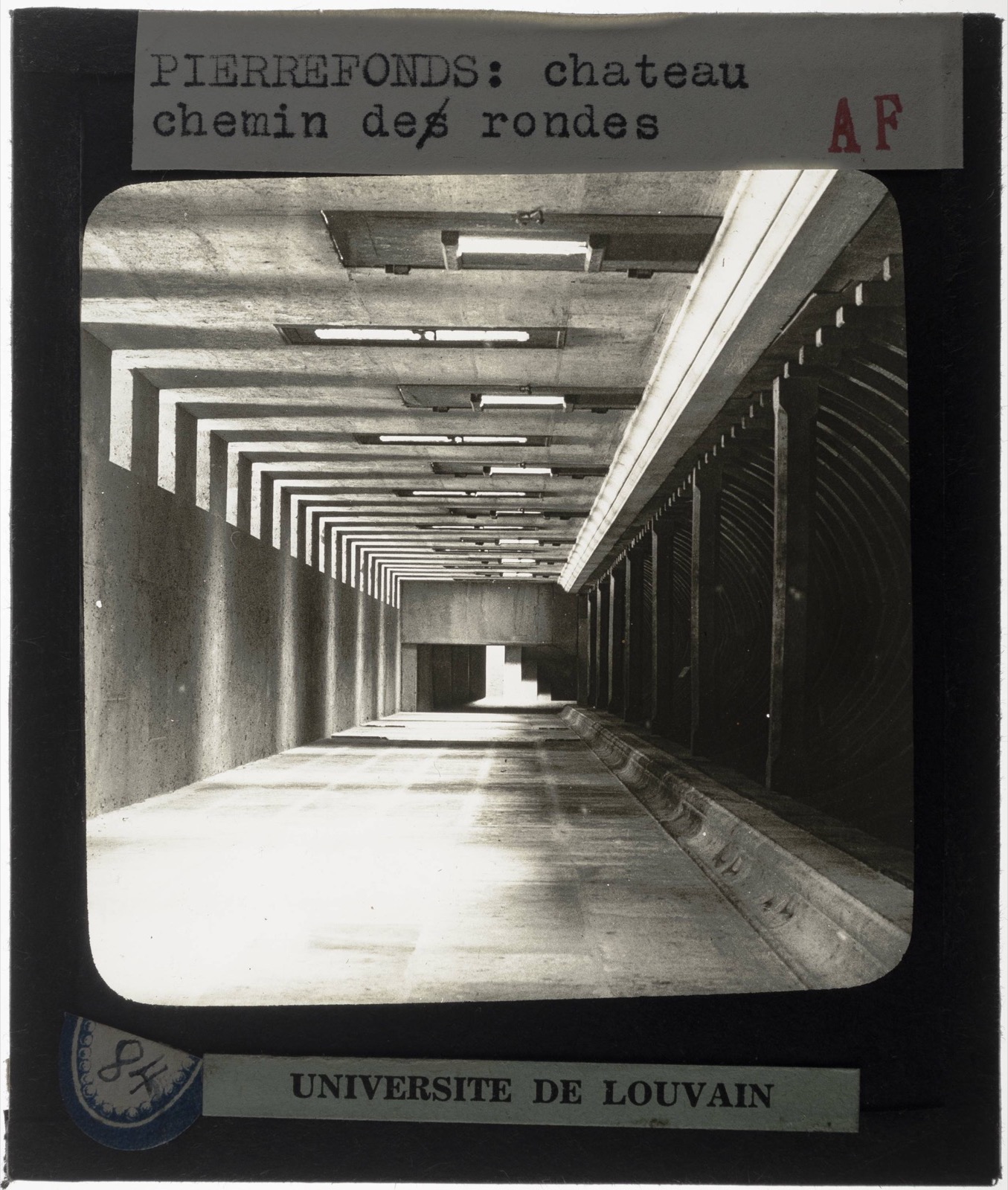
Pierrefonds. Château de Pierrefonds Interieur: Weergang
· Catholic University of Leuven (via Europeana)
Public domain
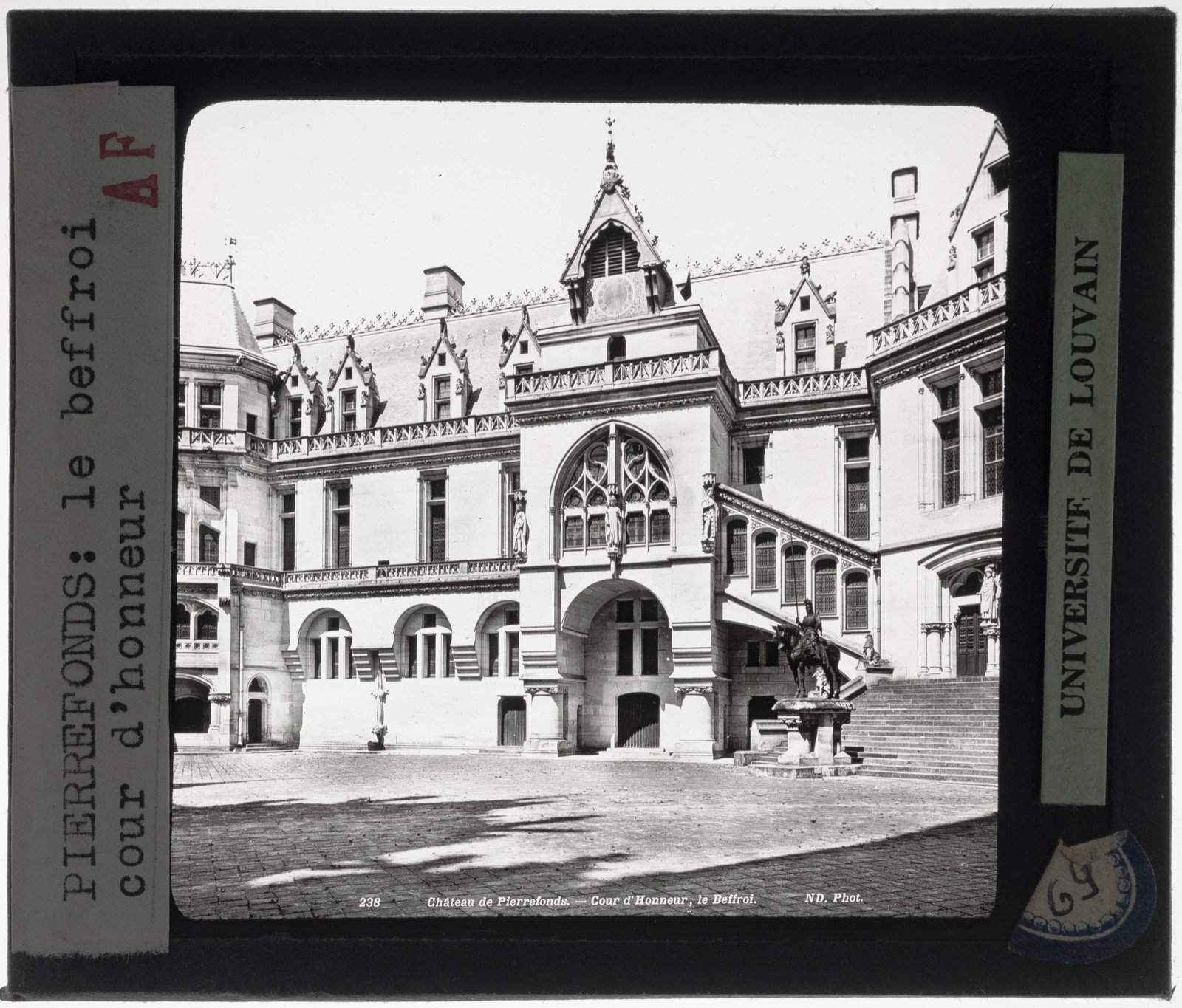
Pierrefonds. Château de Pierrefonds Exterieur: Binnenhof
· Catholic University of Leuven (via Europeana)
Public domain
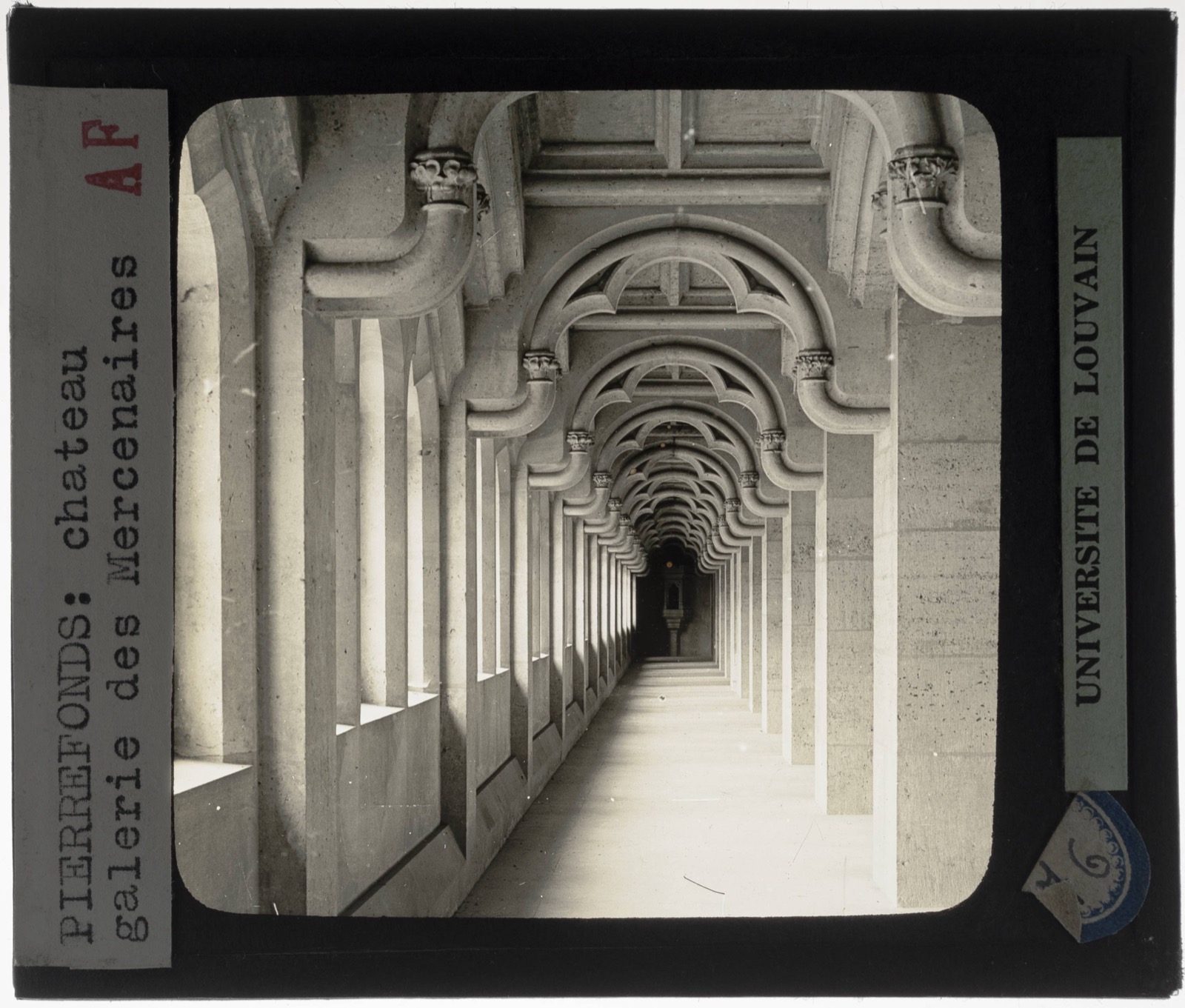
Pierrefonds. Château de Pierrefonds Interieur: Galerie des mercenaires
· Catholic University of Leuven (via Europeana)
Public domain


