
France · Restored
Château de Châteauneuf
The Château de Châteauneuf (Châteauneuf-en-Auxois) is a large medieval stone fortress in Côte-d'Or, France, dating largely from the 12th to 15th centuries and later adapted as a residence by Philippe Pot. It stands on a rocky outcrop above the surrounding plains and is protected as a historic monument; the site now serves as a museum.
Its prime
1480
Today
Restored
As it stood in 1480
What Château de Châteauneuf looked like in its prime.
A long, low 75-metre stone complex on a rocky outcrop of warm beige limestone; the profile is dominated by a massive cylindrical 12th-century keep slightly off-centre, several conical towers with steep red-tile roofs to the left and centre, and a tall square tower on the right capped by a steep slate spire and weather vane. Low residential ranges with red-tiled roofs and connected curtain walls with small rectangular openings run between the towers; trees and grassy slopes frame the base.
Its story
The story of Château de Châteauneuf.
Jean de Chaudenay's Keep, 1132-1175
The square keep is dated to 1132, when Jean de Chaudenay is said to have raised it for his younger son Jehan. Jehan took possession in 1175 and became Jean I de Châteauneuf. Of that first castle only the keep survives.
The site is a limestone balcony standing about a hundred metres above the depression of the Auxois, 475 metres above the plains and 43 km from Dijon. From it the lords watched the obligatory passage of a road that climbed from the Sequanian slope by the Armançon and dropped again towards the valley of the Ouche, Dijon and the Saône.
Walls for the Hundred Years' War, and Catherine Burnt Alive, 1456
Facing the threat of the Hundred Years' War, the lords of Châteauneuf built the powerful enceinte that still rings the 12th-century keep, an oblong circuit of towers and curtain walls following the break of slope, with a small fortified village behind it covering the approach from the plateau. The finished fortress runs 75 metres long by 35 broad.
The family's rule ended after nine generations, and ended badly. Catherine de Châteauneuf, daughter of Isabelle de Plancy and Guyot de Châteauneuf and the last heiress of the line, was burnt alive in 1456 for poisoning her second husband, Jacques d'Haussonville, sire de Montreuil.
Philippe Pot's Burgundian Household, 1457-1493
In 1457 Philippe le Bon, Duke of Burgundy, made over the fortress to his counsellor Philippe Pot, a knight of the Order of the Golden Fleece and a knight of Saint Michael. Pot recast the place as a residence fit for the splendours of the ducal court: a chapel dedicated to Notre-Dame and Saint Jean was consecrated in 1481, and two lodgings - the great logis against the curtain and the south-east tower, and the second known as the logis of Philippe Pot - went up in the courtyard in flamboyant Gothic. The south-east curtain was opened to take a gate with a drawbridge. Pot's device, "Tant L Vault", is cut in many places about the castle.
Philippe Pot died in 1493 without descendants, and Châteauneuf passed to his brother Guy Pot.
The Vienne of Commarin and the Revolution, 1627-1793
Through Montmorency and Luxembourg-Piney marriages the castle descended to Marie-Liesse de Luxembourg-Piney. When she entered the Carmelite convent at Avignon in 1649 it went to Charles I de Vienne-Ruffey, count of Commarin, who had bought it in September 1627; his family held it for the next hundred and fifty years, fitting out apartments and remaking the front of the logis.
In 1767 Louis-Henri de Vienne-Commarin sold the castle to the banker Jean Pâris de Montmartel and his son Armand Pâris de Brunoy. Armand died without issue, and Châteauneuf was bought for 370,000 livres by Jacques-François Damas d'Antigny, baron de Ruffey and de Chevreaux, from whose line it descended to the Vogüé. During the French Revolution every royal symbol and coat of arms on the building was defaced or destroyed.
Classified in 1894, Regional Property by 2008
After the Revolution the castle was auctioned and passed from hand to hand until 1936. It was classified as a monument historique by decree of 10 December 1894, and in 1902 Charles Suisse, the architect of the restoration of La Rochepot, consolidated the fabric. In 1936 Count Georges de Vogüé ceded the fortress to the state.
On 26 August 1939, ahead of France's declaration of war on Germany, the Musée des Beaux-Arts in Dijon closed and a convoy of works set out for the castle under a plan drawn up in 1936 by the Direction des Musées de France. Ten journeys put the museum's 912 most important works out of reach, along with the most precious documents of Dijon's municipal library and the departmental archives of the Côte-d'Or.
Refits of the first-floor rooms and several campaigns of works followed in the last quarter of the 20th century, among them a new roof over the Philippe Pot logis. A convention signed on 14 September 2007 transferred the property to the regional council of Burgundy, owner since 2008 and responsible for its restoration and its programme of events.
Step inside
7 places to explore in 1480.
The record describes 7 distinct spots at Château de Châteauneuf, including 3 interiors: flamboyant gothic chapel (interior), residence wing facing the court (exterior/interior view), castle museum room (interior). Create your own photoreal reconstruction and explore every one, more scenes means more rooms, more angles, and more of the place to stand in.
Build Your Own Castle
Recreate Château de Châteauneuf with AI to explore it.
The artist rebuilds it as it stood in 1480, a photoreal reconstruction that belongs to you alone. Pay with coins, no subscription needed.
Recreate this castle →Defend this castle →Whose castle
Clans who held Château de Châteauneuf.
The families that held Château de Châteauneuf for a decade or more across its history, follow a name to its clan.
Châteauneuf
The lords of Châteauneuf held the fortress from its 12th-century keep, fortifying it against the threat of the Hundred Years' War.
Pot
Offered to Philippe Pot, advisor to Duke Philippe le Bon of Burgundy, in 1457; he remodelled it as a court residence.
Vienne
Held by Charles de Vienne, Count of Comarrin, and his family for 150 years, until Louis Henri de Vienne sold it in 1767.
From the archive
Château de Châteauneuf on paper: the measured plan and period views.
The survey plan and photographs below are the ground truth this page's reconstructions are checked against, drawn and photographed while the castle was still a working garrison. Every image is public-domain or openly licensed, with its source named.
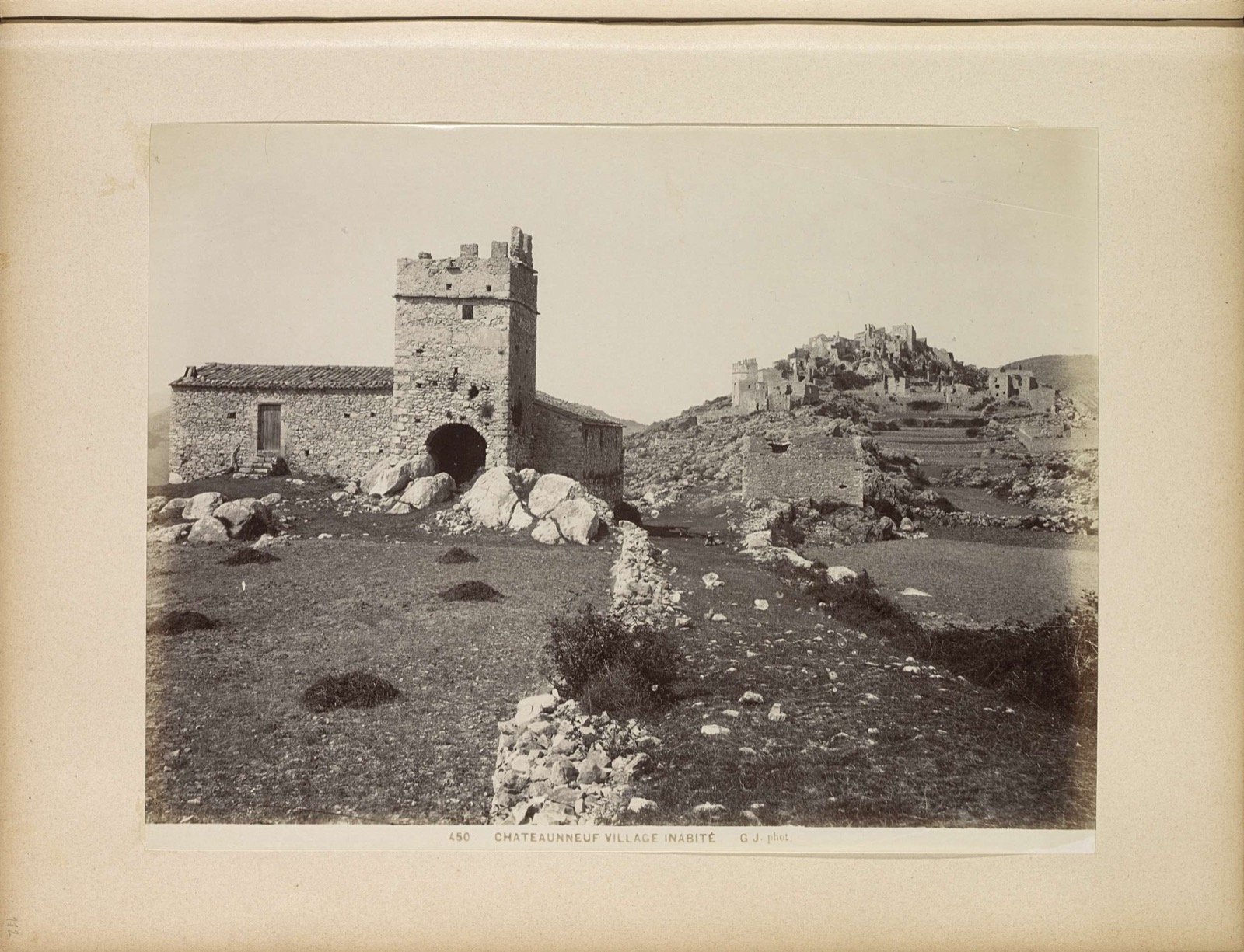
Gezicht op de ruïnes van het verlaten dorp Châteauneuf (Châteauneuf-Villevieille)
· Rijksmuseum (via Europeana)
Public domain


