
France · Still standing
Château de Foix
The Château de Foix is a medieval fortress that dominates the town of Foix in the Ariège department of southern France. Built around a rocky crag with multiple towers and stepped curtain walls, it was a regional stronghold and later served as a garrison; since 1930 it houses the départemental museum. The site has been listed as a monument historique since 1840.
First raised
987
Its prime
1650
Today
Still standing
As it stood in 1650
What Château de Foix looked like in its prime.
Perched on a rocky crag above the town, the château presents a compact silhouette of high curtain walls and terraces stepping down the slope. Three principal towers dominate the skyline: two older square towers with crenellated tops and a larger cylindrical round keep with a machicolated parapet; one tall square tower is capped by a steep slate roof with a small spire. Pale grey-buff dressed stone, continuous battlement walks and layered defensive walls enclose service buildings and a central ward.
Its story
The story of Château de Foix.
The First Counts of Foix, 1002–1034
The castle at Foix is first recorded in a charter from the early 11th century, though it was probably built a little earlier. By 1002 it was substantial enough to be named in the will of Roger I, Count of Carcassonne, who bequeathed it to his youngest child, Bernard, the first to hold the title Count of Foix, from around 1012. From 1034 the castle was capital of the County of Foix; the family installed there controlled access to the upper Ariège valley and could watch over the lower country from behind impregnable walls.
Submission During the Albigensian Crusade, 1211–1218
In 1211 the crusader commander Simon de Montfort besieged Toulouse, failed to take the city, and turned to ravage the allied county of Foix instead, though his forces did little more than winter at Pamiers and raid as far as Foix itself. Renewed operations in 1212 touched the town's outskirts but left the castle untroubled. It was submission, not storm, that changed hands: in 1214 the castle was handed to the pope's legate as a token of submission and opened to Montfort, and the count did not recover it until 1218. Cathars are attested in the county during these years, though the castle itself, by most later accounts, was never their refuge, the counts worked instead to preserve their own independence.
Sequestered by the Crown, 1229–1285
The Treaty of Meaux-Paris in 1229 cut the eastern edge from the county, isolating the lordship of Mirepoix, and the castle was occupied by the king of France for five years. Roger IV, count from 1241, withheld his military support from the count of Toulouse in 1242 for the first time since the crusade began (a refusal that helped doom Toulouse's last revolt), and kept clear of the Montségur affair that followed. In 1272 the count of Foix made a final stand against the crown's encroachment, strengthening the garrison, the gates and the ramparts with siege engines; but faced with the large army Philippe le Hardi gathered from across France, he submitted, was taken prisoner to Carcassonne, and saw the castle and county placed under sequestration until 1285.
Gaston Fébus's Ransomed Lords, 1362
Gaston Fébus, count from 1343 to 1391, defeated the rival house of Armagnac at Launac in 1362 in a dispute over his inheritance of Béarn. Many great lords of the south-west were taken prisoner in the battle and locked in Foix's castle (among them the counts of Armagnac and Comminges, the lords of Albret, Jean de la Barte and the lords of Pardalha) held for months until their families raised the ransoms that freed them, after which they were moved on to Pamiers and then Mazères. Ransom money probably funded building work Fébus carried out at his castles, including Foix, though the counts increasingly preferred more comfortable residences at Orthez and Mazères, and the Governors' Palace below the rock.
Governors, Prison and Museum, 1479–1930
From 1479 the counts of Foix were also kings of Navarre; the last of them, become Henri IV, annexed his Pyrenean lands to France. In 1486 the castle changed hands by force for the only time on record, seized through treachery in a war between two branches of the Foix family. As seat of the region's governor from the 15th century it continued to defend the area through the Wars of Religion. Cardinal Richelieu's regional demolition order of 1632–1638 pulled down some ten castles in the Ariège valley, Pamiers and Mazères among them; Foix came close to the same fate, but here the order was never carried out.
Its towers served as a political and civil prison for four centuries, a role that intensified after the Revolution when the penitentiary passed to the new département of Ariège, until overcrowding forced the prisoners out to a new town gaol in the 1860s. Listed as a monument historique since 1840 and restored under Paul Boeswillwald, the castle has housed the collections of the Ariège departmental museum since 1930, and remains owned today by the Ariège department.
Step inside
8 places to explore in 1650.
The record describes 8 distinct spots at Château de Foix, including 3 interiors: walled inner bailey and service range, prison cell inside one of the square towers, governor's reception chamber within the keep complex. Create your own photoreal reconstruction and explore every one, more scenes means more rooms, more angles, and more of the place to stand in.
Build Your Own Castle
Recreate Château de Foix with AI to explore it.
The artist rebuilds it as it stood in 1650, a photoreal reconstruction that belongs to you alone. Pay with coins, no subscription needed.
Recreate this castle →Defend this castle →Whose castle
Clans who held Château de Foix.
The families that held Château de Foix for a decade or more across its history, follow a name to its clan.
Foix
Held by the family of the Counts of Foix from Roger I of Carcassonne's bequest to his son Bernard in 1002; capital of the County of Foix from 1034.
From the archive
Château de Foix on paper: the measured plan and period views.
The survey plan and photographs below are the ground truth this page's reconstructions are checked against, drawn and photographed while the castle was still a working garrison. Every image is public-domain or openly licensed, with its source named.
![Chateau de Foix from "The Pyrenees, with Excursions into Spain. [With plates.]"., Château de Foix](/heritage/chateau-de-foix/view-euro-0.jpg)
Chateau de Foix from "The Pyrenees, with Excursions into Spain. [With plates.]".
1843 · The British Library (via Europeana)
Public domain
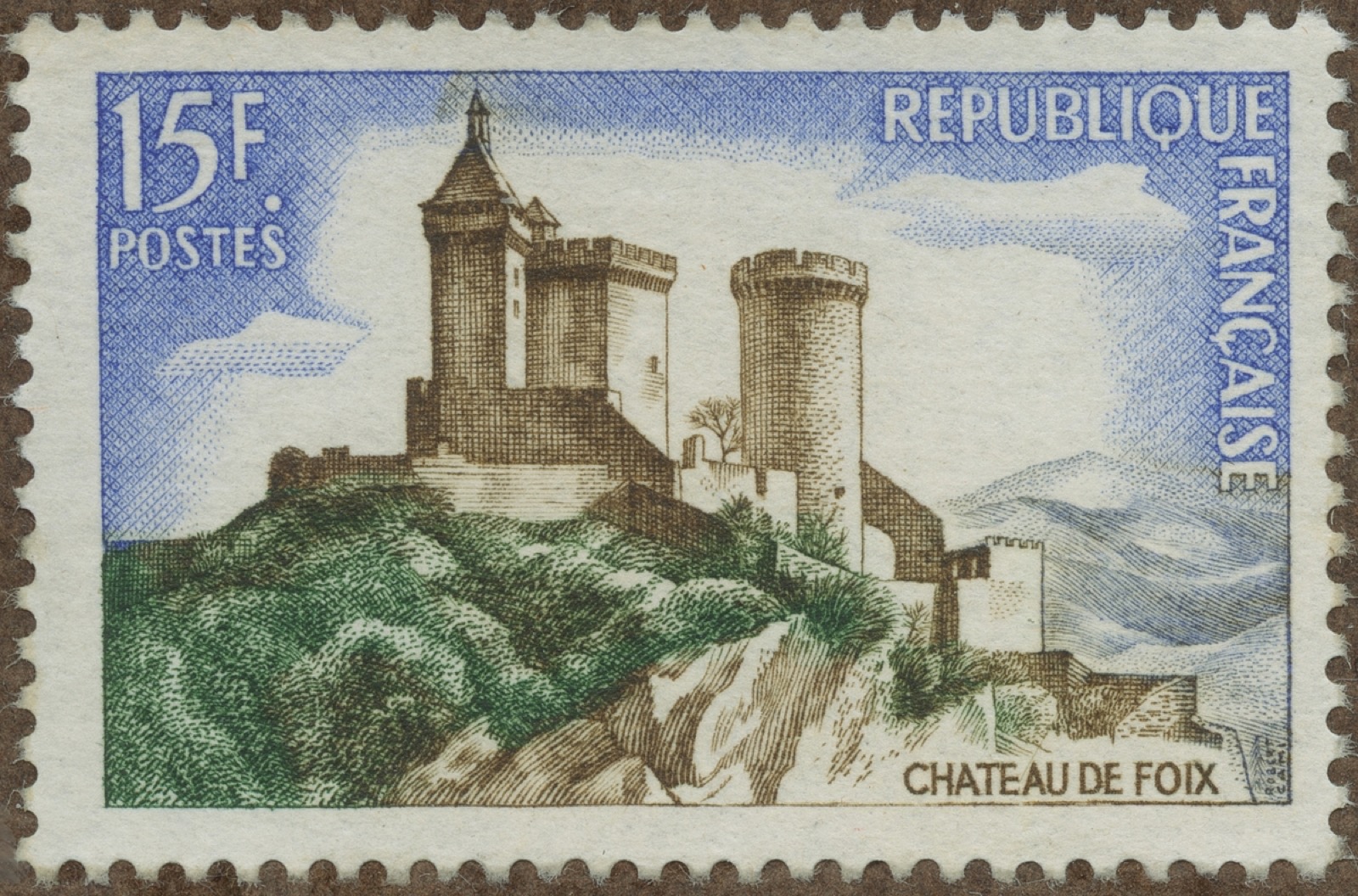
Frimärke ur Gösta Bodmans filatelistiska motivsamling, påbörjad 1950. Frimärke från Frankrike, 1958. Motiv av
· Swedish National Museum of Science and Technology (via Europeana)
Public domain
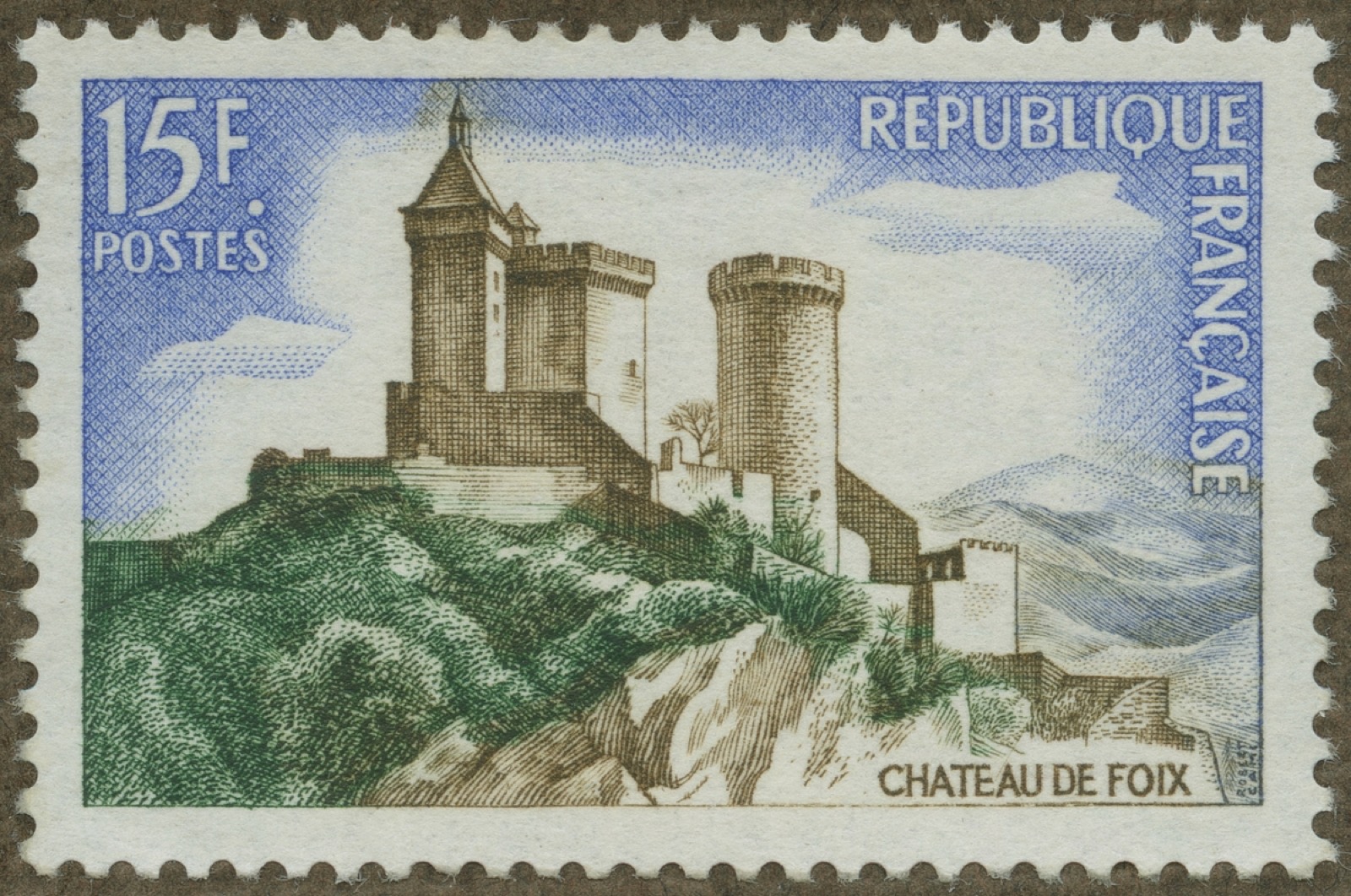
Frimärke ur Gösta Bodmans filatelistiska motivsamling, påbörjad 1950. Frimärke från Frankrike, 1959. Motiv av
· Swedish National Museum of Science and Technology (via Europeana)
Public domain


