France · Restored
Château de Montreuil-Bellay
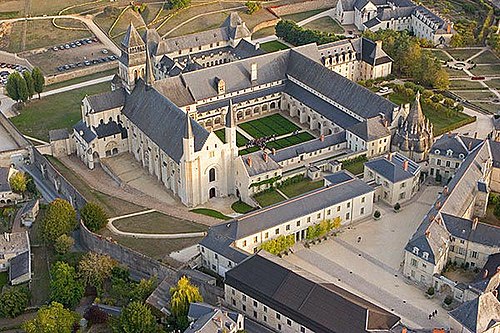
The Château de Montreuil-Bellay is a medieval fortress and residence on a hill above the Thouet River in Montreuil-Bellay, Maine-et-Loire, France. The ensemble combines a continuous curtain wall with multiple round towers and a fortified gatehouse, a residential château block with numerous conical-roofed turrets, and a large steep-roofed hall; it is listed as a monument historique.
First raised
1200
Its prime
1200
Today
Restored
As it stood in 1200
What Château de Montreuil-Bellay looked like in its prime.
Perched on a plateau above the Thouet, the complex is enclosed by a continuous pale limestone curtain wall punctuated by massive cylindrical towers and crenellations. A fortified stone gatehouse with flanking round towers gives access to a broad gravel inner courtyard. Behind the walls rise a cluster of residential ranges with tall narrow windows, numerous cylindrical turrets capped by conical slate roofs, and a long steep-roofed churchlike hall. Formal geometric gardens and a circular fountain lie immediately north of the main buildings.
Its story
The story of Château de Montreuil-Bellay.
First built on the site of a Gallo-Roman village on a hill above the Thouet, the fief of Montreuil-Bellay belonged first to Gelduin le Danois and passed to Berlay le Vieux, who became the first Sir of Bellay. In 1025 the castle was seized by Foulques Nerra, who made Giraud Berlay his vassal. After Philip II's defeat of the English the fief returned to a Berlay descendant, Guillaume de Melun, under whom high massive walls with thirteen interlocking towers were raised, entered only through a fortified gateway.
During the French Wars of Religion the town of Montreuil-Bellay was ransacked and burned, but the sturdy fortress suffered little damage. Ownership changed several times, passing by marriage to the Cossé-Brissac family, and during the Revolution the castle was seized by the revolutionary government and used as a prison for women suspected of royalism.
In 1822 the Saumur businessman Adrien Niveleau acquired the property and divided it into rental units; from 1860 his daughter took up occupancy and undertook a major restoration, redoing rooms in the Troubadour style. Descendants of her husband's nephew own it still, and the château, a listed monument historique, gives its name to a premium wine made on the property.
Step inside
8 places to explore in 1200.
The record describes 8 distinct spots at Château de Montreuil-Bellay, including the full exterior approach. Create your own photoreal reconstruction and explore every one, more scenes means more rooms, more angles, and more of the place to stand in.
Build Your Own Castle
Recreate Château de Montreuil-Bellay with AI to explore it.
The artist rebuilds it as it stood in 1200, a photoreal reconstruction that belongs to you alone. Pay with coins, no subscription needed.
Recreate this castle →Defend this castle →Whose castle
Clans who held Château de Montreuil-Bellay.
The families that held Château de Montreuil-Bellay for a decade or more across its history, follow a name to its clan.
Berlay
The fief of Berlay le Vieux, first Sir of Bellay; restored to his descendant Guillaume de Melun after Philip II drove out the English.
Cossé-Brissac
Came to the Cossé-Brissac family through marriage.
Nearby