
France · Restored
Château de Suscinio
Château de Suscinio is a medieval stone castle on a wooded coastal estate in Brittany, France, notable for several large cylindrical towers with steep conical roofs and a long pitched-roof range between them. The surviving fabric presents continuous coursed ashlar masonry, regular small windows, corbelled parapet bands and tall chimneys.
Its prime
1450
Today
Restored
As it stood in 1450
What Château de Suscinio looked like in its prime.
Compact ensemble of thick cylindrical stone towers with steep conical slate roofs and fleur-de-lis finials, linked by a long, steeply pitched roofed range with tall rectangular chimneys. Towers show a continuous corbelled band beneath the roofline (machicolation-like course) and small rectangular and slit windows set into pale grey-beige ashlar masonry. The castle rises above surrounding mature trees and parkland; roof slate is dark, walls are regular coursed stone, and the silhouette is dominated by the round towers.
Its story
The story of Château de Suscinio.
Pierre de Dreux's Manor, 1213–1305
Married to the Breton heiress Alix de Thouars in 1213, the French king's cousin Pierre de Dreux took the guard of the duchy and began the first manor of Suscinio, probably between 1213 and 1237; the place is first named in a letter of his in 1218. It was substantial enough by 1238 to hold the lord of Lanvaux prisoner, and was described then as recently begun and built by the said duke. His son Jean I le Roux, who took over around 1237, is credited with the great north curtain and the western quadrangular tower, and from 1286 Jean II raised the great north-east tower, called de l'Épervier. The dukes kept their archives and money treasure behind those walls, which could lodge about a hundred people when a duke was in residence.
From Manoir to Chastel
The Breton War of Succession set Charles de Blois, backed by France, against Jean de Montfort, backed by England, and ended with the Montforts on the ducal throne. Suscinio itself seems to have held no important military place in that war, but the deeds stop calling it a manoir and start calling it a chastel, and heavy work to strengthen its defences followed. The castle was fortified and enlarged at the end of the 14th century, the Montfort dukes adding a new seigniorial residence block with a large corner tower, the Tour Neuve, and a casemate for artillery at the end of the 15th.
The Tudors in Exile, 1471–1484
From 1471 to 1484 the castle housed Jasper Tudor, Henry Tudor, later Henry VII of England, and the core of their exiled Lancastrians, some 500 of them by 1483; since Suscinio could hold only about a hundred, the rest must have been billeted around it, at Kermoizin and other villages. Francis II of Brittany kept them against every Plantagenet demand that he surrender them, and for eleven years the place was an armed camp, alert to any attempt to seize the two Tudors and carry them back to England, where they lay under attainder and would have been executed as threats to Yorkist rule. The duke backed the failed Lancastrian invasion of 1483 with 40,000 gold crowns, 15,000 soldiers and a fleet of transports.
When Francis fell into one of his periods of incapacitating illness, his treasurer Pierre Landais agreed to hand Henry Tudor to the representatives of Richard III in return for a pledge of 3,000 English archers to defend Brittany against a threatened French attack. Word of the plot reached the exiles in time: both Tudors escaped separately into France, hours ahead of Landais's soldiers, and were received at the court of Charles VIII. When the duke recovered his faculties he offered the 400 Lancastrians still at and around Suscinio safe conduct into France and paid their expenses, perhaps the last official use of the castle by the dukes of Brittany.
The French Take Suscinio, 1491
Francis II died in 1488, leaving his eleven-year-old daughter Anne of Brittany, the last ruling duchess and twice queen of France. French troops took the castle in 1491, in the fourth French invasion campaign, and it was granted to Jean de Châlon, prince of Orange; Anne recovered it at his death and halted there in 1505, when the estate accounts show it being furnished, its windows mended and food bought for the queen and her suite. She died in 1514 and Brittany's autonomy went with her. The crown gave the castle to a former mistress of Francis I in 1523 and in 1543 to Diane de Poitiers; her daughter's family by marriage, the Brézé, made it a capitainerie under Guillaume de Montigny, one of Diane's own agents, who kept the post after Charles IX bought Suscinio back in 1562.
Storm, Quarry and Rescue
A violent storm carried off the roofs and chimneys in 1599; Henri IV deplored the state of the place, ordered repairs and had a sum set aside each year. In 1641 Richelieu's cousin Jérôme du Camboult was made governor, and a garrison was still stationed in the castle in 1644. Careless management and the poverty of the peninsula's inhabitants, who had to help pay the upkeep, told against it, and by the eve of the Revolution the buildings were storing harvests while the owners' heirs resolved to use only the parts that were not yet falling down. Sold as national property in 1798 to the merchant Pascal Lange for 5,000 francs, it was stripped of everything reusable, roof timbers and cut stone alike.
Prosper Mérimée saw the ruins in 1835 and had the castle classed in 1840 on the first list of historic monuments. The vicomte Jules de Francheville bought it in 1852 and his family did what it could, until the department of Morbihan bought it in 1965 and began consolidating the north curtain and its tower the following year.
Step inside
6 places to explore in 1450.
The record describes 6 distinct spots at Château de Suscinio, including the full exterior approach. Create your own photoreal reconstruction and explore every one, more scenes means more rooms, more angles, and more of the place to stand in.
Build Your Own Castle
Recreate Château de Suscinio with AI to explore it.
The artist rebuilds it as it stood in 1450, a photoreal reconstruction that belongs to you alone. Pay with coins, no subscription needed.
Recreate this castle →Defend this castle →Whose castle
Clans who held Château de Suscinio.
The families that held Château de Suscinio for a decade or more across its history, follow a name to its clan.
de Francheville
Held by the family of Jules de Francheville, who attempted the castle's preservation, until its sale to the Department of Morbihan in 1965.
From the archive
Château de Suscinio on paper: the measured plan and period views.
The survey plan and photographs below are the ground truth this page's reconstructions are checked against, drawn and photographed while the castle was still a working garrison. Every image is public-domain or openly licensed, with its source named.
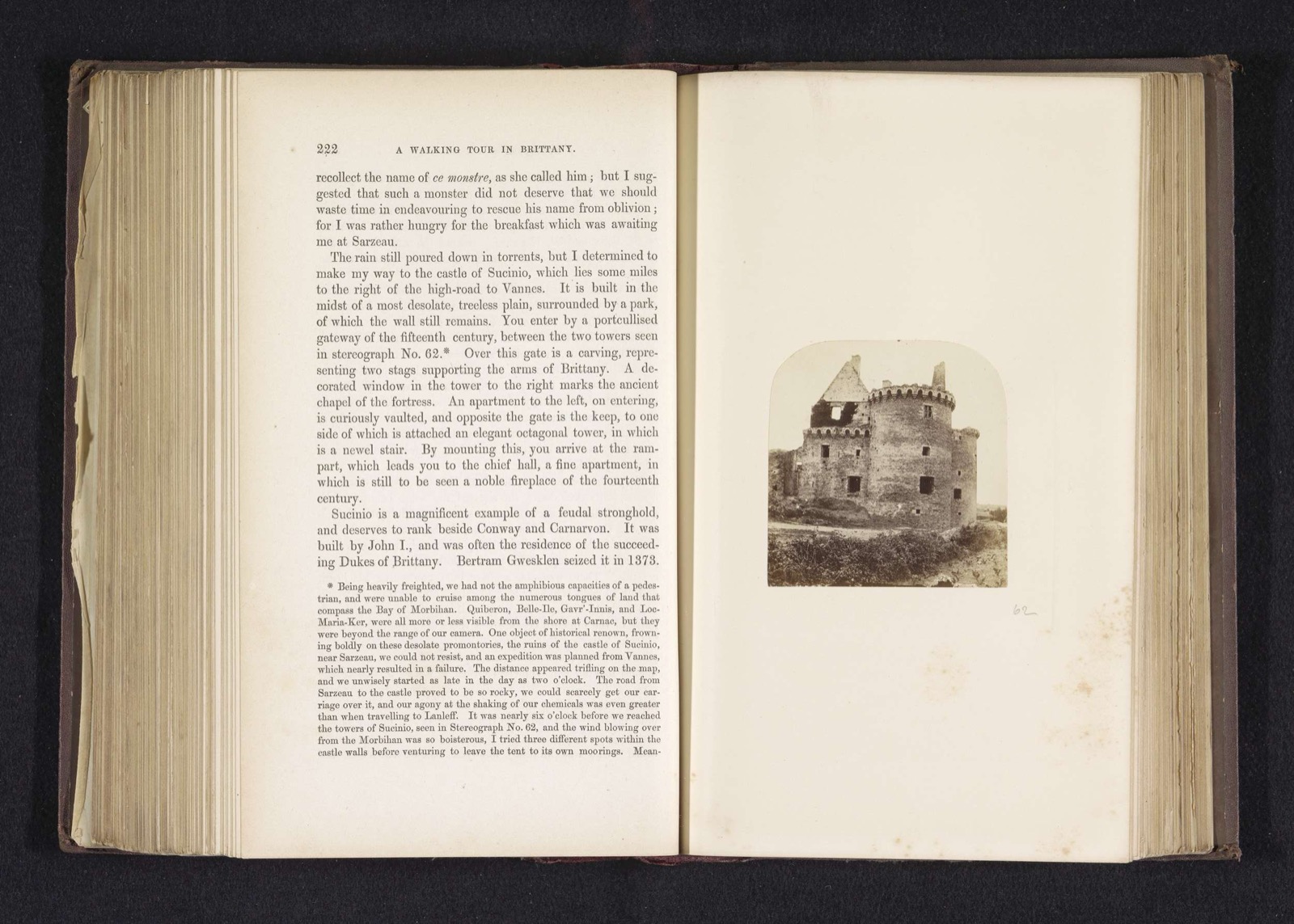
Gezicht op de torens van het kasteel van Suscinio in Sarzeau
· Rijksmuseum (via Europeana)
Public domain


