France · Restored
Château du Rivau
Château du Rivau is a fortified manor-house in Lémeré, Touraine, France, notable for its 13th-century keep, round towers and Renaissance-era alterations. It has historically housed royal stables and extensive formal gardens and has been restored since the late 20th century.
First raised
1445
Its prime
1520
Today
Restored
As it stood in 1520
What Château du Rivau looked like in its prime.
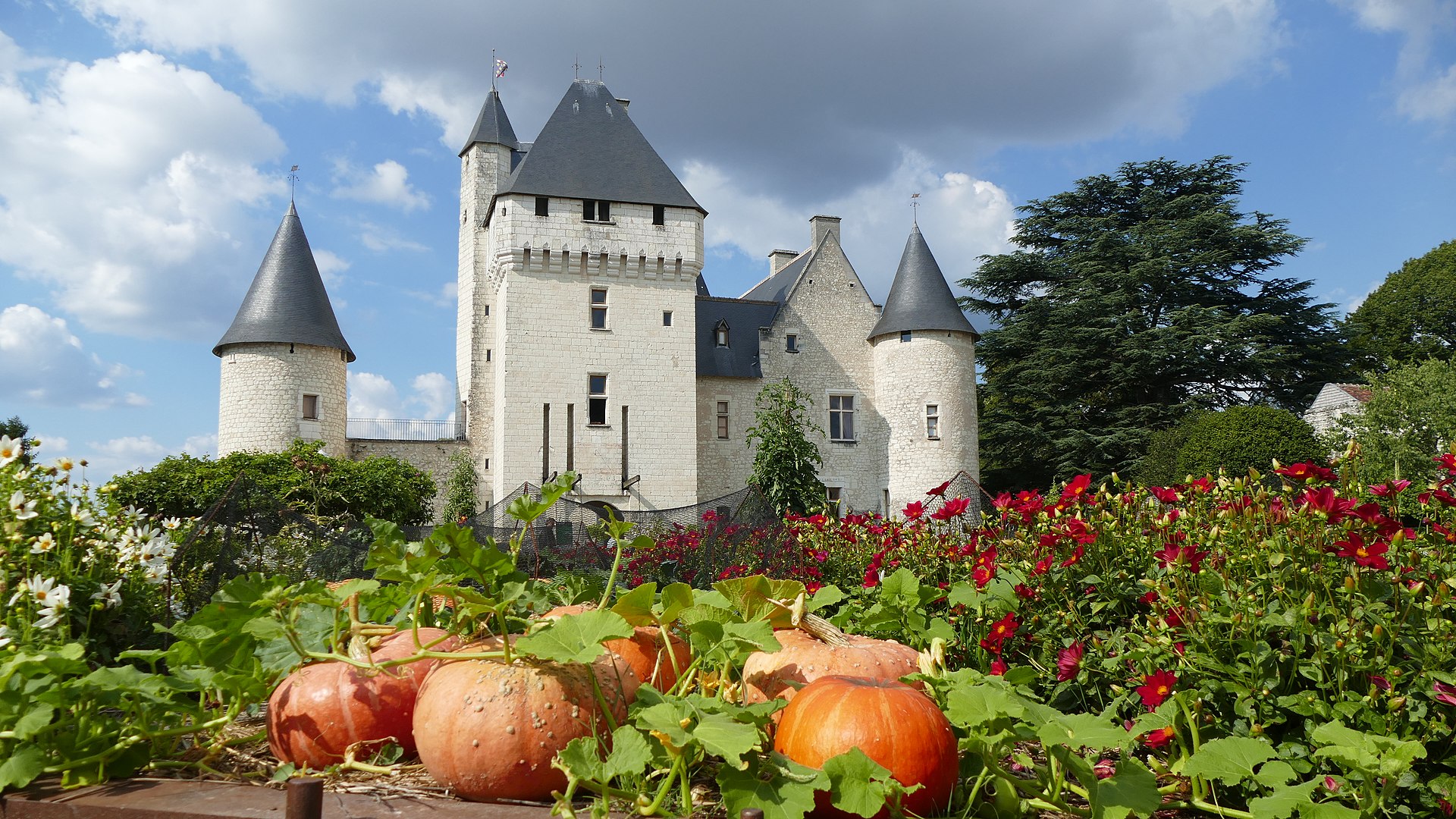
A compact, square white‑tufa keep forms the centre, rising with a machicolated cornice and a steep, dark slate roof; it is flanked by cylindrical round towers capped with pointed conical slate roofs. The masonry is pale, with narrow vertical arrow slits and rectangular windows puncturing the façades. Low curtain walls and outbuildings cluster around a central courtyard; the immediate setting opens onto cultivated formal gardens and flower beds, with mature trees behind the castle.
Its story
The story of Château du Rivau.
From Maison Forte to Beauvau Fortress
The first foundations of Le Rivau go back to the thirteenth century, when the site carried a maison forte rather than a castle. It stands in Touraine, in what is now the commune of Lémeré, on ground that dominates the valleys of the Vienne and the Veude and with them the main routes of communication through the country. It stood at the heart of the Anglo-French conflicts, and it was held by a family that had served the Kings of France since the thirteenth century: the Beauvau, kin to the Counts of Anjou, who carried the privilege of doing homage to their suzerain standing, with a sword at their side and their hats still on.
Le Rivau was known for its horses before it was known for its architecture. War horses were bred where the outbuildings now stand, and by the fifteenth century the reputation of the place rested on stables that were still no more than timber. Joan of Arc, after recognising the dauphin at Chinon, came to Le Rivau in 1429 to fetch mounts for the field before going on to the siege of Orléans.
From 1438 the estate passed as a marriage portion to Pierre de Beauvau, first chamberlain to the dauphin Charles VII, who died in 1453. His record in arms won him the king's authorisation to fortify, and the maison forte became a castle in the proper sense. Rebuilding began in 1443, the same year as work on Jacques Cœur's house at Bourges, and the new quadrilateral went up in a single campaign, with a free-standing chapel beside it and a fourth range, since vanished, closing the court. René de Beauvau rendered homage for it on 8 January 1484. The family's tie to the crown was tighter still after Isabeau de Beauvau married Jean de Bourbon, a prince of the blood, in 1454. Le Rivau stayed in Beauvau hands for 247 years.
The Stables that Supplied the King's Stallions
In 1510 François de Beauvau, châtelain of Le Rivau and a captain of François I, undertook monumental stables in the forecourt, built to furnish the king with stallions. They afterwards served as the royal stables of Henry III and housed his stallions. Their builder did not enjoy them long: he was killed in 1524, fighting at Bayard's side.
His successor Gabriel de Beauvau carried the work further around 1550, raising a building of a very new kind, influenced by what the great lords had seen while accompanying the king on the Italian campaigns. Until then château stables had been purely utilitarian and carried no ornament whatever; at Le Rivau, for the first time in the history of equestrian architecture, they were designed by an architect working in a pioneering manner. The two ranges, set in an L, stabled some thirty horses at ground level, in all likelihood mares on one side and stallions on the other, with a stair built into the thickness of the wall serving storage and the grooms' lodgings above. Some of the carved cartouches in the vaulting carry royal insignia; others were never finished. No document names the architect, though several likenesses to the work of Philibert Delorme have been noticed. The same century saw the range that closed the quadrilateral pulled down and the Gothic windows of the west front enlarged and given sculpture.
Rabelais, a native of this country, put Le Rivau into Gargantua in 1534. In chapter LI the giant shares out his neighbouring castles and lands among his captains, and Le Rivau goes to Tolmere as a reward for his victories in the Picrocholine wars.
Richelieu's Reprieve and the End of the Rivau Beauvaus, 1631-1739
From 1631 Cardinal Richelieu set about pulling down the castles around his new town of Richelieu, ten kilometres away, to recover their materials for the building of it. Le Rivau was left standing. The cardinal's sister, Françoise Du Plessis, was married to Jean de Beauvau, lord of the place, and the castle escaped the dismantling its neighbours suffered.
Jacques de Beauvau (1627-1702), maréchal des camps et armées to Louis XIV, left Le Rivau for the court of the Sun King, and in July 1664 obtained the erection of the estate into a marquisate under the Beauvau name. The court ruined him. He borrowed 80,000 livres from Marie Damond, widow of Charles Croisset, marquis d'Etiau and first councillor to the king, could not repay the debt, and in 1697 had to surrender the land. Before he went he made the castle uninhabitable, taking out every door and window and hiding them at the house of the curé of Lémeré.
The direct male line of the marquis de Beauvau du Rivau ended with his two sons, Pierre-Madeleine (1663-1734) and René-François (1664-1739), archbishop of Narbonne and of Toulouse; a cadet sub-branch had already inherited Montgoger. The senior line, the Beauvau-Craon, became princes in Lorraine, and with that the family left Touraine.
The Castellanes, the Grain Store and the Sale of 1911
For two centuries the castle passed through the hands of marquises and artists. Michel-Ange de Castellane, lord of Villandry, acquired Le Rivau in 1768 and his family stayed until 1796; his son Esprit-François-Henri held it in 1789, the Castellanes being counts of Villandry. The eighteenth century brought no modernising of the buildings. The terrace gardens were walled, a bridge now gone appears to have been thrown across the west moat, and the moat itself was filled in.
What made the place worth holding was the land, planted with sainfoin and walnut and forty-five hectares of vines. Those rich acres were coveted, and the castle became a château de rapport, valued for its revenue and altered no further, so that it kept every characteristic of its original construction.
From the nineteenth century Le Rivau stood uninhabited and slipped out of memory. The chapel north of the Jardin secret was destroyed around 1880, small-paned windows replaced the mullioned ones, and the building was turned over to the storage of wheat. When it came to auction in 1911 it carried sixty-three hectares against the twelve hundred of its great days; the outbuildings were sold to the man farming the land, and a wall was raised between them and the castle. Damage accumulated afterwards: the enclosure wall was breached to admit a combine harvester too large for the gateway, and the calade, the path of stones set on edge, was buried under eighty centimetres of earth.
From Moncel de Perrin's Classification to the Laigneau Restoration, 1918-2001
In 1918 the new owner, the sculptor Alphonse de Moncel de Perrin, who had worked on the ornament of the Petit Palais in Paris, obtained the castle's classification among the monuments historiques. The painter and poster artist Pierre-Laurent Brenot bought Le Rivau in February 1961 and lived there until December 1992, when he sold it to Éric and Patricia Laigneau, who own it still.
The castle was threatening ruin when they took it on, and they began at once on the repair of the castle, its outbuildings and its gardens. More than 5,000 square metres of roofing was replaced, 73 cubic metres of oak went into re-forming the roof frame of the castle alone, and 148 windows were remade to the original pattern. The French Heritage Society awarded the work its grand prix in 1996 and La Demeure historique did the same in 2001. The site opened to visitors in 2000.
The protection has widened twice since the classification of July 1918: the farm was inscribed in February 1988 and the outbuildings classified in August 1999. The fourteen gardens laid out around the castle carry the Jardin remarquable label and hold a collection of more than four hundred roses.
Step inside
8 places to explore in 1520.
The record describes 8 distinct spots at Château du Rivau, including 2 interiors: dining hall with painted mantelpiece, interior of the royal stables. Create your own photoreal reconstruction and explore every one, more scenes means more rooms, more angles, and more of the place to stand in.
Build Your Own Castle
Recreate Château du Rivau with AI to explore it.
The artist rebuilds it as it stood in 1520, a photoreal reconstruction that belongs to you alone. Pay with coins, no subscription needed.
Recreate this castle →Defend this castle →Whose castle
Clans who held Château du Rivau.
The families that held Château du Rivau for a decade or more across its history, follow a name to its clan.
Beauvau
Held Le Rivau for 247 years; François de Beauvau built the royal stables in 1510.
Castellane
Acquired by the marquis Michel-Ange de Castellane in 1768; the family stayed until 1796.