Clan Rising
Ebernburg Castle today

Germany · Restored

Ebernburg Castle

Burg Ebernburg

Ebernburg Castle is a hilltop castle above the town of Bad Münster am Stein-Ebernburg in Rhineland-Palatinate, Germany. Built in the 14th century for the counts of Sponheim and later owned and expanded by the Sickingen family, it was burned in 1523, rebuilt in 1542, and later restored and altered in the 19th and 20th centuries.

Photograph via Wikimedia Commons

First raised

1338

Its prime

1542

Today

Restored

As it stood in 1542

What Ebernburg Castle looked like in its prime.

Perched on a rocky spur above the Nahe valley, the castle presents as a compact medieval stronghold sited on the southeastern edge of the Ebernburg district. The rebuilt mid-16th-century structure consists of stone curtain walls and rebuilt masonry forms hugging the spur, with defensive platforms for heavy artillery added in the late 15th century. From below the slope the castle reads as a fortified residence set above the town, its rebuilt roofs and service buildings added later.

Its story

The story of Ebernburg Castle.

Counts Ruprecht and Johann of Sponheim-Kreuznach built the Ebernburg in 1338, this much is certain, on its hilltop above what is now Bad Münster am Stein-Ebernburg. In 1448 the entire estate came to the Sickingen family, first as a pledge and later as a fief, and they held it until ceding it back to the Electorate of the Palatinate in 1750 and 1771.

The castle was the ancestral seat of the lords of Sickingen and the birthplace of Franz von Sickingen, the famous landsknecht captain and protector of Ulrich von Hutten, to whom a monument was erected on the slope near the ruins in 1889. Burned in 1523, the castle was rebuilt in 1542.

In 1838 the castle came to Karl Günther, landowner and mayor of Feilbingert, who rebuilt it in its original style and added a residence, farm buildings and an inn. In 1914 the Günther family sold it, with all its contents, to the Ebernburg Foundation, established for that purpose.

Step inside

3 places to explore in 1542.

The record describes 3 distinct spots at Ebernburg Castle, including 1 interior: castle chapel. Create your own photoreal reconstruction and explore every one, more scenes means more rooms, more angles, and more of the place to stand in.

Approach from the Nahe valleyArtillery platforms on the curtain wallsCastle chapel

Build Your Own Castle

Recreate Ebernburg Castle with AI to explore it.

The artist rebuilds it as it stood in 1542, a photoreal reconstruction that belongs to you alone. Pay with coins, no subscription needed.

Recreate this castle →

Castle Siege

Play Castle Siege at Ebernburg Castle.

A strategy game played on Ebernburg Castle’s real ground plan: the same surveyed walls shown in the archive below. Post your finite garrison on the battlements between assaults, then hold out as rams, siege towers, trebuchets and sappers arrive in ever-worse waves.

Sign in free to see the garrison muster. One castle costs 150 Clan Coins and is yours forever.

Sign in to take command →

See every castle’s leaderboard →

Whose castle

Clans who held Ebernburg Castle.

The families that held Ebernburg Castle for a decade or more across its history, follow a name to its clan.

  • Sponheim

    Counts Ruprecht and Johann of Sponheim-Kreuznach built the castle in 1338.

  • Sickingen

    Held by the Sickingen family from 1448, as pledge and then fief, until ceded back to the Palatinate in 1750–71.

From the archive

Ebernburg Castle on paper: the measured plan and period views.

The survey plan and photographs below are the ground truth this page's reconstructions are checked against, drawn and photographed while the castle was still a working garrison. Every image is public-domain or openly licensed, with its source named.
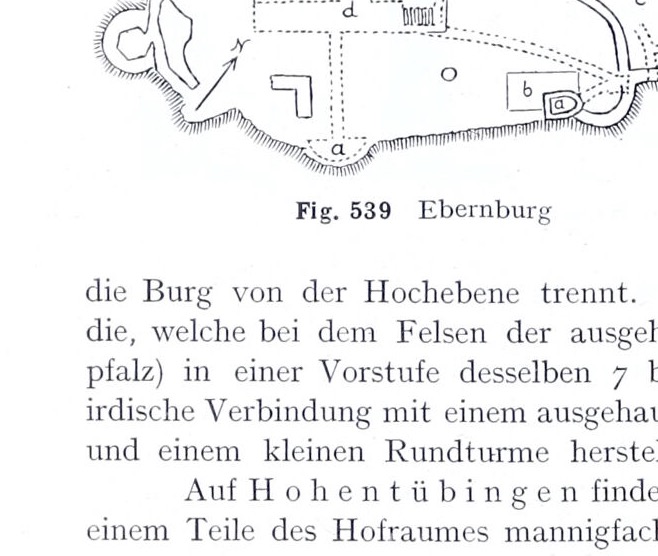
Fig. 539  Ebernburg, Ebernburg Castle

Fig. 539 Ebernburg

1912 · Otto Piper, Burgenkunde (1912)

Public domain

Questions about Ebernburg Castle

What is the history of Ebernburg Castle?

Ebernburg Castle was built in the 14th century for the counts of Sponheim. The Sickingen family acquired the estate in 1448, first as a pledge and later as a fief. The castle was burned in 1523, rebuilt in 1542, and later reconstructed and altered, including work after the Second World War.

What is inside Ebernburg Castle?

Ebernburg Castle contains a documented castle chapel. The supplied material does not identify other interior rooms or describe the chapel’s furnishings, decoration or layout.

Why was Ebernburg Castle built, and what was it used for?

Ebernburg Castle was built as a hilltop stronghold for the counts of Sponheim. It was later expanded and armed with artillery, including several heavy cannons, under Schweickhardt von Sickingen and his son Franz in 1482. Karl Günther later added a residence, farm buildings and an inn.

Where is Ebernburg Castle?

Ebernburg Castle stands above the Nahe valley on a mountain spur at the southeastern edge of the Ebernburg district. It is above the town of Bad Münster am Stein-Ebernburg, in Rhineland-Palatinate. The castle is about 185 metres above sea level.

When was Ebernburg Castle built?

Ebernburg Castle was built in 1338, in the 14th century. Counts Ruprecht and Johann of Sponheim-Kreuznach raised the castle on its hilltop site. It was rebuilt in 1542 after being burned in 1523, so the present structure also reflects later building phases.

Was Ebernburg Castle ever attacked or besieged?

Ebernburg Castle was attacked and besieged during the War of the Palatine Succession. French troops occupied it, and imperial soldiers under the Margrave of Baden recaptured it on 27 September 1697 after an unsuccessful siege in 1692. The castle was then demolished again and used as a quarry.

Which family or clan held Ebernburg Castle?

The Sickingen family held Ebernburg Castle from 1448 until it was ceded back to the Electorate of the Palatinate in 1750 and 1771. Their tenure began as a pledge and later became a fief. The castle was the ancestral seat of the lords of Sickingen.

What did Ebernburg Castle look like in its prime?

Ebernburg Castle presents as a compact medieval stronghold on a rocky spur above the Nahe valley. Its rebuilt mid-16th-century structure uses stone curtain walls and rebuilt masonry forms that follow the spur. Defensive platforms for heavy artillery were added in the late 15th century, while the roofs and service buildings were added later.

Is Ebernburg Castle still standing, or is it a ruin?

Ebernburg Castle is still standing and is described as restored. It was burned in 1523, rebuilt in 1542, and later demolished and used as a quarry after its recapture in 1697. Karl Günther rebuilt it in its original style from 1838, and it was expanded into its present form after the Second World War.

More castles of Germany

All castles of Germany · Castles of Europe · the best castles in Europe · explore the finished reconstructions.