
Germany · Restored
Falkenstein Castle
Burg Falkenstein
Falkenstein Castle (Burg Falkenstein) is a hill castle in the Harz mountains of Saxony-Anhalt, Germany, originally built in the High Middle Ages and later altered in the Gothic and early modern periods. The site occupies a rocky outcrop above the Selke valley and today houses a museum and event spaces.
First raised
1120
Its prime
1150
Today
Restored
As it stood in 1150
What Falkenstein Castle looked like in its prime.
Perched on a rocky crag above the Selke valley, the castle presents a compact complex of rough brown-grey fieldstone curtain walls and terraced outer walls. A massive cylindrical bergfried with very thick lower walls rises from the inner bailey and is topped by a bulbous/helmeted cap and observation gallery. Attached to the curtain on one side is a multi-storey timber-framed palas with steep slate roofs and jettied upper floors; multiple gates, zwingers and a high shield wall protect the approach.
Its story
The story of Falkenstein Castle.
The Konradsburg Killing and the New Castle, c. 1080–1150
Falkenstein begins, by tradition, with a killing. Around 1080 the Saxon nobleman Egeno II of Konradsburg struck down Count Adalbert II of Ballenstedt in a quarrel, and the killer was said to have been made to give up his family seat so that it could be turned into a monastery; a Benedictine house was indeed founded on the Konradsburg after 1120. Egeno's son Burchard of Konradsburg had the new castle at Falkenstein built, and the lords of the Konradsburg thereafter styled themselves Counts of Falkenstein.
Building began around 1120 and ran on through the middle decades of the twelfth century, on a rock spur about 320 metres up on the south side of the Selke valley in the Lower Harz, with the older Falkenstein a short distance to the west-south-west. The work was Romanesque.
Eike of Repgow's Law Book, after 1220
In the years after 1220, during the rule of Prince Henry of Anhalt, the Anhalt ministerialis Eike of Repgow, from what is now Reppichau, compiled the Sachsenspiegel at Falkenstein, the first German law book. It is dedicated to the man who commissioned it, Hoyer of Falkenstein.
The Asseburgs Take the Fief, 1437–1592
In 1437 the Bishopric of Halberstadt granted the castle as a fief to the brothers Busso and Bernd IV of the house of Asseburg. Through the fifteenth and sixteenth centuries the Asseburgs built busily on the rock. One of the most considerable of the Falkenstein builders is reckoned to be Count Bernd VI of Asseburg-Falkenstein, born about 1451 and dead by 1518 or shortly after, who had the south wing raised entirely anew; an armorial stone still on the castle carries his name and the year, 'Bernt van der Asseborch 1491'.
Bernd VI is remembered as a dark figure. Breach of the land peace and murder by stealth were laid at his door, and the Harz legend of Tidian has him blind a poor shepherd out of greed for gold. Further work followed under Augustus of the Asseburg in 1592, a century after Bernd's time; in that same year the Thalmühle was built in the Selke valley below the castle. Falkenstein was altered often across these centuries, most heavily in the middle of the sixteenth, yet it kept the character of a medieval fortress through all of it.
The Defences and the Swedish Garrison of 1642–1643
From October 1642 to February 1643, in the Thirty Years' War, a Swedish garrison lay in the castle.
Falkenstein was never taken, a thing credited to the strength of its position. The defences were laid out in depth along a site some 310 by 90 metres: seven gates and five zwingers, three outer baileys in front of a core only about forty metres square, a shield wall seventeen metres high on the side from which the main attacks were expected, and a cistern sunk twenty metres into the rock. At the centre of the core stands the bergfried, thirty-one metres high and teardrop in plan, its solid wedge turned east towards the quarter from which enemy attack was looked for, so that missiles would glance off it and any that struck home would do less damage. A wooden bridge originally ran from the palas in the north-west corner to the bergfried, about nine metres above the ground; later Gothic alterations joined the buildings.
Buried Treasure, Expropriation and the Foundation, 1943–2026
In 1943 the brothers Lothar of Asseburg-Falkenstein-Rothkirch (1914–1984) and Karl-Christoph of Rothkirch (1920–2006) buried part of the family treasure on the Tormannswiese, and in the spring of 1945 hid more of it inside the castle itself, in a windowless intermediate storey off the Spinndiele. The family held Falkenstein and Meisdorf from 1437 until they were expropriated after the Second World War. The buried hoard was recovered in 1990 and the hidden storey opened in 1992; from the castle hiding place alone some 3,000 pieces were secured. The Asseburg cup was among the pieces the two brothers had saved. After a long legal action most of the collection was awarded to the family and afterwards sold, a smaller part remaining at the castle on permanent loan. In 2017 building work opened a further cavity holding valuable Meissen porcelain, since shown in the castle museum as a loan from its owners.
A museum has occupied the castle since 1946. In 1996 Falkenstein passed into the assets of the state foundation for palaces, castles and gardens of Saxony-Anhalt, now the Kulturstiftung Sachsen-Anhalt, which took over the running of the museum in 1998. The castle is a protected heritage monument in Saxony-Anhalt and a station on the Straße der Romanik, the Romanesque Road, with a falconry and a restaurant serving the traditional Ritteressen, and its bergfried open as a viewing tower over the Selke valley. It closed to visitors in mid-January 2025 for a thorough restoration, part of a 200 million euro federal and state investment programme covering eleven sites and projects of the foundation, and reopened on 28 March 2026.
Step inside
8 places to explore in 1150.
The record describes 8 distinct spots at Falkenstein Castle, including 1 interior: summit and observation gallery of the bergfried. Create your own photoreal reconstruction and explore every one, more scenes means more rooms, more angles, and more of the place to stand in.
Build Your Own Castle
Recreate Falkenstein Castle with AI to explore it.
The artist rebuilds it as it stood in 1150, a photoreal reconstruction that belongs to you alone. Pay with coins, no subscription needed.
Recreate this castle →Defend this castle →Whose castle
Clans who held Falkenstein Castle.
The families that held Falkenstein Castle for a decade or more across its history, follow a name to its clan.
Falkenstein
Built 1120–1150 by the lords of the Konradsburg, who thereafter styled themselves Counts of Falkenstein.
Asseburg
Held by the House of Asseburg as a fief of Halberstadt from 1437 until confiscation after the Second World War.
From the archive
Falkenstein Castle on paper: the measured plan and period views.
The survey plan and photographs below are the ground truth this page's reconstructions are checked against, drawn and photographed while the castle was still a working garrison. Every image is public-domain or openly licensed, with its source named.
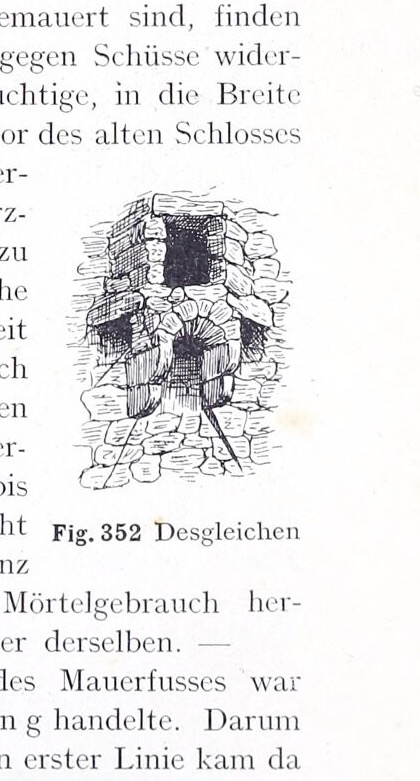
Fig. 351 Falkenstein
1912 · Otto Piper, Burgenkunde (1912)
Public domain
Fig. 352 Desgleichen
1912 · Otto Piper, Burgenkunde (1912)
Public domain


