
Germany · Restored
Herzberg Castle
Schloss Herzberg
Herzberg Castle (Schloss Herzberg) is a quadrangular Welf schloss on a wooded eminence above Herzberg am Harz in Lower Saxony. The present building has medieval origins and was rebuilt after a major fire, completed in 1528, with a sandstone base and timber-framed upper wings. It served as a ducal residence for centuries and today contains a museum and cultural facilities.
Its prime
1528
Today
Restored
As it stood in 1528
What Herzberg Castle looked like in its prime.
A long, enclosed four-winged schloss on a wooded hill, forming a rectangular courtyard; lower levels are of pale sandstone while three of the upper wings display white infill with dark timber framing in a strict grid. One wing’s upper storey is stone. The roof is a continuous steep red tile roof stretching along the long façade. A two-storey gatehouse and barbican provide the approach, and a clock tower occupies the eastern corner with timber upper storeys and an ornamental cupola and weather vane.
Its story
The story of Herzberg Castle.
From Imperial Castle to Welf Possession, 1029–1158
A tradition dates the beginnings of the site to a hunting lodge raised here between 1024 and 1029 and credits it to a Werner von Lutterberg, though that account is very probably not correct. The castle proper is thought to have been built at the behest of King, later Emperor, Lothair III, known as Lothair of Süpplingenburg, on a wooded spur 275 m above sea level immediately west of and above the centre of what is now Herzberg am Harz in the Landkreis Göttingen, with the River Sieber running past to the north. The first indirect sign that it existed is a ministerialis, Luipold von Herzberg, who appears as a witness to a charter of 1050. Of the original fortification a ditch survives to the south, still up to 5 m deep, and an outer rampart runs along the south-east against the ridge behind it, some 80 m long, up to 2.5 m high and as much as 5 m broad at the base.
Count Hermann of Lutterberge lived at Herzberg until his death in 1143, leaving no heir who could take up the fief. In 1144, on Welf orders, a family of ministeriales from Bavaria, the von Göttingen, took the castle and the district around it into possession for the Welfs as a lapsed fief, charged with maintaining the place and its surroundings. The oldest direct evidence for the castle is a pair of charters that Henry the Lion issued there in 1156 and 1158, which show it at his disposal; the site still carried the status of an imperial castle, and Henry acquired it outright only through an exchange of property with Frederick Barbarossa, giving up in return estates in Swabia that had come to him through his first wife, Clementia of Zähringen.
A Widows' Seat and the Grubenhagen Dukes, 1218–1596
After Henry the Lion's death the castle passed to Otto IV, and on his death in 1218 it served his widow, the Empress Maria of Brabant, as her dower seat. She made out a deed at the Hertsberg in that year, which made the place an imperial residence for a short while. The role recurred more than once in the centuries that followed: from 1279 the castle housed the widow of Duke Albert the Great.
In 1290 Herzberg became the residence of the Welf line of Brunswick-Grubenhagen, formed at about that time. From 1384 to 1402 it was held as an apanage by Ernest of Brunswick-Grubenhagen, formerly abbot of Corvey. From 1486 the dukes of the Principality of Grubenhagen lived here until their line died out in 1596, after which the estate passed to the Welf line of Brunswick-Lüneburg.
Duke Philip's Escape from the Flames and the Rebuilding in Timber
A serious fire swept the castle in November 1510. The lord of the castle, Duke Philip I, his wife Catharine and their son Philip were pulled clear at the last minute as the flames took hold; the duke's shield bearer and the duchess's chambermaid died in it. In thanks for the help the townspeople gave during the fire and the rebuilding that followed, Philip I granted the burghers of Herzberg the right to hold shooting festivals and made them a gift of a silver chain hung with a silver stag.
The rebuilding turned the medieval castle into a schloss: an enclosed four-winged range around a rectangular courtyard of 40 by 58 m, finished in 1528, its basements of sandstone, one wing carrying an upper storey of stone and the other three timber-framed above. With 180 rooms it is the largest Renaissance schloss complex in Lower Saxony built in timber framing. Remains of the older castle are still suspected in the south range, the so-called Stammhausflügel, and the approach was kept as it had been, through a gate tower and the barbican behind it and then through a second, two-storey gatehouse at the south-western corner.
A Ducal Residence and the Birth of Ernest Augustus, 1337–1714
From 1337 to 1714 Herzberg was a ducal residence almost without a break, and one of the significant seats of the several lines of the duchy of Brunswick-Lüneburg. Duke George of Brunswick and Lüneburg lived here with his wife, the Landgravine Anne Eleanor of Hesse-Darmstadt, from 1617 until 1636. Their youngest son was born at the castle in 1629: Ernest Augustus, Duke of Brunswick-Lüneburg, later the first Elector of Hanover. His sister-in-law, Duchess Dorothea Sophie of Celle, lived at Herzberg as a widow from 1665 for three years, until she married Frederick William of Brandenburg, the Great Elector, and moved to Berlin.
The north range along the Sieber, put up in about 1648 to 1660, held the ducal household in its stone ground floor and its two timber-framed storeys above, and the square clock tower, with three timber-framed upper storeys of its own, went up in the angle of the wings at the same period. In 1714, the year in which Ernest Augustus's son George I became King of Great Britain and Ireland in personal union, Herzberg was given up as a residence.
Granary, Courthouse and the Explosion of 1945, 1714–2023
With the court gone the building was put to other work. The peasants' tithe had already been stored at the castle, so fitting out further rooms as tithe lofts was the obvious step, and in 1798 the schloss became a granary. Since 1852 it has housed the Amtsgericht Herzberg, the local court, in the Sieber wing and the Grey wing, though law had been administered at the castle before the Kingdom of Hanover introduced a uniform court constitution in that year; the largest courtroom occupies the former castle kitchen. The gaol stood beside the gatehouse in earlier times, and the gatehouse itself held a juvenile detention unit until the beginning of 2000. The Welfs meanwhile kept Herzberg without a break for 708 years, until the Kingdom of Hanover came to an end in 1866.
The east wing's predecessor was taken down in about 1860 and rebuilt on its old cellar in late classical form in 1861, and in 1900 a museum was set up in the schloss. The castle had come through the centuries largely undamaged by fire; the end of the Second World War hit it hard. On the night of 4 April 1945 an explosives works below the castle, where 40,000 kg of explosives and 8,000 mines were stored, went up in a huge detonation that stripped the roof off the schloss. The museum was destroyed in the course of it and probably looted. Further damage came in 1947 when military bunkers nearby were blown up. All of that has since been made good.
Parts of the complex were restored in 2006, and since 2017 the whole site has been under a general restoration planned to run ten years, taking in the gatehouse and barbican, the clock tower, the Marstall wing, the Grey wing and the Sieber wing. The clock tower, scaffolded for years on safety grounds, was completed first in December 2021 with funds from the state of Lower Saxony, its timber framing rebuilt in the original clay technique as monument protection required and its beams painted the historic ochre rather than the brown-red they had carried; the Marstall wing followed a year later and took in the district court. The work begun in the summer of 2017 was costed at 7.5 million euros against an estimated 20 million overall, and from 2021 the federal government joined the state with a commitment of 7 million euros over five years. Archaeological digs alongside the building work have turned up numerous foundation walls of the former castle on the Schlossberg. A supporters' association formed in 2004 to preserve the Welfenschloss as a protected monument has bought paintings and exhibits for the museum, among them a portrait of Duke George of Brunswick-Lüneburg, who resided here with his family from 1617 to 1636. In the summer of 2023 four further portraits from the Leineschloss in Hanover, of Duchess Sophie and the dukes Ernest Augustus, John Frederick and Christian Ludwig, arrived on permanent loan and hang in the Rittersaal. Besides the court the schloss holds a small cultural centre with a café-restaurant, the museum and that hall, all of which have stayed open through the building works. The museum belongs to the Kulturerbe Niedersachsen and covers the forestry of the Harz, the history of the castle and of the Welfs, the Herzberg gun manufactory and the organ builder Johann Andreas Engelhardt, and it holds a facsimile of the Gospels of Henry the Lion and, since 2017, a restored Welf cradle of the sixteenth century.
Step inside
7 places to explore in 1528.
The record describes 7 distinct spots at Herzberg Castle, including 2 interiors: sandstone basement and lower works, great hall interior. Create your own photoreal reconstruction and explore every one, more scenes means more rooms, more angles, and more of the place to stand in.
Build Your Own Castle
Recreate Herzberg Castle with AI to explore it.
The artist rebuilds it as it stood in 1528, a photoreal reconstruction that belongs to you alone. Pay with coins, no subscription needed.
Recreate this castle →Defend this castle →Whose castle
Clans who held Herzberg Castle.
The families that held Herzberg Castle for a decade or more across its history, follow a name to its clan.
Welf
Held by the House of Welf for 700 years, the "Welfenschloss"; a ducal residence almost continuously from 1337 to 1714.
From the archive
Herzberg Castle on paper: the measured plan and period views.
The survey plan and photographs below are the ground truth this page's reconstructions are checked against, drawn and photographed while the castle was still a working garrison. Every image is public-domain or openly licensed, with its source named.
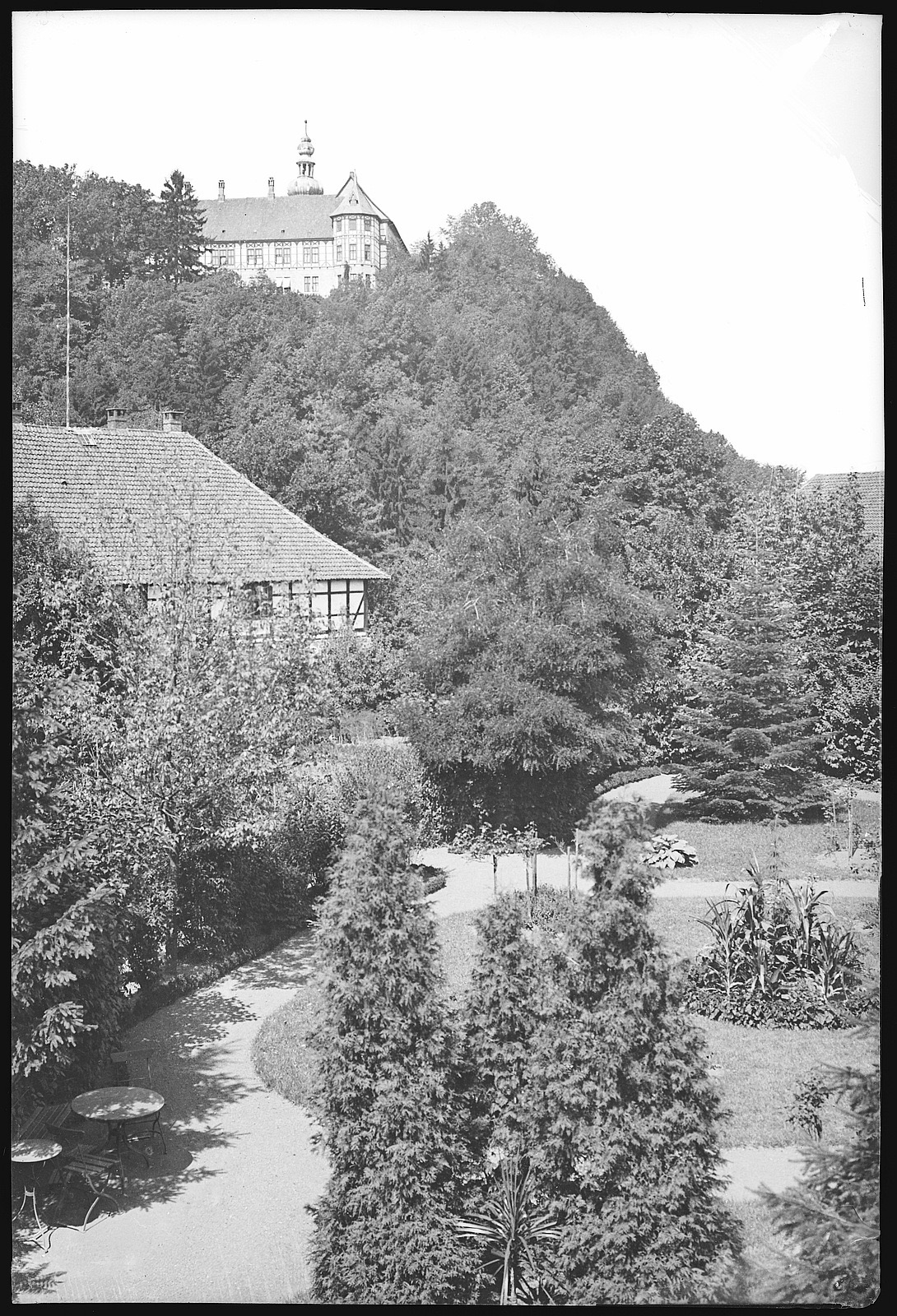
Bad Herzberg. Schloss
· Deutsche Fotothek (via Europeana)
Public domain
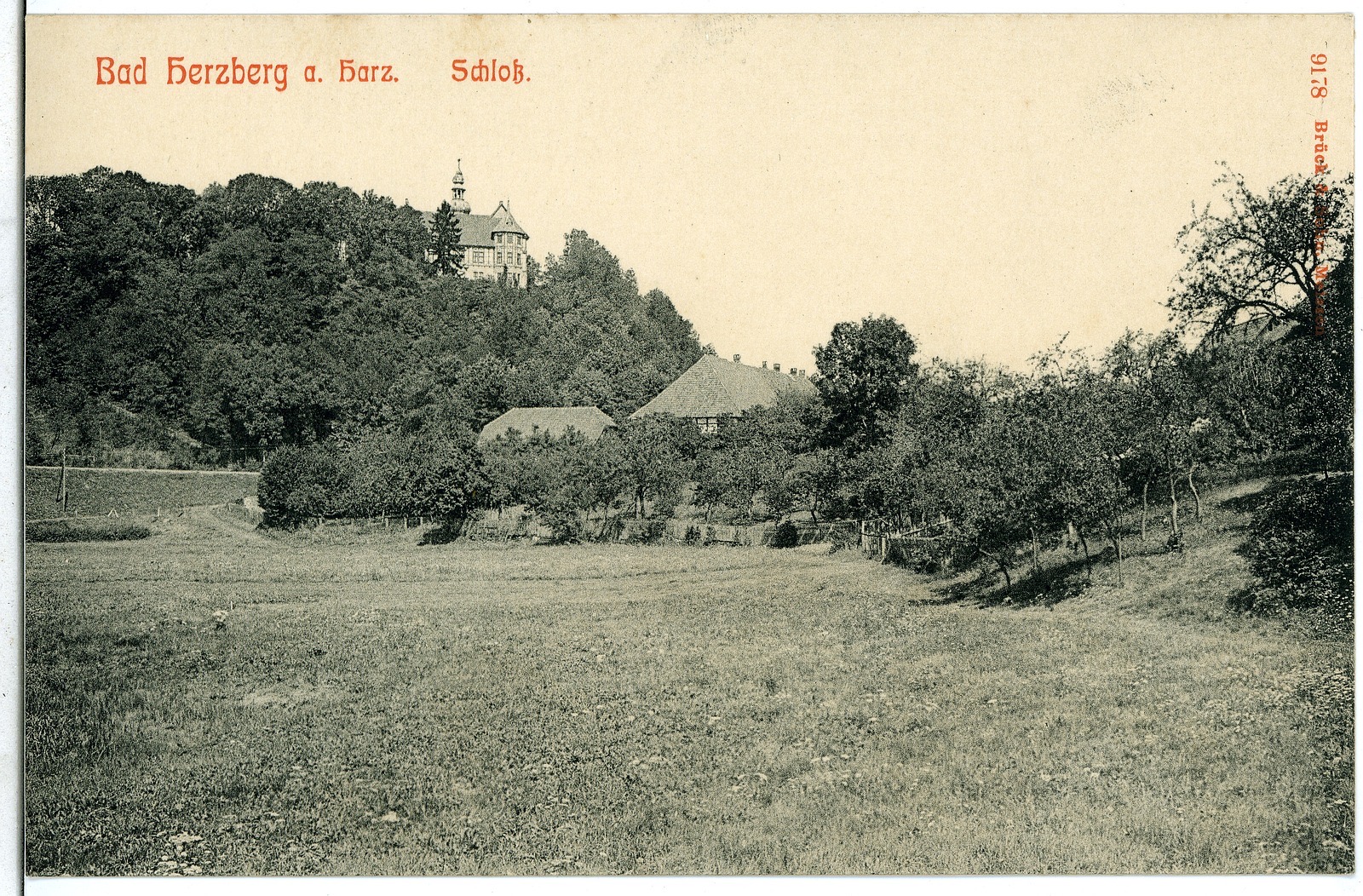
Bad Herzberg. Schloss
· Deutsche Fotothek (via Europeana)
Public domain
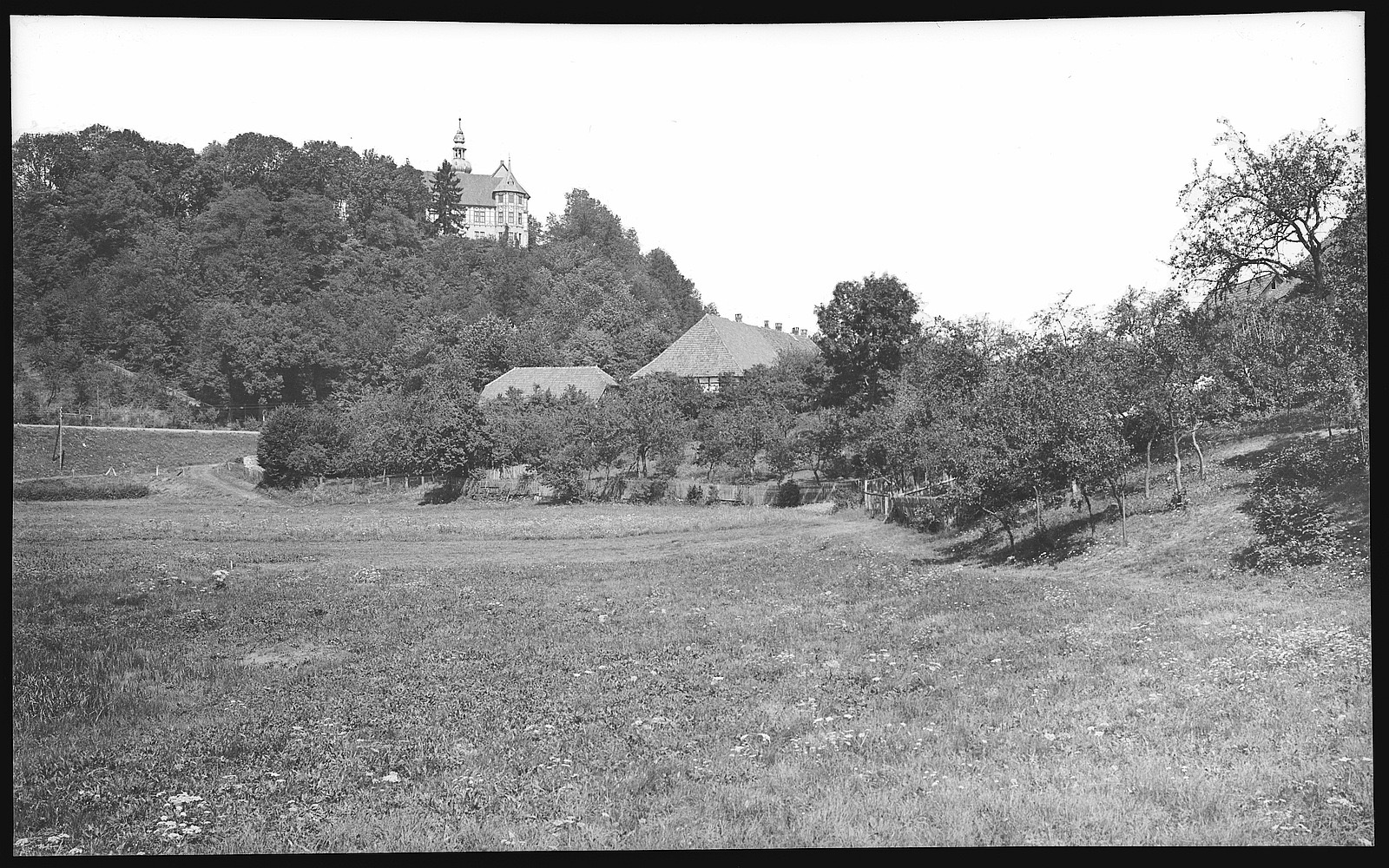
Bad Herzberg. Castle
· Deutsche Fotothek (via Europeana)
Public domain


