
Germany · Still standing
Harburg Castle
Burg Harburg
Harburg Castle is a largely complete medieval hill castle on a steep spur above the Wörnitz valley in Bavaria. Originating in the 11th–12th centuries and extended in the late medieval and early modern periods, the complex comprises a main castle with curtain wall and six towers, an outer bailey and a cluster of domestic and defensive buildings. It remains a preserved, visitable site managed by a cultural foundation.
First raised
1150
Its prime
1730
Today
Still standing
As it stood in 1730
What Harburg Castle looked like in its prime.
Perched on a steep wooded limestone spur, the castle presents a continuous pale plastered curtain wall pierced by small embrasures and topped by a parapet walk; six towers (round and angular) rise above the wall, two larger keeps mark the core, and a long multi-storey hall block with rows of rectangular windows sits at the centre. Roofs are steeply pitched with red-orange clay tiles and several towers end in conical or onion-like tiled caps; an outer bailey and lower gate sit down the slope.
Its story
The story of Harburg Castle.
The Spur Above the Wörnitz: Kuno of Harburg, c. 1100–1139
The castle stands on a steep spur above the Wörnitz, at the south-eastern entrance to the Ries. It was raised without reference to any older settlement below, a sequence rare in the High Middle Ages; the town of Harburg grew afterwards on the narrow floor between river and castle rock.
The first written trace is Cuno de Horburc, Kuno of Harburg, named by about 1100 in sources on the founding of Berchtesgaden's Benedictine house. Half-brother of its founder Berengar of Sulzbach, he apparently held the Harburg at the end of the eleventh century and died childless on 30 June 1139; Jürgen Dendorfer has argued that the Harburg may have reached the Staufer as the dowry of Gertrude of Sulzbach on her marriage to Conrad III.
A Letter to Constantinople and the Imperial Castle, 1150–1239
The castle itself first appears in 1150, in a letter sent to Constantinople by the thirteen-year-old Staufer Henry, son and co-king of Conrad III. Writing to his aunt, the empress there, and Manuel Komnenos, he told how on 8 February "that lofty and unfaithful Welf" (Welf VI) had entered "our country" in hostility while his father was away on affairs of state. Welf moved against Flochberg; Henry, he wrote, was in another castle, Harburg. He pursued with five large battalions, sent fast horsemen to cut off the retreat, and took three hundred knights. Harburg was a Staufer imperial castle at that date.
From the mid-twelfth to the mid-thirteenth century it was built out into a large imperial castle taking in the bailey: the two keeps, the palas later walled into the Fürstenbau, parts of the castle church of St Michael, the ring wall and the Inner Gate all date from it. In May 1239 King Conrad IV lived at Harburg and issued charters there.
Pledged to the Counts of Oettingen, 1299–1418
King Albert I of Habsburg pledged the castle to the Counts of Oettingen in 1299 for 900 pounds heller. In 1418 Emperor Sigismund declared the pledge unredeemable and confirmed the counts in their ownership of the Harburg.
Residence, Reformation and the Schmalkaldic War, 1493–1731
Count Wolfgang I and his son Karl Wolfgang used the Harburg as their residence from 1493 to 1549. Karl Wolfgang brought Paul Warbeck to the castle as court preacher and introduced the Reformation in 1524, which made the castle church of St Michael the first Protestant preaching place in the Ries; in 1539, after the Peasants' War, he called a synod at Harburg at which the Augsburg Confession was adopted.
He stayed neutral in the Schmalkaldic War and did not join the League, yet in September 1546 League troops occupied the castle; after their capitulation imperial troops plundered the market town and took the castle themselves. In December 1546, despite his neutrality, Karl Wolfgang was deposed, and he died childless at Harburg in 1549. His brother Ludwig XV, who had joined the League, was outlawed and banished, but after the Peace of Augsburg in 1555 he resumed the reforming work and Harburg turned Protestant again, staying with the Protestant Oettingen-Oettingen line when the house divided by confession. Count Gottfried rebuilt the main castle largely into its present form later in the sixteenth century, the Lower Gate finished in 1594.
The Harburg came through the Thirty Years' War undestroyed, unlike the other castles of the Ries. Prince Albert Ernest II meant to remodel it as a baroque residence in the eighteenth century, but only the castle church, the Fürstenbau and the hall building were altered, and the fortified character remained. His death extinguished the Oettingen-Oettingen line, and in 1731 the Harburg passed to the Catholic line of Oettingen-Wallerstein, which set up a district office and gaol there.
French Guns in 1800, the Nazi Years and the Cultural Foundation
On 24 June 1800, in the War of the Second Coalition, 160 Austrian infantry under a lieutenant held the castle against the French advance from Ebermergen. After some thirty cannon shots and a threat to burn the Harburg with howitzers, the Austrians capitulated and were declared prisoners of war; French soldiers plundered the market town during and after the bombardment. Because the affair passed off comparatively lightly, Harburg still keeps the Bockfest.
In the 1940s the Hitler Youth ran military-training camp II/36 at the Harburg. The castle was also used by the Gestapo, which held prisoners there for interrogation.
Since 2000 the castle has belonged to the charitable Fürst zu Oettingen-Wallerstein Cultural Foundation, and it is a listed architectural monument in Bavaria. Two exhibition rooms in the tower-keeper's house at the White Tower opened in March 2025, and the interior is shown on guided tours daily from mid-March to early November.
Step inside
12 places to explore in 1730.
The record describes 12 distinct spots at Harburg Castle, including 3 interiors: hall building (interior), castle chapel (interior), bakery building and service yard (interior/exterior). Create your own photoreal reconstruction and explore every one, more scenes means more rooms, more angles, and more of the place to stand in.
Build Your Own Castle
Recreate Harburg Castle with AI to explore it.
The artist rebuilds it as it stood in 1730, a photoreal reconstruction that belongs to you alone. Pay with coins, no subscription needed.
Recreate this castle →Defend this castle →Whose castle
Clans who held Harburg Castle.
The families that held Harburg Castle for a decade or more across its history, follow a name to its clan.
Oettingen-Wallerstein
The princely House of Oettingen-Wallerstein owned the castle, completing it as a prince's residence between the 16th and 18th centuries; since 2000 it belongs to the family's cultural foundation.
From the archive
Harburg Castle on paper: the measured plan and period views.
The survey plan and photographs below are the ground truth this page's reconstructions are checked against, drawn and photographed while the castle was still a working garrison. Every image is public-domain or openly licensed, with its source named.
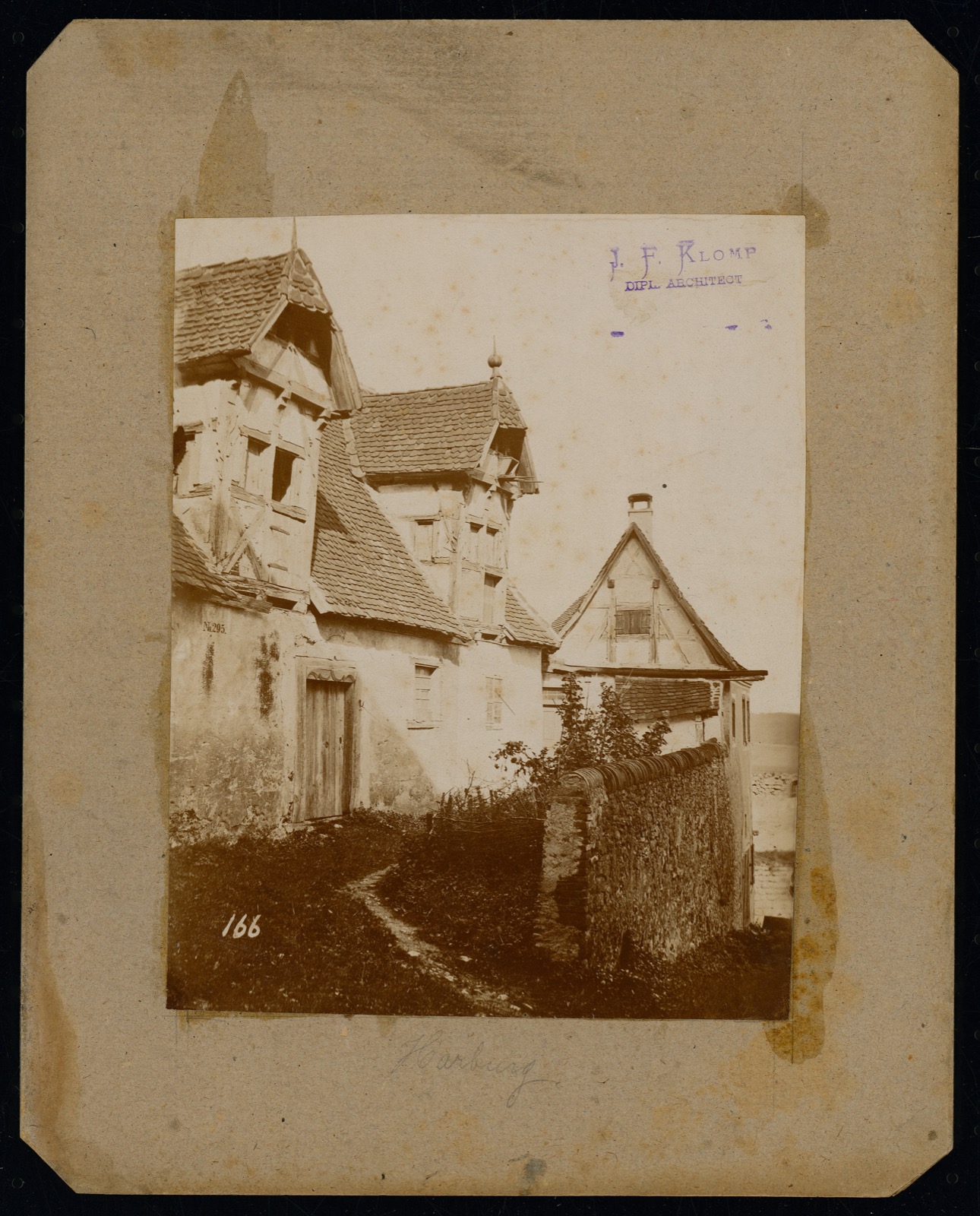
Burg Harburg, Harburg: Rote Stallungen
· Museum of Architecture at Berlin Institute of Technology (via Europeana)
CC0 (no rights reserved)
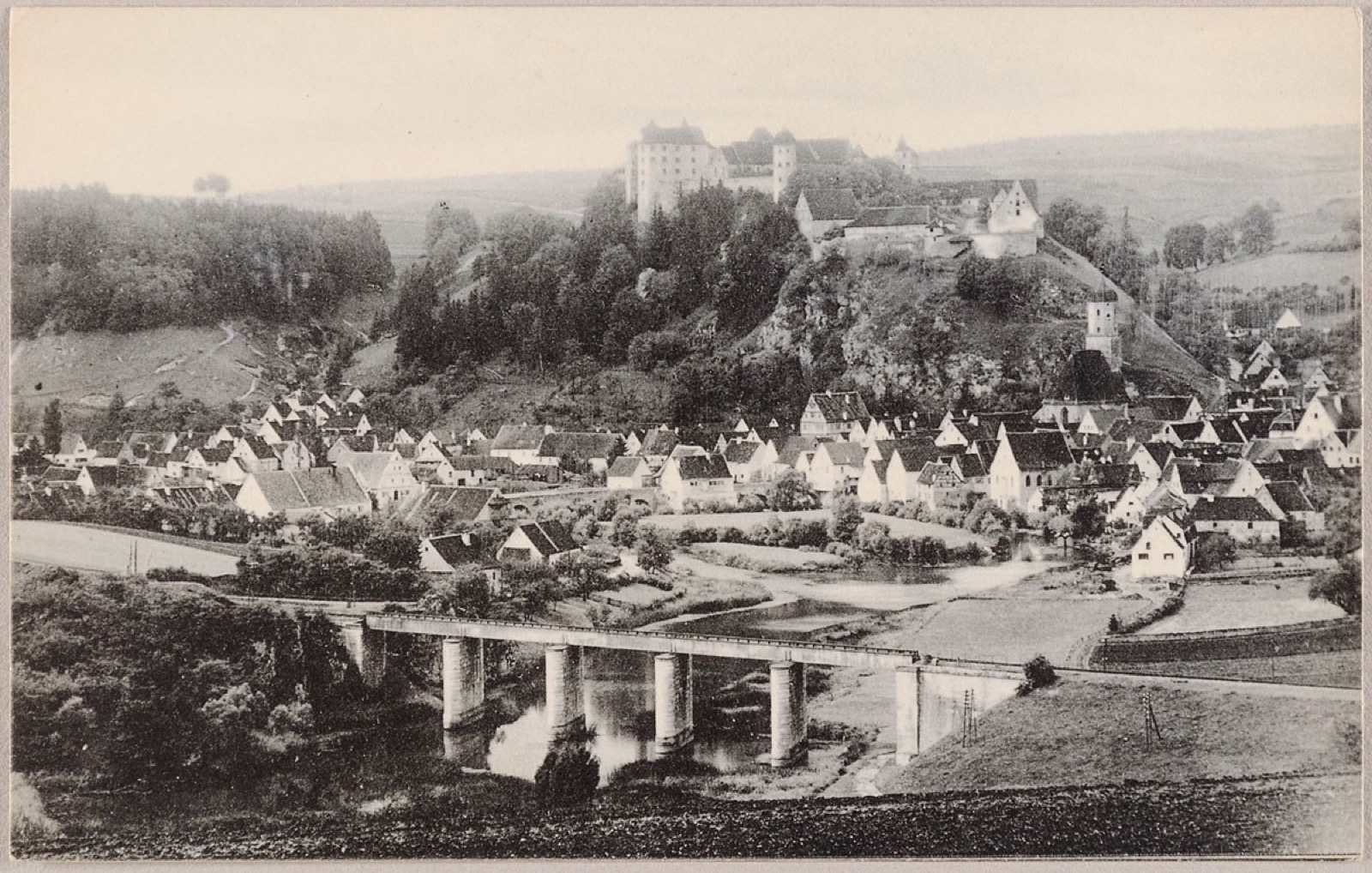
Harburg am Ries (Baiern)
· Museum of Arts and Crafts, Hamburg (via Europeana)
CC0 (no rights reserved)


