
Germany · Restored
Stahleck Castle
Burg Stahleck
Stahleck Castle is a fortified hilltop castle above the town of Bacharach on the left bank of the Rhine in Rhineland-Palatinate, Germany. Originally medieval, it was heavily rebuilt in the 20th century and today functions as a youth hostel occupying the restored buildings on the crag above vineyards.
Its prime
1930
Today
Restored
As it stood in 1930
What Stahleck Castle looked like in its prime.
Perched on a steep crag above terraced vineyards, the castle presents a compact cluster of stone buildings dominated by a tall cylindrical tower with a steep conical slate roof, smaller round and square towers, and a long multi-storey palas with a Fachwerk (half-timbered) upper storey and dormers. A stone ring wall and a visible shield wall run along the slope with a courtyard behind them; a water-filled partial moat sits at the lower approach. Walls are rough local sandstone.
Its story
The story of Stahleck Castle.
Origins and the Counts Palatine, c.1100–1442
Bacharach is presumed to have belonged to the Archbishops of Cologne from about 1000, who probably had Stahleck built, perhaps in the late eleventh or early twelfth century. Goswin von Falkenburg, attested in 1120–21, had gained the castle by marriage; his son Hermann married Gertrud of Swabia, sister of King Conrad III, and was granted Stahleck in 1140 and the County Palatine of the Rhine in 1142, making him one of the greatest lords of the Holy Roman Empire.
After Hermann's death in 1156, Barbarossa gave the county to his half-brother Conrad of Hohenstaufen, who intended his daughter and heir Agnes for King Philip II of France. While Conrad was away in early 1194, Agnes secretly married Henry the Elder of Brunswick, son of his enemy Henry the Lion, a match remembered as the Stahleck Marriage. Henry succeeded as Count Palatine, and by 1214 the castle had passed through his son to his daughter Agnes, while the rest of the county went to the Bavarian Duke Ludwig I of Wittelsbach, who secured Stahleck by marrying his son Otto to her in 1222.
Wittelsbach rule then moved to Heidelberg, and Stahleck was used only occasionally, though it hosted the election of Ludwig IV as King of Germany in 1314, the wedding of King Charles IV in 1349, and a reception for King Frederick of Habsburg in 1442.
Eight Sieges of the Thirty Years' War, 1620–1650
An artillery platform was added to guard the approach after the introduction of cannon, but the castle was besieged, captured and sacked eight times during the Thirty Years' War. Spanish troops under Ambrogio Spinola took Stahleck and Bacharach on 4 October 1620; Protestant Swedish forces evicted them on 9 January 1632 after a siege that badly damaged the castle. It then changed hands repeatedly: Imperial, Weimaran, Bavarian and Spanish troops each held it in turn between 1635 and 1640. French soldiers captured castle and town after a ten-day siege in September 1644; Cologne troops drove them back into the castle the following month with heavy losses, and their commander bombarded it without attempting to storm it. The French held on until 24 July 1650, when the Peace of Westphalia returned Stahleck to the Palatinate and Count Palatine Karl Ludwig.
Destruction in 1689 and Rebuilding as a Youth Hostel, 1666–1927
Karl Ludwig repaired the castle in 1666, remodelling the palas and adding a half-timbered building. During the War of the Palatine Succession, Stahleck's commander, von Dachenhausen, surrendered it to French troops on 11 October 1688, and on 15 March 1689 they blew it up. The explosion destroyed the ring wall and keep, fire gutted the residential buildings, and falling debris wrecked the Gothic Werner Chapel at the hill's foot. Too damaged to rebuild, the ruin passed to the Palatinate under the 1697 Treaty of Ryswick, then to Prussia in 1815.
In 1909 the ruin passed to the Rhenish Association for Landmark Preservation. From 1925 architect Ernst Stahl rebuilt it as a youth hostel around the surviving walls and newly excavated foundations; a boys' hostel opened in June 1926, a girls' hostel by July 1927.
Nazi Requisition, Wartime Internment and Postwar Protection, 1934–2002
The palas was rebuilt from November 1934, and the enlarged hostel, with 260 beds, was dedicated in October 1935; Stahleck became one of 27 'Jugendburgen' used to indoctrinate teenagers and young adults.
The castle served as a military hospital, 1940–1942. From November 1940, Luxembourg students who had been studying in Germany and Austria were forced into re-education classes there; in 1942 male schoolchildren and students from Esch-sur-Alzette and Echternach were interned at Stahleck for four months for protesting the introduction of compulsory military service in Luxembourg and for joining the general strike that followed, and those of military age were then sent to the front. From January 1943 the castle held German youths judged insufficiently loyal to the Nazi Party (including founders of the Catholic resistance group the Michael Troop, some of whom were taken from Stahleck to concentration camps), and from June 1943 to summer 1944 it served as a work and military training camp for Germans aged 14 to 18.
Stahleck returned to hostel use in November 1947; rebuilding in 1965–1967 completed the keep and its conical roof, reopening on 20 May 1967. It is now owned by the Roman Catholic Archdiocese of Cologne, run as a hostel leased to the Rhineland-Palatinate Youth Hostel Association, and lies within the Upper Middle Rhine Valley: a UNESCO World Heritage Site since 2002 and, since 1989, protected under the Hague Convention as a building of exceptional cultural value.
Step inside
9 places to explore in 1930.
The record describes 9 distinct spots at Stahleck Castle, including 2 interiors: longhouse interior: day-room and kitchen, dormitory on the top floor (interior). Create your own photoreal reconstruction and explore every one, more scenes means more rooms, more angles, and more of the place to stand in.
Build Your Own Castle
Recreate Stahleck Castle with AI to explore it.
The artist rebuilds it as it stood in 1930, a photoreal reconstruction that belongs to you alone. Pay with coins, no subscription needed.
Recreate this castle →Defend this castle →Whose castle
Clans who held Stahleck Castle.
The families that held Stahleck Castle for a decade or more across its history, follow a name to its clan.
Hohenstaufen
Conrad of Hohenstaufen, half-brother of Frederick Barbarossa, held Stahleck as Count Palatine from 1156.
Welf
Henry the Elder of Brunswick, son of Henry the Lion, came into possession as Count Palatine after Conrad's death.
Wittelsbach
The county was later bestowed on Duke Ludwig I of Bavaria of the House of Wittelsbach.
From the archive
Stahleck Castle on paper: the measured plan and period views.
The survey plan and photographs below are the ground truth this page's reconstructions are checked against, drawn and photographed while the castle was still a working garrison. Every image is public-domain or openly licensed, with its source named.
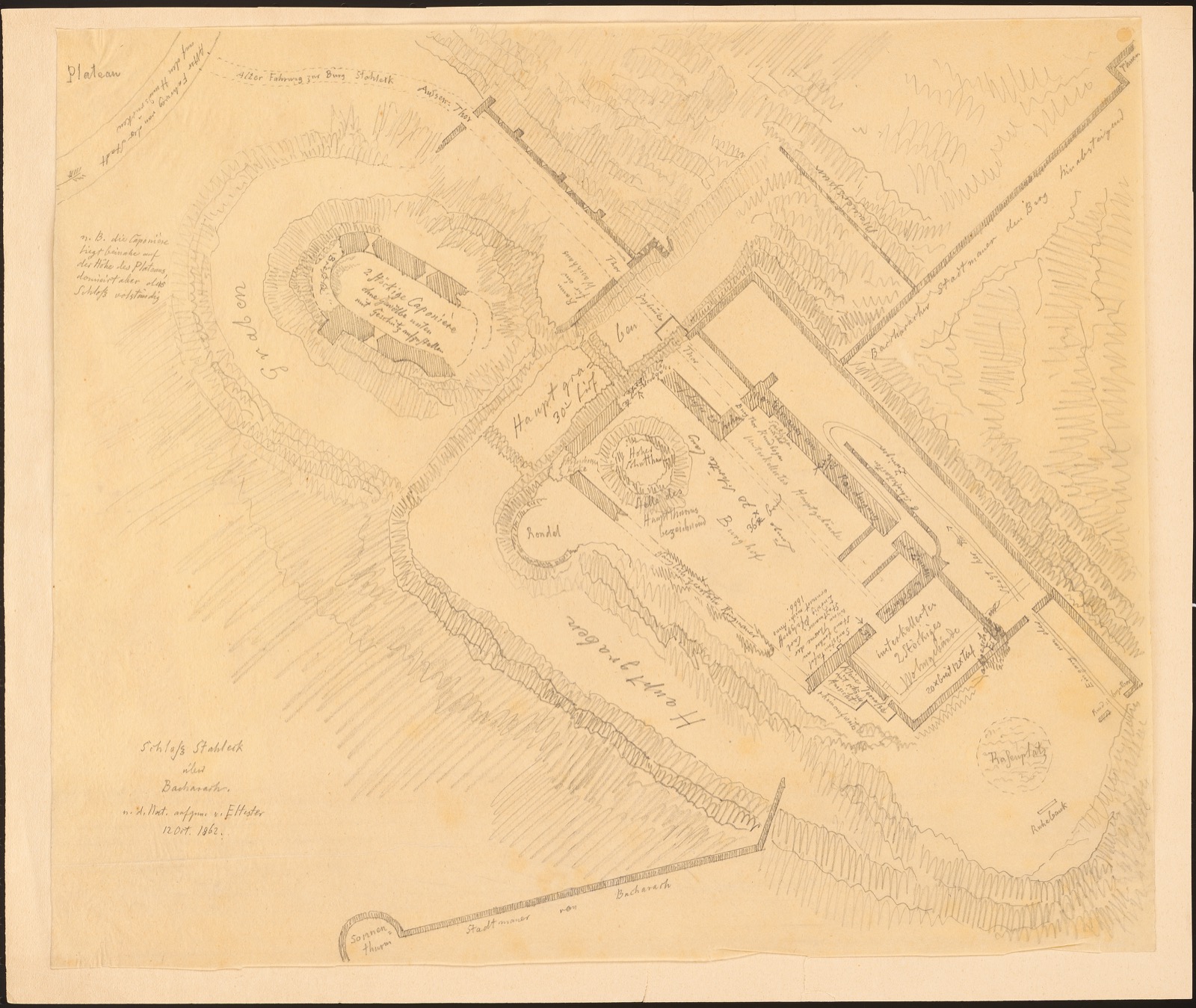
Burg Stahleck, Bacharach: Grundriss der gesamten Burganlage
· Museum of Architecture at Berlin Institute of Technology (via Europeana)
CC0 (no rights reserved)
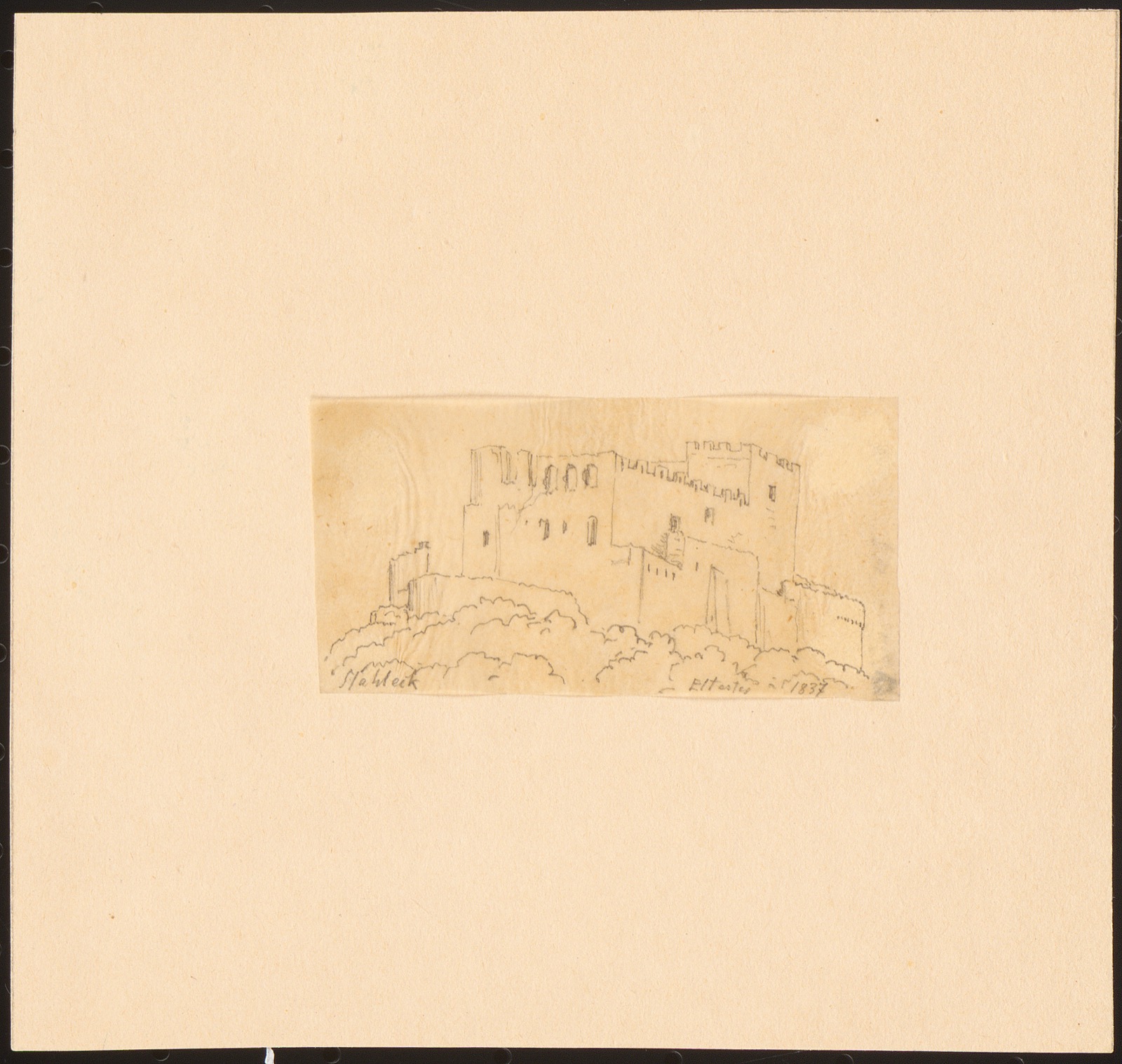
Burg Stahleck, Bacharach: Perspektivische Ansicht der Burgruine
· Museum of Architecture at Berlin Institute of Technology (via Europeana)
CC0 (no rights reserved)


