
Germany · Ruin
Calenberg Castle
Burg Calenberg
Calenberg Castle is a medieval lowland water castle on the chalk-marl Calenberg hill near Schulenburg, built in 1292 and converted into a gun-era fortress in the early 16th century. As a fortress it featured a long curtain wall, a three-storey battery tower and a broad flooded moat. It was slighted in the late 17th century and today survives as a ruin with high ramparts and underground vaults.
Its prime
1610
Today
Ruin
As it stood in 1610
What Calenberg Castle looked like in its prime.
The site is a low, rounded chalk-marl hill rising from flat river meadows, with thick, high earthen and masonry ramparts faced in pale chalky stone and a band of red brick at the base. A long curtain wall encircles a raised rectangular plateau; the outer slope is cut into chalk marl and stepped, with occasional embrasures and a rectangular gun-slit visible in the facing. Trees grow on and around the ramparts and a compact path runs alongside the wall.
Its story
The story of Calenberg Castle.
Origins and the Saldern Tenure, 1292–1432
Calenberg was built as a water castle in 1292 by the Welf duke Otto the Strict, in the Leine river meadows between two branches of the river, on the chalk-marl hill that gave it its name. The first structure was a three-storey tower on a motte (Turmhügelburg), 14.4 metres square, with a residential wing to the north, commanding the road from Gestorf through the Leine valley to Hildesheim. For lack of funds the dukes enfeoffed it in 1327 to the knight Conrad of Saldern, who was also permitted to found an unfortified town to its south; that settlement, Lauenstadt, never fully developed and by 1613 ranked last among the principality's towns. By 1350 a west wing and a second gate tower had been added, the bailey closed by a curtain wall, and a mill and customs post stood at the Leine bridge by 1363.
The Saldern family had to relinquish the castle to Duke William in 1364, having joined a secret pact with the Bishop of Hildesheim. In 1380 Calenberg withstood a siege by the same bishop; his castle of Nabershausen, near Barnten, was slighted afterwards. From 1371 Calenberg served as seat of the ducal advocates of the Grand Advocacy of Calenberg, and in 1432 it was named a Residenz for one of the Welf dukes.
Fortress of the Welfs, 1519–1636
At the start of the sixteenth century, and before the Hildesheim Diocesan Feud, Duke Eric I had the water castle rebuilt into a modern fortress, by then the stronghold had already given its name to the Welf Principality of Calenberg. A 700-metre wall with eight stone sconces protected the castle square, ringed by a 40-metre moat flooded from the Rössingbach stream, and a three-storey battery tower some 24 metres across, with walls two metres thick and paired gun slits, stood behind the western drawbridge. Armed with seventeen guns, the fortress was better equipped than the principality's own towns of Göttingen and Hanover.
The fortress withstood a three-week siege during the Great Diocesan Feud in 1519. In the Thirty Years' War it was besieged for three weeks by Tilly in 1625 and surrendered only after a mutiny among its own garrison. In 1632 Duke George of Brunswick-Calenberg, fighting on the Swedish side, failed to retake it despite a six-week siege; only after his victory at the Battle of Hessisch-Oldendorf and a further siege did he capture the heavily damaged fortress, in 1633. By 1636, with Swedish help, he had recovered the wider territory for the House of Welf and chose Hanover as his residence.
Prisoner of the Interim, 1549–1552
In 1548 the Catholic Duke Eric II accepted the Augsburg Interim of Emperor Charles V. At the Lutheran synod of Münden in 1549, the reformer Anton Corvinus and Pattensen preacher Walter Hoiker, with 140 other priests, opposed it. On 2 November that year Eric II placed the two in custody at Calenberg to force them and the other clergy to accept the Interim; they were well cared for, able to exchange letters and speak with visitors through an open window. After the Peace of Passau, when the emperor declared the Interim invalid and Eric II had fallen out of favour, both were released on 21 October 1552.
Decline, Slighting and What Remains, 1634–2011
After several divisions of the Welf estates, Calenberg and Göttingen were merged in 1634 into the Principality of Brunswick-Lüneburg-Celle, which became the Electorate of Hanover on gaining electorate status in 1692. From 1648 the manor house was restored as a fortress and served as a garrison, with further repairs between 1656 and 1662; from 1673 it housed a glass factory and later a prison. After the Thirty Years' War it could no longer withstand the range of contemporary artillery and was judged a security risk should it fall into enemy hands; abandoned, it was demolished from 1690 as dilapidated and formally slighted in 1692, its southern rampart levelled and its moats filled; Hanover itself was fortified in consequence.
A demesne established on the Leine's left bank in 1669 became seat of the Amt of Calenberg and its farmlands into the 19th century. After Prussia annexed the Kingdom of Hanover in 1866, Calenberg Castle and its demesne passed into state ownership; a compensation agreement after 1920 returned them to the House of Hanover, and the demesne buildings were sold in 2011, though the farmland remains with the former royal family. Since 1997 the ruin has lain within the Calenberg-Leine Valley Protected Landscape and is a listed architectural heritage monument in Lower Saxony; its ramparts, cellars and battery-tower remains survive, though the tower and its two cellars were closed to the public in mid-2008; bats hibernate in the vaulted cellars beneath the castle's two wings.
Step inside
10 places to explore in 1610.
The record describes 10 distinct spots at Calenberg Castle, including 2 interiors: residential wing (north, interior), underground vaults. Create your own photoreal reconstruction and explore every one, more scenes means more rooms, more angles, and more of the place to stand in.
Build Your Own Castle
Recreate Calenberg Castle with AI to explore it.
The artist rebuilds it as it stood in 1610, a photoreal reconstruction that belongs to you alone. Pay with coins, no subscription needed.
Recreate this castle →Defend this castle →Whose castle
Clans who held Calenberg Castle.
The families that held Calenberg Castle for a decade or more across its history, follow a name to its clan.
Welf
Built by the Welf duke Otto the Strict in 1292; a Welf Residenz from 1432 and namesake of the Principality of Calenberg.
Saldern
Held by the von Saldern family until forced to relinquish the castle to Duke William in 1364.
From the archive
Calenberg Castle on paper: the measured plan and period views.
The survey plan and photographs below are the ground truth this page's reconstructions are checked against, drawn and photographed while the castle was still a working garrison. Every image is public-domain or openly licensed, with its source named.
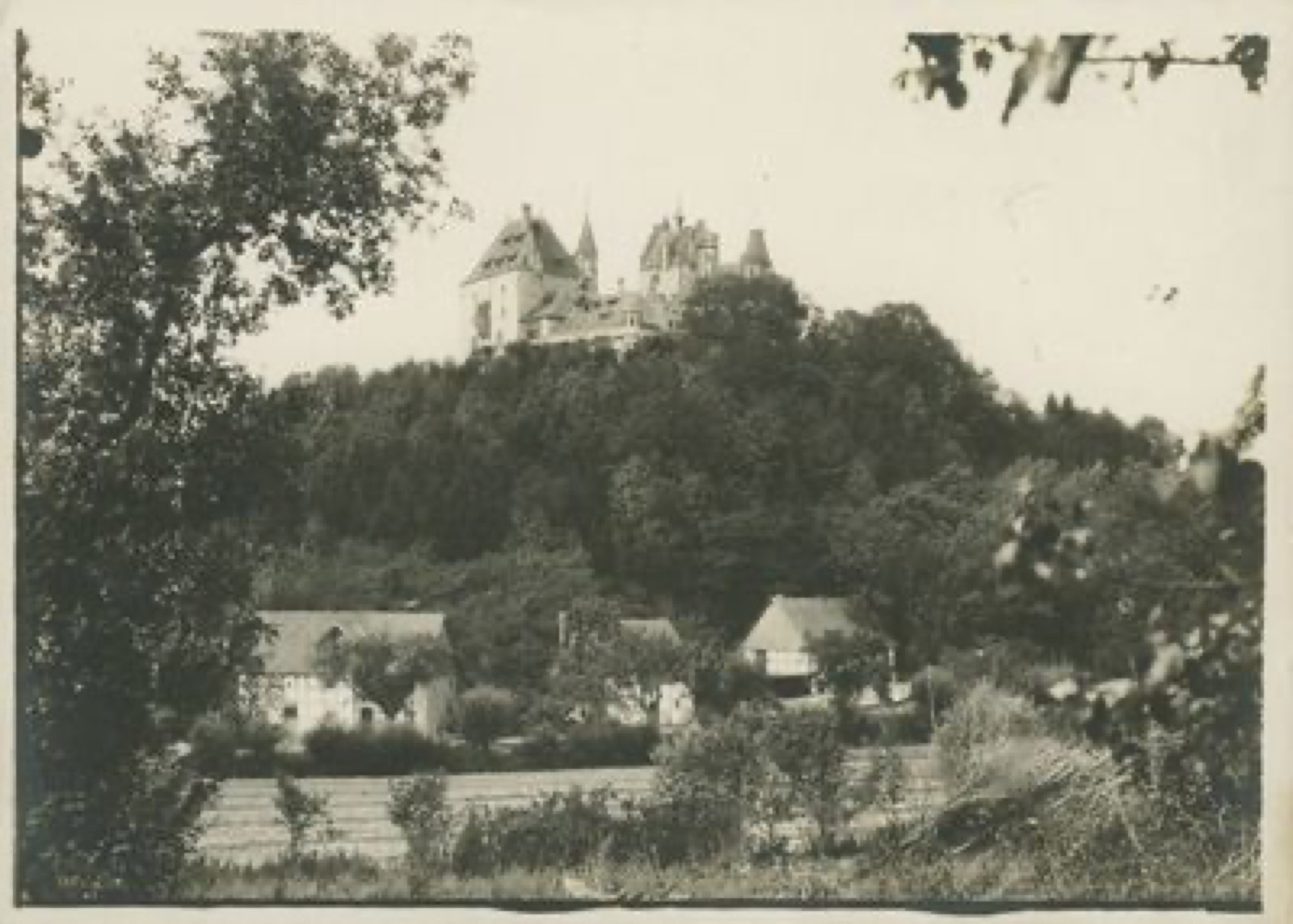
Calenberg, Kreis Warburg
1935 · Kassel University Library (via Europeana)
CC BY-SA


