
Germany · Still standing
Lahneck Castle
Burg Lahneck
Lahneck Castle is a 13th-century medieval fortress in Lahnstein, Rhineland-Palatinate, Germany, sited on a steep rock above the confluence of the Lahn and the Rhine. Built from rough brown masonry with an oblong rectangular plan, it includes a rare pentagonal bergfried and a residential range with slate roofs; the complex remains extant and privately owned.
First raised
1226
Its prime
1245
Today
Still standing
As it stood in 1245
What Lahneck Castle looked like in its prime.
Perched on a steep rocky spur above the Lahn–Rhine confluence, the castle has an oblong rectangular curtain with rough brown stone walls, crenellated parapets and several towers. The dominant feature is a tall pentagonal bergfried of the same rubble masonry with a crenellated top and a projecting wooden oriel; a slate‑roofed residential range with steep gables and multi‑paned windows sits along one side, and a white arched gatehouse fronts the outer approach.
Its story
The story of Lahneck Castle.
Guarding the Lahn for the Archbishop of Mainz, 1220–1245
Archbishop Siegfried III of Eppstein of Mainz began building Lahneck in 1226 to secure his territory at the mouth of the Lahn, where the town of Oberlahnstein and a silver mine had passed to the archbishopric in 1220. Its symmetrical, oblong-rectangular plan is typical of the later castles of the Hohenstaufen period, and its pentagonal bergfried is a shape rare among castle towers. The castle chapel, dedicated to Saint Ulrich of Augsburg, was built in 1245, the same year the knight Embricho of Lahneck took up residence as its first burgrave.
Adolf of Nassau, a Conspiracy and the Templars' Legend, 1298–1332
In 1298 King Adolf of Nassau was a guest at the castle shortly before his death at the Battle of Göllheim against King Albert I of Habsburg. To avenge him, the Burgrave of Lahneck, Friedrich Schilling of Lahnstein, joined a conspiracy against Albert; the castle was stormed in 1309 and Schilling was executed. According to legend, when Pope Clement V ordered the Knights Templar disbanded in 1312, the last twelve Templars took refuge at Lahneck and died fighting the forces of Mainz's Archbishop Peter of Aspelt. In 1332 Pope John XXII granted a 40-day indulgence to those attending Mass in the castle chapel.
Deposing a King and Strengthening the Walls, 1400–1475
In 1400 the four Rhenish prince-electors, meeting at Lahneck, declared King Wenceslaus of Germany deposed; Burgrave Frederick of Nuremberg hosted many of the cities' delegates there alongside the Prince-elector of Mainz. The following day, at Rhens, Rupert, Count Palatine of the Rhine, was elected the new King of the Romans. In 1475 the Archbishop of Mainz, Diether of Isenburg, had the castle strengthened with a second ring of walls following the Mainz Bishops' Feud with his rival, Archbishop Adolph II of Nassau.
War Damage, Goethe's Verse and the Sale to Private Hands, 1632–1850
Swedish and Imperial troops badly damaged the castle in the Thirty Years' War, in 1632 and again in 1636. In 1774, passing along the Lahn, Johann Wolfgang von Goethe was moved by the sight of the castle to write the poem Geistesgruß. In the German Mediatisation of 1803, when the Archbishopric of Mainz lost its secular territories, Lahneck was granted to the Duchy of Nassau; it was sold in 1850 to the Scottish railway entrepreneur Edward Moriarty and has remained in private hands since.
Idilia Dubb's Legend and the Mischke Family, 1851–2002
Local legend remembers Idilia Dubb, a 17-year-old British visitor who, on holiday in June 1851, climbed the abandoned tower's staircase; it collapsed behind her, and the tower's high enclosing wall meant no one heard her calls. She left a diary, its last entry dated 19 June; both diary and remains were found only years later, during a restoration of the tower.
During the ownership of Earl Kleist-Tychow, a more-than-life-sized portrait of Queen Victoria was presented and can still be seen at the castle. The Magdeburg industrialist Hauswald then owned it from 1893 until 1907, when Imperial Admiral Robert Mischke, later commander of the battlecruiser SMS Von der Tann, purchased Lahneck; it has remained in his family's ownership since. Since 2002 the castle has formed part of the UNESCO World Heritage Site of the Upper Middle Rhine Valley; it is a protected Kulturdenkmal, open for guided tours between April and All Saints' Day, with rooms on its first floor still occasionally inhabited.
Step inside
8 places to explore in 1245.
The record describes 8 distinct spots at Lahneck Castle, including 3 interiors: high tower stairwell (interior), castle chapel of saint ulrich (interior), burgrave's residential range (interior). Create your own photoreal reconstruction and explore every one, more scenes means more rooms, more angles, and more of the place to stand in.
Build Your Own Castle
Recreate Lahneck Castle with AI to explore it.
The artist rebuilds it as it stood in 1245, a photoreal reconstruction that belongs to you alone. Pay with coins, no subscription needed.
Recreate this castle →Defend this castle →Whose castle
Clans who held Lahneck Castle.
The families that held Lahneck Castle for a decade or more across its history, follow a name to its clan.
Kleist-Tychow
Private owners of Lahneck before 1907; presented the castle's portrait of Queen Victoria.
Mischke
Purchased in 1907 by Imperial Admiral Robert Mischke; owned by his family ever since.
From the archive
Lahneck Castle on paper: the measured plan and period views.
The survey plan and photographs below are the ground truth this page's reconstructions are checked against, drawn and photographed while the castle was still a working garrison. Every image is public-domain or openly licensed, with its source named.
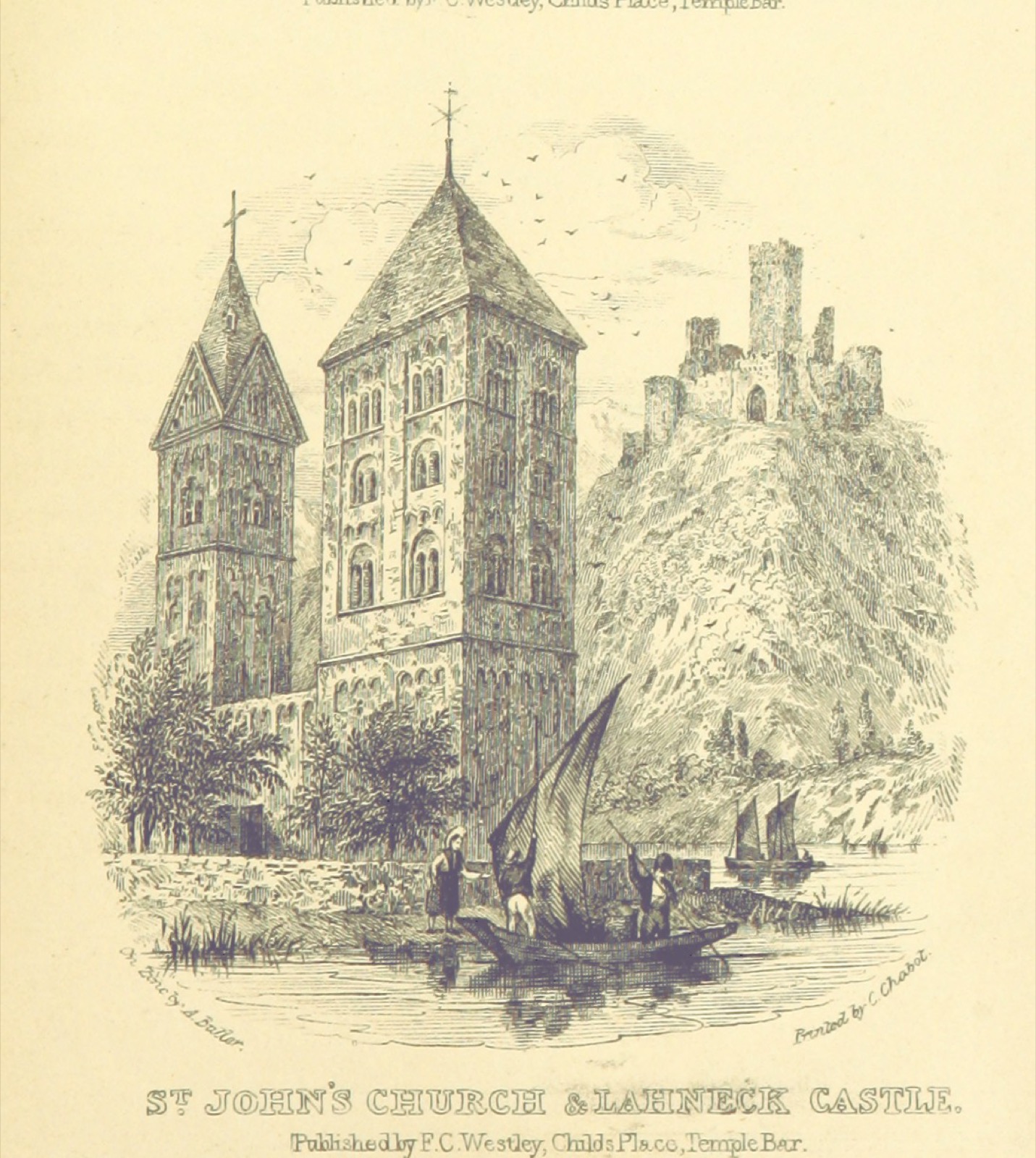
Lahneck Castle from "The Rhine: legends, traditions, history, from Cologne to Mainz".
1839 · The British Library (via Europeana)
Public domain


