
Germany · Restored
Dankwarderode Castle
Burg Dankwarderode
Dankwarderode Castle is a Saxon lowland castle on the Burgplatz in Braunschweig that served as the Pfalz of Duke Henry the Lion. Built in the late 12th century, the surviving palas and keep were rebuilt in the 19th century and today form part of the Herzog Anton Ulrich Museum's medieval display. The castle stands adjacent to Brunswick Cathedral on what was originally an island in the river Oker.
First raised
1963
Its prime
1175
Today
Restored
As it stood in 1175
What Dankwarderode Castle looked like in its prime.
Compact Romanesque palas of light-coloured sandstone with a steep red-tile roof and a triangular gable facing the square; paired round-arched windows and a small projecting balcony punctuate the main façade. A prominent external stair with a series of blind arches climbs to the upper level, set into a long curtain of similarly dressed masonry. A cylindrical tower with a conical/pointed roof rises behind the roofline. The castle sits on an island beside the cathedral and faces an open castle square.
Its story
The story of Dankwarderode Castle.
A Brunonian Stronghold on the Oker, before the 12th Century
A fortification of the Brunonian counts already stood on a natural island in the river Oker by the eleventh century, first recorded by name in 1134 as castrum Tanquarderoth; excavation has traced a settlement layer on the site back to the second half of the ninth century, and a rampart was raised there in the tenth. No secure conclusions survive about who built that roughly 140-by-120-metre ringwork or what it was originally for. A fire, probably before 1030, was followed by reinforcement of the rampart with a facing wall of stone, and in the second half of the eleventh century that facing was replaced by a mortared stone wall, work credited to the Brunonian counts, whose male line died out in 1090 and female line in 1117. The site passed, through the last Brunonian, Gertrud, and her daughter Richenza, to Lothar of Supplinburg, whose grandson Henry the Lion built Dankwarderode in its place. No Duke Dankward, the name's apparent namesake, is historically attested.
Henry the Lion's Pfalz and the Welf Partition, 1160–1269
Henry the Lion built Dankwarderode about 1160 to 1175 as his Pfalz, modelled on the imperial palace at Goslar: a two-storey palas with a double chapel, its ground floor warmed, like Goslar's hall, by underfloor heating. A doorway on the upper floor opened directly into the north transept of Brunswick Cathedral, begun alongside the castle in 1173.
Fire destroyed Dankwarderode and much of the old town in 1252. The Brunswick court in time moved its residence to Wolfenbüttel; after the Duchy of Brunswick was first divided in 1267/69, the castle stayed the joint property of every Welf line. It lost its military significance early, closed in on every side as the city grew up around it.
Fire, Decay and Rebuilding under the Dukes, 16th Century–1878
The palas burned down in the first half of the sixteenth century and was not repaired, both because relations between the city and the House of Welf were strained and because no sub-principality besides Brunswick-Wolfenbüttel would share the cost. Its remaining walls were torn down in the 1580s, and between 1616 and 1640 the palas was replaced by a new, south-extended building in the Renaissance style. Between 1635 and 1643 the building, then also called the Mosthaus, was the seat of Duke August the Younger, before he too moved the residence to Wolfenbüttel.
Duke Anton Ulrich added extensions in 1690–1700; the castle chapel of St Georg and St Gertrud was pulled down after a fire in the late seventeenth century, and the castle gate followed in 1797/98, when the moat was also culverted underground to clear ground for new building. Between 1763 and 1765 the palas's southern part was rebuilt for Ferdinand, brother of Duke Karl I, as the so-called Ferdinandsbau. From 1808 the palas served as a barracks. A fire on the night of 21 July 1873 prompted a plan to demolish it for road-building; public protest stopped the demolition, and the city bought the ruin, with the help of a state grant, in 1878.
Ludwig Winter's Reconstruction and the Medieval Museum, 1887–Present
Braunschweig's city building officer Ludwig Winter rebuilt the palas between 1887 and 1906, funded by the regent Prince Albrecht and based on intensive archaeological investigation, substantially recovering the medieval footprint. Only the basement's column arcade and the palas's rear wall on Münzstraße, with the Romanesque windows of the Knights' Hall, are original medieval fabric; the rest, including the well-known facade facing the Burgplatz, is Historicist reconstruction that most likely never existed in that form.
An explosive bomb scored a direct hit during the Second World War, destroying much of the Knights' Hall's roof structure and its historicist painted decoration; the damage was only provisionally repaired afterwards. Since 1963 the ground-floor Knappensaal has housed the Herzog Anton Ulrich Museum's medieval collection, including the original Brunswick Lion statue raised on the neighbouring Burgplatz in the twelfth century and the imperial cloak of Otto IV. The Knights' Hall upstairs was reconstructed in detail in the early 1990s and is now used for events and temporary exhibitions rather than regular public viewing. The site is run by the 3Landesmuseen network and listed as an architectural heritage monument.
Step inside
7 places to explore in 1175.
The record describes 7 distinct spots at Dankwarderode Castle, including 2 interiors: palas great hall (interior), ground-floor chamber beneath the palas. Create your own photoreal reconstruction and explore every one, more scenes means more rooms, more angles, and more of the place to stand in.
Build Your Own Castle
Recreate Dankwarderode Castle with AI to explore it.
The artist rebuilds it as it stood in 1175, a photoreal reconstruction that belongs to you alone. Pay with coins, no subscription needed.
Recreate this castle →Defend this castle →Whose castle
Clans who held Dankwarderode Castle.
The families that held Dankwarderode Castle for a decade or more across its history, follow a name to its clan.
Brunswick
Residence of the Brunswick dukes for centuries, from Henry the Lion's 12th-century Pfalz.
From the archive
Dankwarderode Castle on paper: the measured plan and period views.
The survey plan and photographs below are the ground truth this page's reconstructions are checked against, drawn and photographed while the castle was still a working garrison. Every image is public-domain or openly licensed, with its source named.
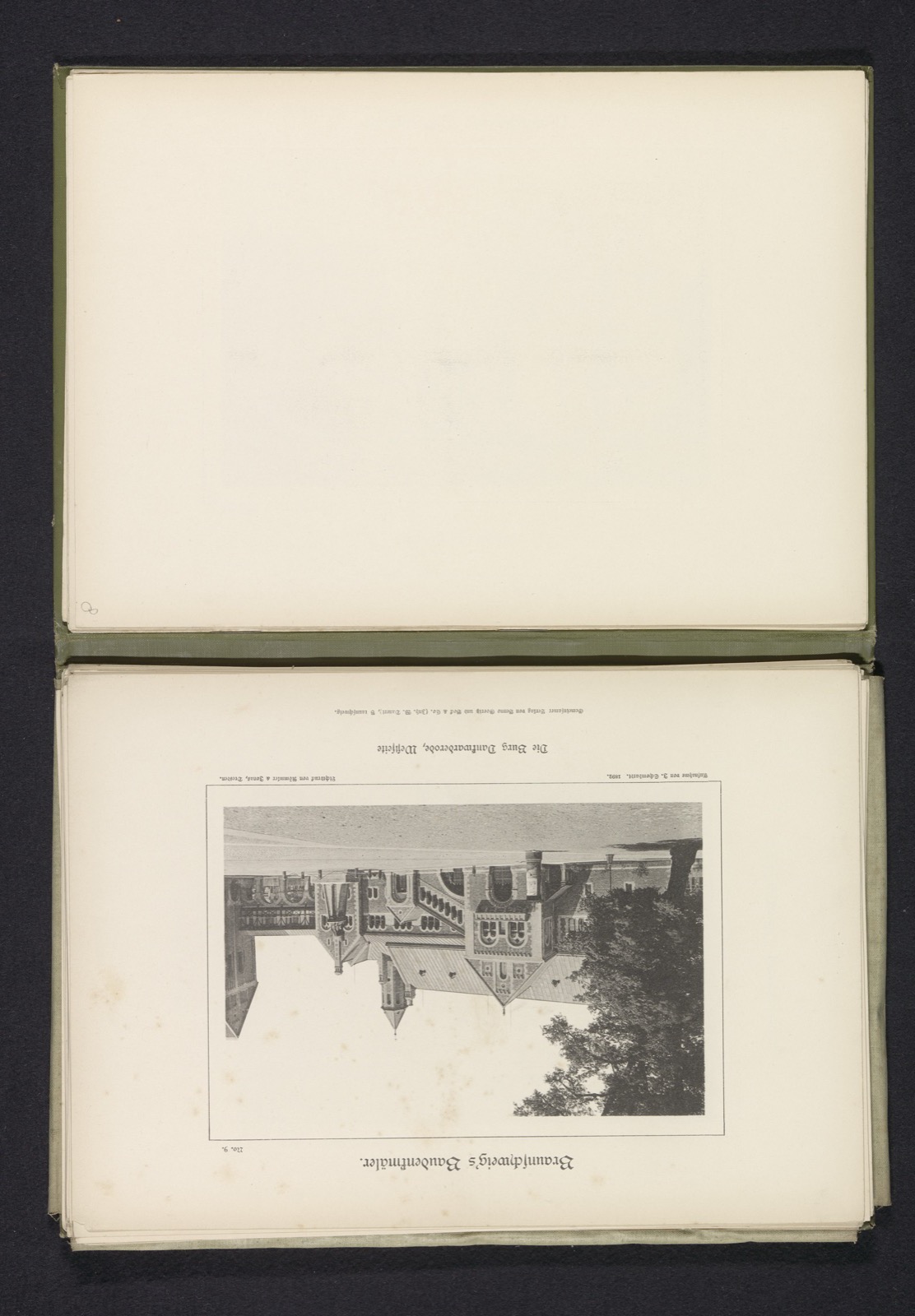
Westelijke gevel van het kasteel Dankwarderode te Braunschweig
1892 · Rijksmuseum (via Europeana)
Public domain


