
Germany · Still standing
Meersburg Castle
Burg Meersburg
Meersburg Castle (Burg Meersburg or Alte Burg) is a medieval castle on a rocky outcrop above the Lower City of Meersburg on Lake Constance, long used as the residence of the Prince-Bishops of Constance and later a private house and museum. Portions remain inhabited and open to visitors; a Medieval Museum was established there in the 19th century. The central keep, known as the Dagobertturm, is the castle's defining feature.
Its prime
1520
Today
Still standing
As it stood in 1520
What Meersburg Castle looked like in its prime.
Perched on a rocky outcrop above Lake Constance, the castle reads as a compact complex of pale, plastered stone ranges and steep red-brown tiled roofs clustered around a tall square keep with a crow-stepped gable. The Dagobertturm’s base shows very large, roughly squared masonry blocks; its upper stages have narrow slit windows. Low curtain walls and short crenellated stretches connect the residential ranges; the castle sits level with the town behind a band of trees and overlooks the colorful lakeside houses below.
Its story
The story of Meersburg Castle.
Two Theories of Origin and the Bishopric's Fief, 630–1268
Meersburg Castle, the Alte Burg above Lake Constance, is considered one of the oldest inhabited castles in Germany. One tradition dates its central keep, the Dagobertturm, to 630, when the Merovingian king Dagobert I is recorded working in the region on the Christianisation of the Alamanni, a claim resting on a source of 1548 and championed by the nineteenth-century castle-owner Joseph von Lassberg. A rival theory places construction in the early twelfth century, noting that no other castles are recorded as founded around Lake Constance in the seventh century, against many in the twelfth and early thirteenth; the site is first reliably documented as 'Merdesburch' in 1147, though a man styled 'de Merdesburch' is attested as a witness as early as 1113.
In the traditional account, from 730 until 911 the Meersburg was a Carolingian castle owned by the Counts of Linzgau and administered by the Counts of Buchhorn; after the Buchhorn line died out it would have passed to the Counts of Welf, whose contract with the Bishopric of Constance promised the castle to the bishops if the count died without a male heir. The Hohenstaufens held it for a time (Frederick II kept Holy Week there in 1213 and granted Meersburg its weekly market right in 1233), and Conrad IV, deposed shortly before his death in 1254, entrusted his young son Conradin to the castle's keeping; Conradin later campaigned in Italy, where he was captured and executed. The castle passed entirely to the Bishopric of Constance in 1268.
The Bishops' Election Siege and the Town's Revolt, 1334–1457
Even as a bishop's residence, Meersburg saw fighting. In 1334, after a disputed election, Baron Nikolaus of Kenzingen was chosen bishop by the Pope's supporters while Albrecht of Hohenberg was the Emperor's candidate; Nikolaus barricaded himself in the castle for fourteen weeks while an Imperial army under Emperor Louis IV besieged it. Cannon were reportedly used for the first time on German soil during the siege, but the Imperial troops could not take the castle; when Duke Otto of Austria asked for help against the Bohemians, Louis abandoned the siege at the end of August and confirmed Nikolaus as bishop. Albrecht was compensated with the Bishopric of Würzburg in 1345.
Under Bishop Heinrich IV of Hewen, appointed in 1436, friction between Meersburg's bishops and the town turned to open conflict: after a riot the town was fined 4,000 florins for breaching the peace on castle ground, and when it later sought Free Imperial City status the inhabitants stormed and captured the castle in 1457. Heinrich besieged the town in return; a compromise brokered by Sigismund of Austria, Constance and Zürich saw him withdraw, but he attacked again shortly after, caught the citizens off guard, executed the rebellion's leaders and stripped the town of its rights.
Hohenlandenberg's Residence to the Secularization, 1526–1877
The tower's crow-stepped gable was added under Bishop Hugo von Hohenlandenberg, who moved his residence to Meersburg in 1526 after a conflict with the city of Constance; the castle served for a time as the bishops' seat, until they built the New Castle at Meersburg in the eighteenth century. In 1647, during the Thirty Years' War, Swedish troops set its roof timbers alight, though the damage went no further. After 1750 the old castle served only administrative purposes for the town.
Following the Secularization, Meersburg passed to the Grand Duchy of Baden, which sold it to a private buyer in 1838: the collector Joseph von Lassberg and his wife, Baroness Maria Anna von Droste-Hülshoff. In 1841 her sister, the poet Annette von Droste-Hülshoff, moved into the castle, where she spent much of her last eight years and died on 24 May 1848. After Lassberg's death the castle passed to his heirs, who could not afford its upkeep and sold it in 1877 to the Munich collector Carl Mayer von Mayerfels, who established a Medieval Museum there.
The Mayerfels Museum and Family Ownership, 1877–2018
Mayer von Mayerfels opened his museum to visitors the year after buying the castle; ownership passed to his daughter in 1910 and then to his granddaughter Maria in 1939, whose husband Hubert Naeßl founded the museum now on site. Hubert's sister, Ottilie Naeßl, later inherited the castle, and in 1977 her adopted son, Vinzenz Naeßl-Doms, took it over; his family has held it since his death in 2018. The castle remains in private ownership, carries listed status as a Kulturdenkmal, and combines a family residence with the museum, standing beside the eighteenth-century New Castle that replaced it as the bishops' seat.
Step inside
7 places to explore in 1520.
The record describes 7 distinct spots at Meersburg Castle, including 1 interior: medieval museum room (former residential chamber). Create your own photoreal reconstruction and explore every one, more scenes means more rooms, more angles, and more of the place to stand in.
Build Your Own Castle
Recreate Meersburg Castle with AI to explore it.
The artist rebuilds it as it stood in 1520, a photoreal reconstruction that belongs to you alone. Pay with coins, no subscription needed.
Recreate this castle →Defend this castle →Whose castle
Clans who held Meersburg Castle.
The families that held Meersburg Castle for a decade or more across its history, follow a name to its clan.
Linzgau
Owned by the Counts of Linzgau from 730 to 911, administered by the Counts of Buchhorn.
From the archive
Meersburg Castle on paper: the measured plan and period views.
The survey plan and photographs below are the ground truth this page's reconstructions are checked against, drawn and photographed while the castle was still a working garrison. Every image is public-domain or openly licensed, with its source named.
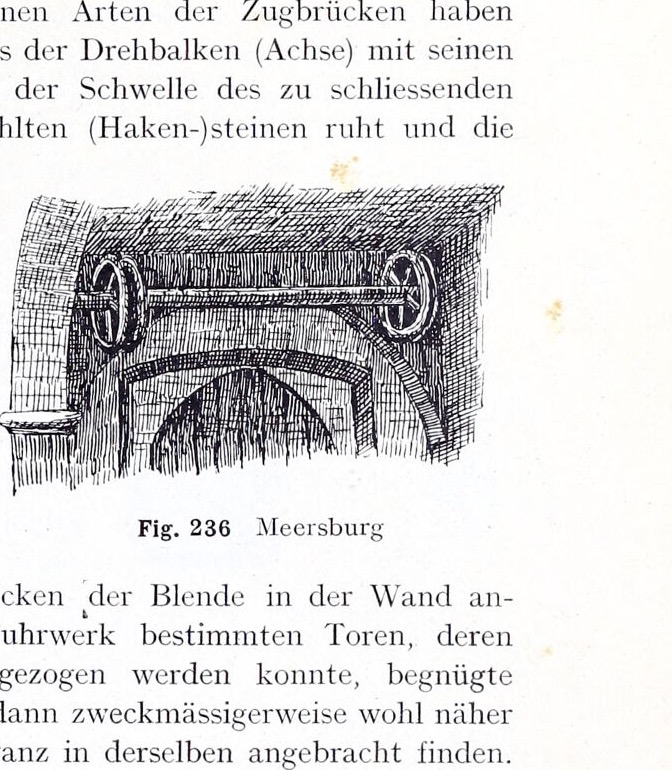
Fig. 236 Meersburg
1912 · Otto Piper, Burgenkunde (1912)
Public domain


