Germany · Restored
Hambach Castle
Hambacher Schloss
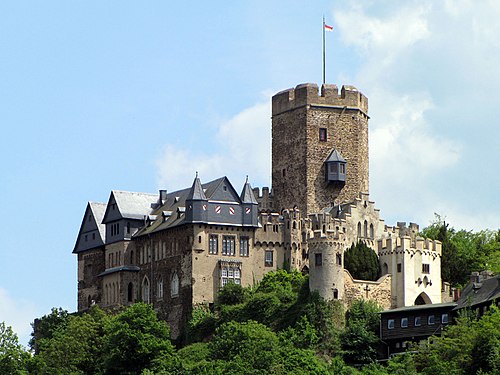
Hambach Castle (Hambacher Schloss) is a hilltop castle on the Schlossberg above Neustadt an der Weinstraße in Rhineland-Palatinate, Germany. It served as an episcopal stronghold and residence of the Bishops of Speyer through the late Middle Ages and later became the symbolic site of the 1832 Hambacher Fest; today it is a restored national memorial, museum and convention centre.
First raised
1100
Its prime
1475
Today
Restored
As it stood in 1475
What Hambach Castle looked like in its prime.
Perched on the Schlossberg (325 m) above surrounding sweet chestnut woods, the medieval castle presents a ringwork of stone curtain and an outer ring wall encircling a compact ensemble of multi-storey residential ranges and a chapel. Roofs are predominantly steeply pitched; masonry is exposed stone. The complex occupies a raised summit terrace with an enclosed central courtyard and an approach track climbing through the forest. In its prime (c.1475) the curtain walls, chapel roof and residential ranges stood intact and occupied.
Its story
The story of Hambach Castle.
An Episcopal Stronghold, 1090–1414
Archaeological finds show the hill was in use in late Roman times, and a refuge castle stood here in the late Carolingian and Ottonian periods; portions of it survive under the outer ring wall. Probably in the first half of the 11th century a new castle called Kästenburg ("chestnut castle" in Palatinate dialect, after the sweet chestnut forests around it) was built within the older enclosure. Between 1090 and 1104 Bishop Johann I of Speyer signed the estate, together with Castle Meistersel, over to the Bishopric of Speyer, which held it until the end of the 18th century. Standing over the trade roads and the Palatinate stretch of the Way of St James below, the estate served both as a protection castle and as a robber-baron castle.
The castle was said to be one of the Bishopric's most important properties in the late Middle Ages, an importance indicated by the many bishops' residencies there from 1180. Its earliest resident knights served the Empire rather than the church; Burkhard of Kästenburg is recorded in imperial service from 1154 to 1186, his brother Trushard from 1178 to 1201. Later houses of Burgmannen followed: the ministerial family Schnittlauch of Kästenburg from 1256, the Earls of Zweibrücken from 1284 and the Earls of Veldenz from 1311. Building continued through the 13th century, and Bishop Nikolaus I was consecrated in the castle chapel on 12 July 1388; the castle held the Speyer episcopal archive at the end of the 14th century. Its standing declined after 1414, one reason being the bishops' new residence at Hanhofen.
War and Fire, 1525–1581
During the German Peasants' War in 1525 the Kästenburg was occupied and looted, though not destroyed, by the Nußdorf peasant band. In 1552 it was conquered and burned by troops of the margrave and mercenary leader Albrecht Alcibiades of Brandenburg-Kulmbach, after the Bishopric refused him a tribute of 150,000 gulden. Bishop Marquard of Speyer, in office from 1560 to 1581, arranged only a provisional rebuilding of the residential quarters and made the ruin the seat of a forester.
Destruction of 1688 and the Bavarian Rebuild
The castle survived the Thirty Years' War undamaged, but in September 1688, during the War of the Palatine Succession, French soldiers destroyed the abandoned fortress. It received another provisional restoration between 1701 and 1703. In 1797 it was declared French state property; after the Congress of Vienna in 1816 the ruin passed, with the rest of the left-bank Palatinate, to the Kingdom of Bavaria. Citizens of Neustadt then gave the ruined estate to the Bavarian king Maximilian II as a wedding present, which is why the castle is also known colloquially as the "Maxburg". Bavaria began rebuilding it in neo-Gothic style in 1844, to plans by August von Voit.
The Hambacher Fest, 1832
In 1832, while still a ruin, the castle became the site of the Hambacher Fest, a gathering of Palatinate citizens protesting the repressive Bavarian administration in place since 1816 and its withdrawal of rights granted under French revolutionary rule between 1797 and 1815. The gathering made Hambach Castle a symbol of the German democracy movement, an association it has carried ever since.
From District Property to National Memorial, 1969–2007
The castle was completely restored ahead of the 150th anniversary of the Hambacher Fest in 1982, at a cost of around 12 million Deutschmarks, and was closed to visitors for a year during further renovation in 2006–07 before the 175th anniversary. It is now a national memorial, museum and convention centre drawing about 200,000 visitors a year, and hosts events for the state of Rhineland-Palatinate, the district of Bad Dürkheim and the city of Neustadt an der Weinstraße; US President Ronald Reagan visited in May 1985 to deliver a speech there titled, in translation, "to the youth of the world". Ownership passed to the newly created district of Bad Dürkheim in 1969; since 2002 the castle has belonged to a charitable trust of the state of Rhineland-Palatinate, the Bezirksverband Pfalz, the district of Bad Dürkheim and the city of Neustadt, backed financially by the federal government. It is listed as a cultural heritage monument in Rhineland-Palatinate.
Step inside
6 places to explore in 1475.
The record describes 6 distinct spots at Hambach Castle, including 1 interior: castle chapel interior. Create your own photoreal reconstruction and explore every one, more scenes means more rooms, more angles, and more of the place to stand in.
Build Your Own Castle
Recreate Hambach Castle with AI to explore it.
The artist rebuilds it as it stood in 1475, a photoreal reconstruction that belongs to you alone. Pay with coins, no subscription needed.
Recreate this castle →Defend this castle →From the archive
Hambach Castle on paper: the measured plan and period views.
The survey plan and photographs below are the ground truth this page's reconstructions are checked against, drawn and photographed while the castle was still a working garrison. Every image is public-domain or openly licensed, with its source named.
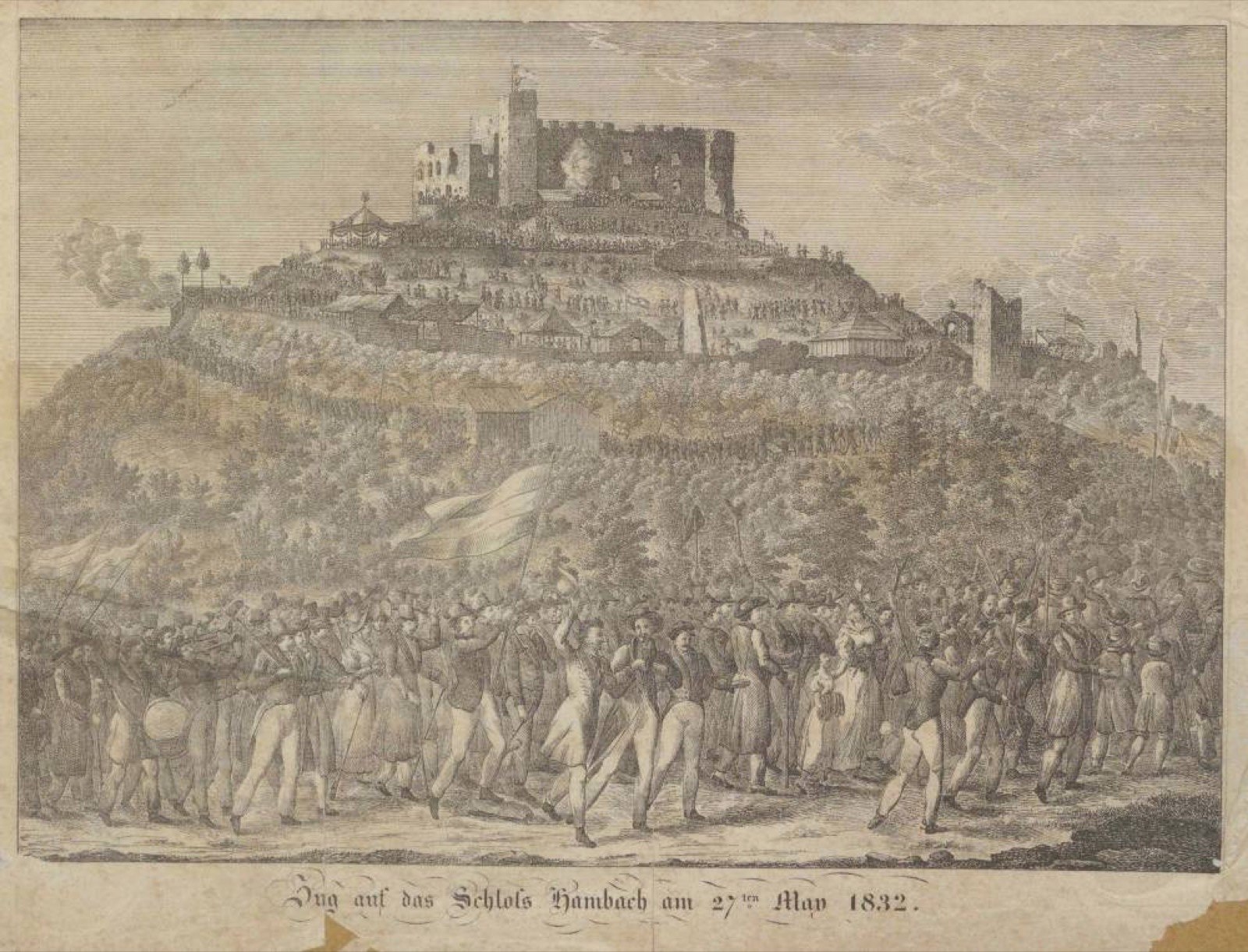
"Zug auf das Schloss Hambach am 27ten May 1832"
· State Archives of Baden-Württemberg (via Europeana)
CC BY
![[Sistema de fortificações entre Neustatt, o castelo de Hambach e Speyerdorf, na Baviera], Hambach Castle](/heritage/hambach-castle/map-euro-1.jpg)
[Sistema de fortificações entre Neustatt, o castelo de Hambach e Speyerdorf, na Baviera]
1701 · National Library of Portugal (via Europeana)
Public domain
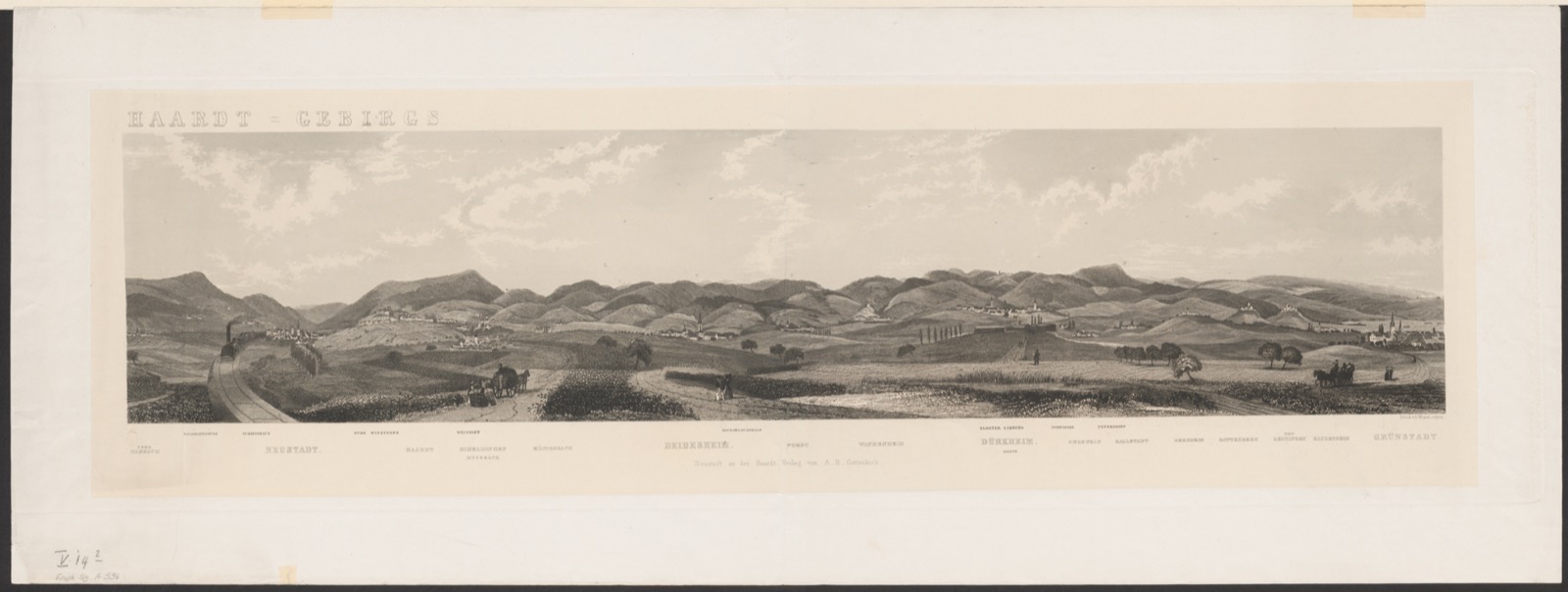
Panorama des Haardt-Gebirges
· Heidelberg University Library (via Europeana)
Public domain
Nearby