
Germany · Ruin
Rudelsburg
The Rudelsburg is a medieval hill castle ruin on a steep limestone ridge above the River Saale in Saxony-Anhalt, Germany. Built in the Middle Ages by the Bishop of Naumburg, it comprised an inner (central) keep, an outer keep and surrounding curtain walls and served to secure the Saale trade route before being destroyed in the Thirty Years' War.
Its prime
1150
Today
Ruin
As it stood in 1150
What Rudelsburg looked like in its prime.
Perched on a steep, layered shell-limestone escarpment 85 metres above the Saale, the castle forms a compact plan of broad, pale-grey curtain walls enclosing a tall, square central keep with a high, pitched roof and crenellated wall-walk. To the east a rounded outer keep projects from the curtain; narrow window slits and small rectangular openings pierce the masonry. The rocky cliff falls away directly beneath the walls; wooded slopes and fields spread below.
Its story
The story of Rudelsburg.
The Rudelsburg was established in 1050 as a border fortification by the Bishop of Naumburg, securing trade routes such as the Via Regia through the Saale valley, and was extended around 1150 with central and outer wards. It became a point of conflict between the bishops of Naumburg and the Margraves of Meissen of the House of Wettin; Margrave Heinrich III received the castle from the bishop in 1238 as recompense for services to the church and installed families of the service nobility there.
The Schenk family of Saaleck, of the House of Vargula, are named as masters of the citadel in 1383, and a Wettin loan certificate of 1441 records the brothers Rudolf, Günther and Heinrich von Bünau as owners, apparently holding no land beyond that on which the castle stood. In 1581 the von Bünaus sold the Rudelsburg to Hans Georg von Osterhausen to cover their debts. The castle was destroyed in the Thirty Years' War and fell into disrepair.
The ruin, a Romanesque bergfried some 20 metres high under its stone pyramid roof, with a great hall and encircling walls above the cliff over the Saale, became a popular destination in the early 19th century with the romanticisation of mountains and the rise of hiking. From 1855 it achieved national renown as the annual meeting place of the Kösener Senioren-Convents-Verband, the oldest union of German-speaking student fraternities.
Step inside
8 places to explore in 1150.
The record describes 8 distinct spots at Rudelsburg, including 3 interiors: inner courtyard, knight's hall and staircase, dungeons and underground vaults. Create your own photoreal reconstruction and explore every one, more scenes means more rooms, more angles, and more of the place to stand in.
Build Your Own Castle
Recreate Rudelsburg with AI to explore it.
The artist rebuilds it as it stood in 1150, a photoreal reconstruction that belongs to you alone. Pay with coins, no subscription needed.
Recreate this castle →Defend this castle →Whose castle
Clans who held Rudelsburg.
The families that held Rudelsburg for a decade or more across its history, follow a name to its clan.
Wettin
Margrave Heinrich III of Meissen, of the House of Wettin, received the castle from the Bishop of Naumburg in 1238; at the Wettin partition of 1485 it fell to the Albertine line.
Schenk
The Schenk family of Saaleck, of the House of Vargula, are named as masters of the citadel in 1383.
Bünau
The von Bünau brothers are recorded as owners from 1441; the family sold the castle in 1581 to cover its debts.
Osterhausen
Hans Georg von Osterhausen bought the Rudelsburg in 1581; the Osterhausens were still maintaining its fabric in 1612.
From the archive
Rudelsburg on paper: the measured plan and period views.
The survey plan and photographs below are the ground truth this page's reconstructions are checked against, drawn and photographed while the castle was still a working garrison. Every image is public-domain or openly licensed, with its source named.
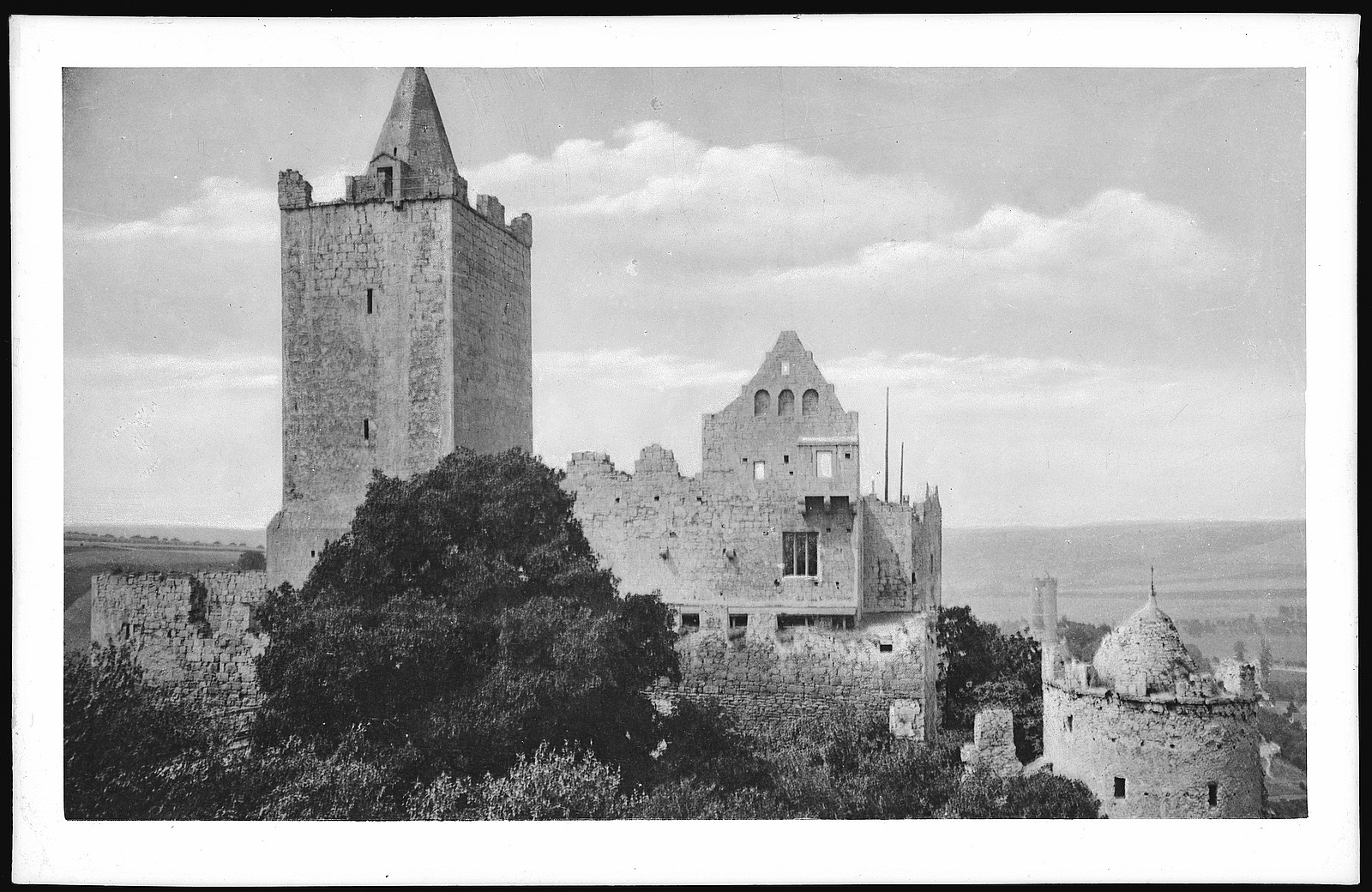
Rudelsburg. Rudelsburg
· Deutsche Fotothek (via Europeana)
Public domain
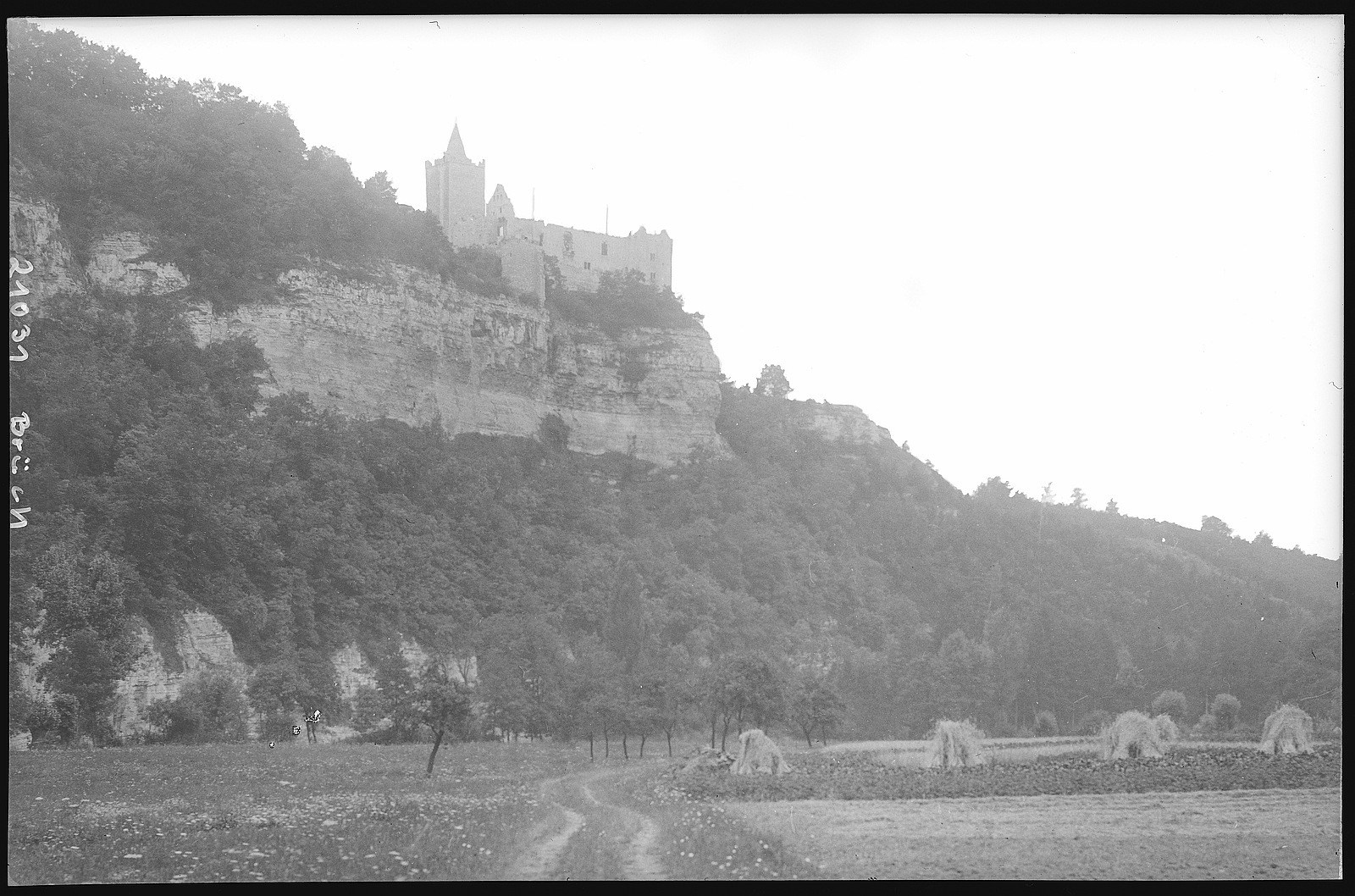
Rudelsburg. Rudelsburg
· Deutsche Fotothek (via Europeana)
Public domain
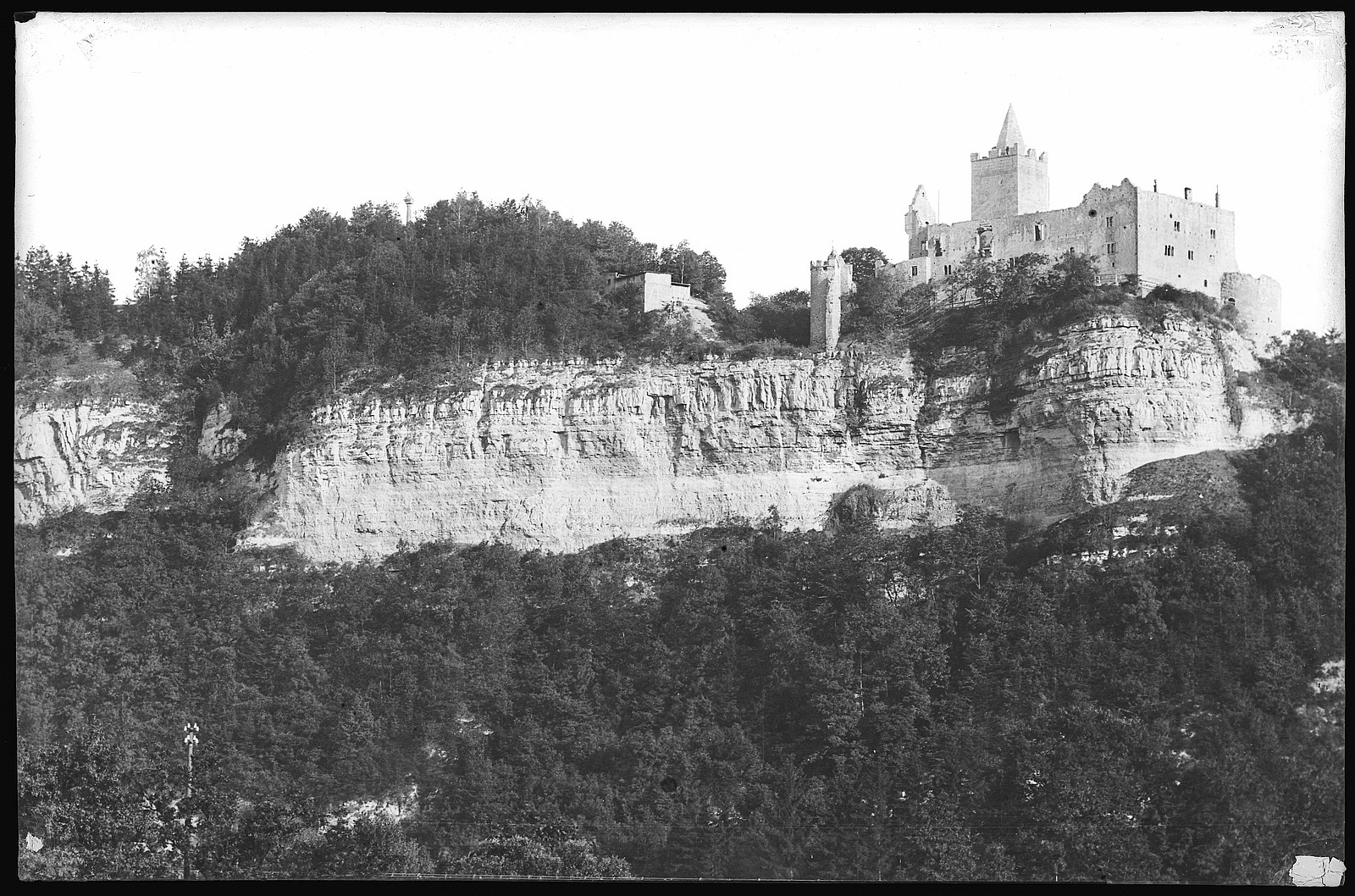
Rudelsburg. Rudelsburg
· Deutsche Fotothek (via Europeana)
Public domain


