Clan Rising
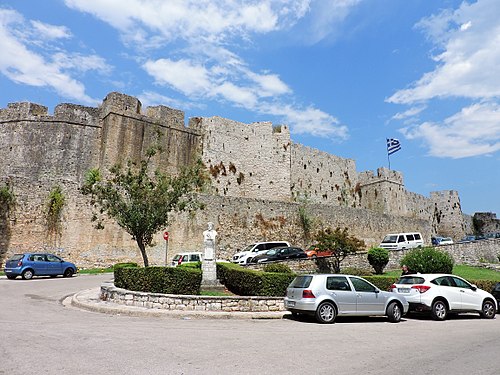
Castle of Didymoteicho today

Greece · Partial ruin

Castle of Didymoteicho

Didymoteicho Fortress is a hilltop citadel in Thrace, Greece, whose extant circuit of Byzantine walls and towers dominates the town and the Erythropotamos valley. The complex preserves a long linear curtain wall with multiple towers and internal rock-cut rooms, and later contains several post-Byzantine churches within the enceinte. It has been fortified and modified from Justinianic times through the late Byzantine period and into Ottoman rule.

Photograph via Wikimedia Commons

Its prime

1303

Today

Partial ruin

As it stood in 1303

What Castle of Didymoteicho looked like in its prime.

A massive hilltop curtain wall and attached round towers of warm brown-grey coursed rubble stone rise directly from a rocky escarpment; occasional horizontal bands of red brick and irregular stone courses are visible. The silhouette is defined by thick, cylindrical towers and long wall faces punctuated by narrow openings and putlog/loophole traces. Vegetation sprouts from joints and from the parapet line. The whole complex hugs the crest of the hill overlooking the town and river below.

Its story

The story of Castle of Didymoteicho.

The Didymoteicho Fortress crowns a hilltop above the town of Didymoteicho in Thrace, fortified since ancient times and refashioned from the Justinianic period through late Byzantine rule and into Ottoman times. Its Byzantine walls survive for a kilometre, reaching twelve metres high, with 24 towers, some bearing the monograms of Byzantine personalities or decorative and symbolic patterns.

The two central Kale Gates are flanked by five-sided towers dating to the Justinianic refurbishment, while the intact west gate facing the Erythropotamos river holds a smaller gate beside a tower with pointed arches and a court added in early Ottoman times. Inside the circuit are carved caves once used as parts of houses, and post-Byzantine churches, Aghia Aikaterini with its tombs, the cathedral of Aghios Athanasios (1834) and the church of the Christ (1846).

The castle carries its share of legend, most famously the myth of the Forty Arches, and Charles XII, King of Sweden, is said to have been imprisoned here by the Turks.

Step inside

7 places to explore in 1303.

The record describes 7 distinct spots at Castle of Didymoteicho, including 1 interior: interior carved caves and domestic rooms. Create your own photoreal reconstruction and explore every one, more scenes means more rooms, more angles, and more of the place to stand in.

Approach from the rocky lower slopeFoot of a large round towerThe Kale Gates (central gate complex)Curtain wall and tower with carved marksInterior carved caves and domestic roomsTop of a preserved tower (vantage over walls)Ramparts overlooking the Erythropotamos River

Build Your Own Castle

Recreate Castle of Didymoteicho with AI to explore it.

The artist rebuilds it as it stood in 1303, a photoreal reconstruction that belongs to you alone. Pay with coins, no subscription needed.

Recreate this castle →Defend this castle →
Questions about Castle of Didymoteicho

What is the history of Castle of Didymoteicho?

Castle of Didymoteicho has a history reaching from ancient fortification through Byzantine and Ottoman rule. Its walls were reconstructed under Justinian I in the 6th century and strengthened under Constantine V in 751. Bulgarian Tsar Kaloyan besieged it in 1206, Byzantine rule returned in 1303, and the fortress fell to the Ottomans by 1361.

What is inside Castle of Didymoteicho?

Inside Castle of Didymoteicho are scattered carved caves once used as parts of houses, along with post-Byzantine churches. These include Aghia Aikaterini with tombs, the Cathedral of Aghios Athanasios dating from 1834, and the church of the Christ dating from 1846. Domestic rooms are also documented within the complex.

Why was Castle of Didymoteicho built, and what was it used for?

Castle of Didymoteicho was built and maintained as a strong hilltop fortress overlooking the town, the Erythropotamos River and the road to Constantinople. Its fortifications were reconstructed and strengthened in successive Byzantine periods, then continued into Ottoman rule. It also later contained houses and churches within its defensive enceinte.

Where is Castle of Didymoteicho?

Castle of Didymoteicho stands on a hilltop above the town of Didymoteicho in Thrace. It overlooks the Erythropotamos valley and river, with the town below. The castle is located in Didymoteicho Municipality.

Was Castle of Didymoteicho ever attacked or besieged?

Castle of Didymoteicho was attacked and besieged several times. Bulgarian Tsar Kaloyan besieged the fortress in 1206 and took it, while the Ottomans defeated Serbian forces near its walls in October 1352. The fortress had fallen to the Ottomans by 1361.

What did Castle of Didymoteicho look like in its prime?

In its prime, Castle of Didymoteicho had a massive Byzantine curtain wall about 1 kilometre long and up to 12 metres high, with 24 towers. Warm brown-grey coursed rubble stone, red-brick bands and narrow openings shaped its exterior. Thick cylindrical towers rose along the rocky hill crest above the town and river.

Is Castle of Didymoteicho still standing, or is it a ruin?

Castle of Didymoteicho is a partial ruin, but substantial parts still stand. Its Byzantine walls survive for about 1 kilometre, with 24 towers, and post-Byzantine buildings remain within the circuit. The fortress was already in a ruinous state by 1848 after inadequate preservation, incursions and damage during Russo-Turkish wars.
All castles of Greece · Castles of Europe · the best castles in Europe · explore the finished reconstructions.