Greece · Restored
Rio Castle
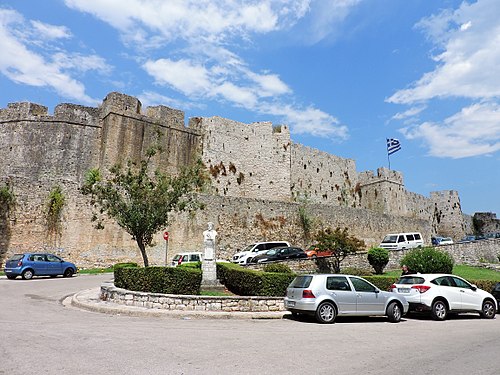
Rio Castle is a seafront fortification on the northern tip of the Rio peninsula guarding the entrance to the Corinthian Gulf. Built on the shoreline with a broad sea-filled moat and linked outer bastions, it retains low curtain walls, rounded towers and internal arcaded service buildings. Today it is a cultural site and tourist attraction.
First raised
1499
Its prime
1690
Today
Restored
As it stood in 1690
What Rio Castle looked like in its prime.
Perched on the peninsula tip at the waterline, the castle presents low, continuous ashlar curtain walls of pale tan stone punctuated by several large rounded bastions and cylindrical sea-facing towers. Its northern wall meets the open sea while the southern side is defended by a broad, sea-filled moat and two triangular outer ravelins linked to the main fort by stone bridges. Inside is an open grassy parade ground and a long arched stone gallery along one side, plus a small chapel building.
Its story
The story of Rio Castle.
Ottoman Sultan Bayezid II built Rio Castle in 1499, within three months, above the ruins of an ancient temple of Poseidon at the north tip of the Rio peninsula. With its twin, Antirrio Castle across the water, it guarded the entrance to the Corinthian Gulf, and the pair were nicknamed the "Little Dardanelles". It was historically known as the Castle of the Morea, opposite its counterpart the Castle of Rumelia.
The fortress changed hands repeatedly. The Genoese under Andrea Doria briefly captured it in 1533 before the Ottomans retook it the same year; in 1687, during the Morean War, it fell to the Venetians under Francesco Morosini, who rebuilt and strengthened it with added towers, giving it its final shape, and built the small chapel of the Life-giving Spring. The Ottomans retook it in 1715 and held it until they surrendered it to the French General Nicolas Joseph Maison.
Between 1831 and 1912 the seafront castle served as a military and then civilian prison, whose inmates were often used by the municipality of Patras for cleaning the streets of Rio. Today, with the Rio-Antirio Bridge alongside and ferry docks on either side, it is used for cultural purposes, especially concerts.
Step inside
9 places to explore in 1690.
The record describes 9 distinct spots at Rio Castle, including 3 interiors: central courtyard (parade ground), long arched gallery / service range, chapel of the life-giving spring (zoodochos pege). Create your own photoreal reconstruction and explore every one, more scenes means more rooms, more angles, and more of the place to stand in.
Build Your Own Castle
Recreate Rio Castle with AI to explore it.
The artist rebuilds it as it stood in 1690, a photoreal reconstruction that belongs to you alone. Pay with coins, no subscription needed.
Recreate this castle →Defend this castle →