Ireland · Partial ruin
Leighlinbridge Castle
Caisleán Leithghlinn an Droichid
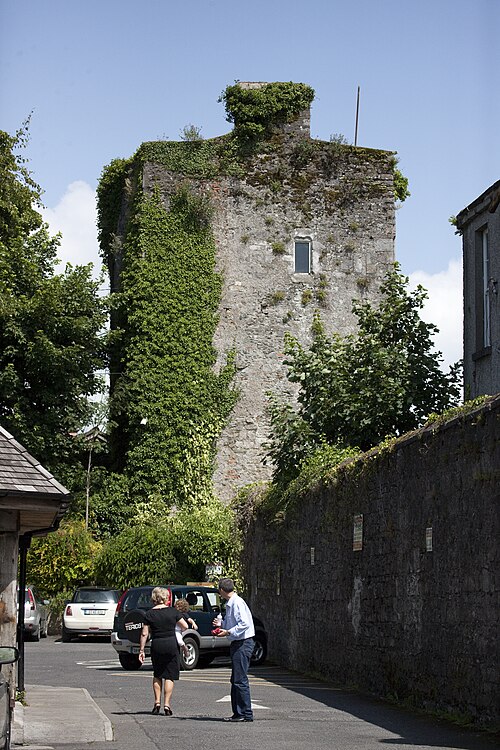
Leighlinbridge Castle, called the Black Castle, is a medieval fortification on the River Barrow in Leighlinbridge, County Carlow, Ireland. Originating as a Norman castle and later converted from a Carmelite friary into a fortified bawn in the mid-16th century, its fabric includes a rectangular tower-house/keep, a surrounding rectangular bawn with artillery openings, and associated outbuildings.
Its prime
1546
Today
Partial ruin
As it stood in 1546
What Leighlinbridge Castle looked like in its prime.
A rectangular limestone bawn roughly 315 by 234 feet encloses a cobbled inner court beside the River Barrow; the curtain wall is thick and punctured by gun-ports and embrasures. At the northwestern corner a tall rectangular three-storey tower-house/keep rises to a crenellated parapet with mural passages; its lowest storey is stone-vaulted. A squat round tower stands in the southwest corner. The bawn meets the river on one side and is defended by a surrounding ditch on the others, with the nine-arched bridge nearby.
Its story
The story of Leighlinbridge Castle.
Leighlinbridge Castle, the Black Castle, stands on the River Barrow in the village of Leighlinbridge, County Carlow. The early castle was built around 1181 for the Normans; another castle, the "White Castle", was built nearby around 1408 by Gerald FitzGerald, 5th Earl of Kildare. In the 1540s a Carmelite friary on the site was converted into a new fort by Edward Bellingham, and in 1604 the castle was granted as socage by the king to George Tuchet, Lord Awdeley.
Modern analysis reads the Black Castle as a three-storey limestone tower house, its lowest storey vaulted, with artillery openings in both the tower and the surrounding rectangular bawn, architecture indicative of a 16th-century building. By the 1840s the structure was already derelict; today a broken tower some 50 feet tall and parts of one side of the enclosing wall survive.
Step inside
8 places to explore in 1546.
The record describes 8 distinct spots at Leighlinbridge Castle, including 3 interiors: vaulted ground floor of the keep, inner courtyard and stables, wall-walk and mural passages. Create your own photoreal reconstruction and explore every one, more scenes means more rooms, more angles, and more of the place to stand in.
Build Your Own Castle
Recreate Leighlinbridge Castle with AI to explore it.
The artist rebuilds it as it stood in 1546, a photoreal reconstruction that belongs to you alone. Pay with coins, no subscription needed.
Recreate this castle →Defend this castle →Whose castle
Clans who held Leighlinbridge Castle.
The families that held Leighlinbridge Castle for a decade or more across its history, follow a name to its clan.
Tuchet
Granted as socage by the king to George Tuchet, Lord Awdeley, in 1604.