
Italy · Ruin
Castello di Arco
Arco Castle (Castello di Arco) is a medieval castle ruin perched on a prominent rocky spur above the town of Arco and the Sarca Valley in Trentino, northern Italy. It was the seat of the local Counts of Arco from the Middle Ages and was abandoned after a siege in 1703; restorations from 1986 onward have uncovered frescoes in some of the interior chambers.
First raised
1000
Its prime
1500
Today
Ruin
As it stood in 1500
What Castello di Arco looked like in its prime.
Perched directly on a steep rocky spur above the town of Arco and the Sarca Valley, the castle in its prime presents a continuous mass of stone masonry clinging to the ridge; surviving buildings and wall-works step down the slope. Interior rooms retained plastered walls bearing painted frescoes; chambers open to long views down to the valley and town. The overall silhouette is that of a medieval fortified residence crowning the promontory, largely intact in plan and roofed in its prime.
Its story
The story of Castello di Arco.
The Rock Above the Sarca and the Allodial Declaration of 1196
Arco Castle holds the summit of a steep rocky crag standing over the plain of the Sarca, with the old centre of Arco at its foot; the castle's walls appear once to have formed a single defensive system with those of the town below. The buildings and fortifications together cover more than 23,000 square metres.
The exact date of foundation is unknown. The crag had given refuge to tribes from about 300 BC, and construction on the summit is placed around the year 1000, the work of the community's free nobles and raised for defence; the castle was said to have been built by the citizens and to have passed to the local nobility only later. The first notices of its existence belong to the twelfth century. In 1196 Federico d'Arco declared the castle the allodial property of the inhabitants of the town, after which the d'Arco family became its sole owner.
Frederick II's Counts and the Scaliger Years, 1124–1413
The counts of Arco (the name from the Latin arcus, 'bow') were probably of Italian origin; a presumed kinship with the Bavarian counts of Bogen could not be established. They are first mentioned in a deed of 1124, and for a time served as liensmen of the prince-bishops of Trent. The Hohenstaufen emperor Frederick II raised them to comital rank in 1221, and in 1272 they had to acknowledge the overlordship of the Meinhardiner princely counts of Tyrol.
The prince-bishops of Trent expelled the counts in 1349, and the castle fell to the Veronese house of Scaliger. The counts regained it in a local uprising, and in 1413 strengthened their position further by obtaining the status of imperial immediacy from the hands of Emperor Sigismund.
Assaults That Failed, and Dürer's Watercolour of 1495
The lords of Seiano, the Lodron and the troops of the Venetian Republic all made attempts on the castle rock. The town below was attacked and taken, but the castle held out on every occasion. In 1495 Albrecht Dürer painted a watercolour of it, in which the complex resembles a small fortified village.
Ferdinand II's Commissioners to Leopold I's Seizure, 1579–1680
In August 1579 Archduke Ferdinand II of Tyrol had Arco Castle, and Castel Penede at Nago, occupied by his own commissioners. Against the Habsburgs, rulers of Tyrol since 1363, the counts could not prevail in the long run: they submitted in 1614, and from that year they were again in occupation of the castle. Emperor Leopold I officially seized their estates in 1680.
Vendôme's Bombardment to the Restoration of 1986, from 1703
The eighteenth century opened the castle's decline. In August 1703, during the French invasion of Trentino in the War of the Spanish Succession, the army of General Louis Joseph de Bourbon, Duke of Vendôme, pushed into the lower Sarca, laid siege to Arco, took the town and bombarded the castle; its garrison surrendered. The ruin of the castle began there, the townspeople below working it as a stone quarry to repair houses damaged in the bombardment and to build new ones.
The d'Arco family meanwhile divided into two branches, one living at Arco and Mantua, the other at Munich in Bavaria, the castle remaining the property of both in equal shares. In 1927 Countess Giovanna d'Arco, marchioness of Bagno, bought it and became sole owner; fifty-five years later, in 1982, the comune of Arco bought the castle together with other assets of the Fondazione d'Arco in Mantua.
The cultural heritage service of the Autonomous Province of Trento began radical restoration work in 1986, consolidating the main towers and bringing to light a fourteenth-century fresco cycle of court scenes: ladies and knights at chess, St George killing the dragon, the investiture of a knight, a lady weaving garlands of roses. The ruin is protected as Italian national heritage and is held by the comune.
Step inside
4 places to explore in 1500.
The record describes 4 distinct spots at Castello di Arco, including 2 interiors: frescoed chamber (interior), ridge-facing room or gallery (interior). Create your own photoreal reconstruction and explore every one, more scenes means more rooms, more angles, and more of the place to stand in.
Build Your Own Castle
Recreate Castello di Arco with AI to explore it.
The artist rebuilds it as it stood in 1500, a photoreal reconstruction that belongs to you alone. Pay with coins, no subscription needed.
Recreate this castle →Defend this castle →Whose castle
Clans who held Castello di Arco.
The families that held Castello di Arco for a decade or more across its history, follow a name to its clan.
Arco
Seat of the counts of Arco, first recorded in 1124 and raised to comital rank by Frederick II in 1221, until their expulsion in 1349.
Scaliger
The castle fell to the Veronese noble house of Scaliger after the counts of Arco were expelled in 1349.
From the archive
Castello di Arco on paper: the measured plan and period views.
The survey plan and photographs below are the ground truth this page's reconstructions are checked against, drawn and photographed while the castle was still a working garrison. Every image is public-domain or openly licensed, with its source named.
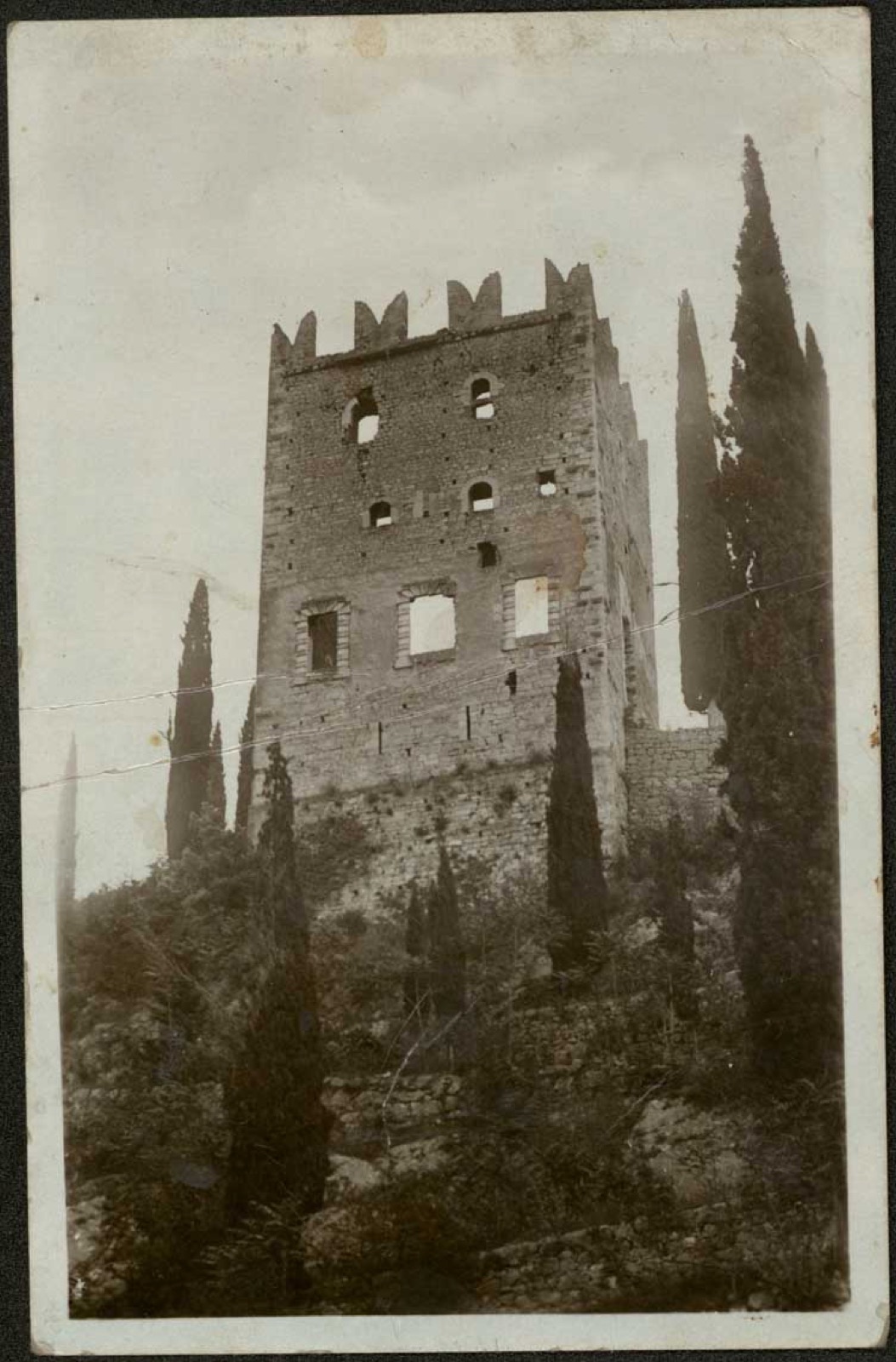
Arch of Trento - Castello
· Digital Library Trentino (via Europeana)
Public domain
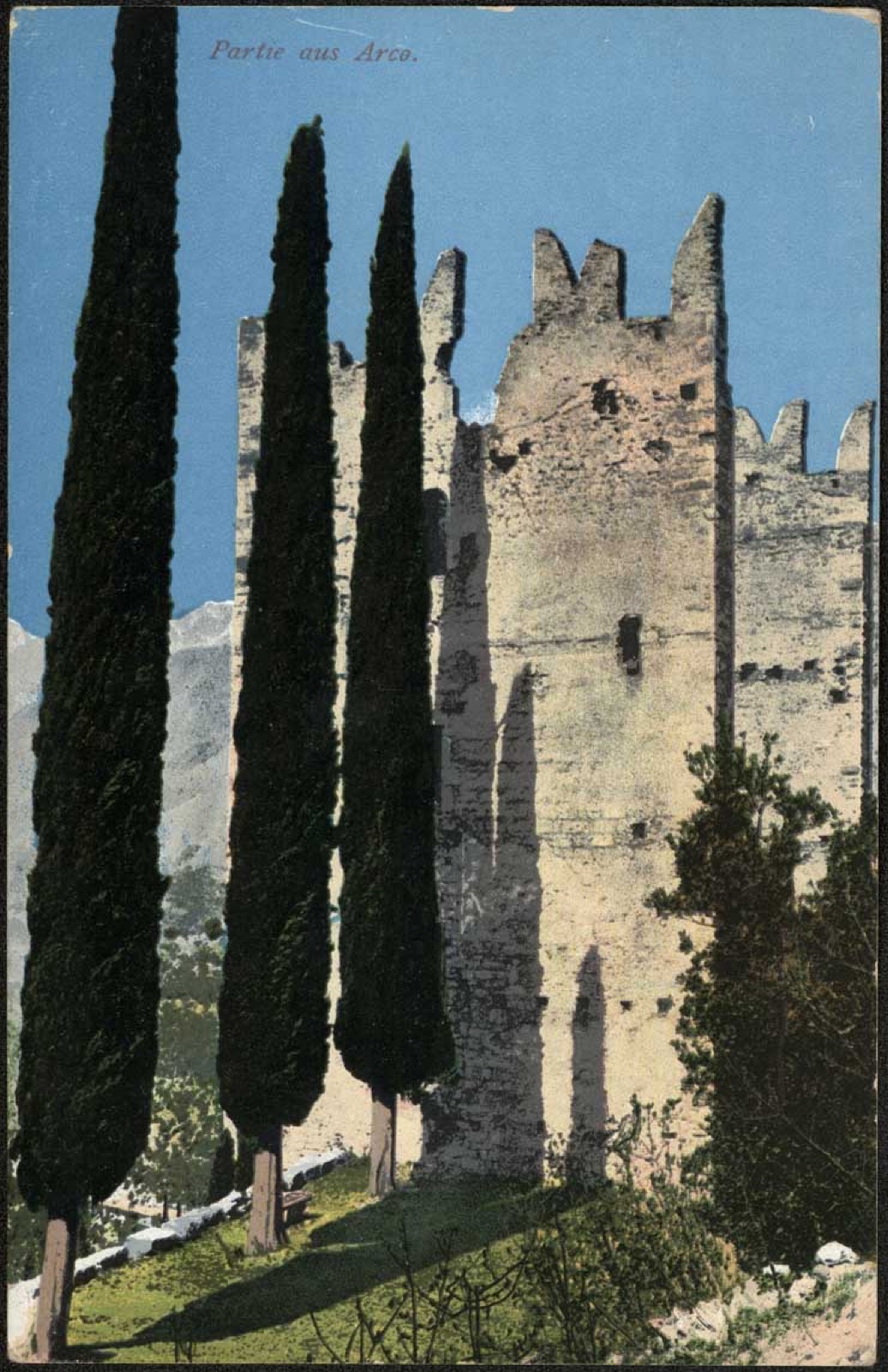
Partie aus Arco
1908 · Digital Library Trentino (via Europeana)
Public domain


