
Italy · Restored
Rocca Maggiore
Rocca Maggiore is the hilltop castle that dominated Assisi and the Tescio valley for centuries. The present complex dates from the early 14th century and comprises a larger fortress (Major) and a smaller stronghold (Minor) linked by high medieval walls built from the pink limestone of Mount Subasio. The site retains a keep, towers at the curtain-wall corners, a round bastion, and a large central courtyard containing former service rooms and the castle's original core (the mole).
First raised
1173
Its prime
1535
Today
Restored
As it stood in 1535
What Rocca Maggiore looked like in its prime.
Perched on a rounded ridge above Assisi, the Rocca Maggiore presents long trapezoidal curtain walls of pink Mount Subasio limestone with towers at each corner; the main complex on the right includes a tall square formwork supporting the keep and a compact cluster of stone buildings with terracotta roofs. A polygonal northwestern tower connects by a defended corridor to the rest of the walls, and a later round bastion projects from the interior side. The large enclosed courtyard opens against the inner wall.
Its story
The story of Rocca Maggiore.
First Record and the Young Frederick II, 1173–1198
The fortress is first documented in 1173, when Christian of Mainz, a German archbishop serving as chancellor of Germany under Emperor Frederick I Barbarossa, occupied Assisi on the emperor's behalf and stayed there briefly.
As a child, the future King of Sicily and Holy Roman Emperor Frederick II was entrusted by his mother, Costanza d'Altavilla, to the Duchess of Urslingen, wife of Corrado, Duke of Spoleto, in the fortress. His mother later returned to Assisi with her husband, Henry VI, and their son was baptised in the city's cathedral of San Rufino. In 1198 the city turned to the Guelph party loyal to Pope Innocent III, and the population expelled the imperial legate along with the four-year-old Frederick, inflicting extensive damage on the fortress; that same year Francis of Assisi turned sixteen.
Cardinal Albornoz's Fortifications, 1356–1360
The fortress was rebuilt in 1356, keeping its medieval plan, on the initiative of Cardinal Gil Álvarez Carrillo de Albornoz, sent from Avignon by Pope Innocent VI to strengthen the defences of the Papal States. In 1360 Albornoz also had the smaller Rocca Minore built on the mountainside above, later known as the stronghold of St Anthony, linked to the main fortress by walls of the same century.
Piccinino's Tower and the Renaissance Popes, 1458–1535
In 1458 Jacopo Piccinino, captain of Perugia and Lord of Assisi, built the polygonal north-western tower, later completed by Pope Pius II and linked to the rest of the walls by a fortified corridor. The trapezoidal circuit, raised in the pink limestone of Mount Subasio with a tower at each corner, was renovated in 1478, when the square base beneath today's keep was rebuilt. A round bastion giving onto the interior courtyard was added in 1535 on the orders of Pope Paul III.
A Film Set and a Living Monument, 1972–Present
In 1972 the interior served as a filming location for Franco Zeffirelli's Brother Sun, Sister Moon. The Rocca Maggiore is designated Italian national heritage and today functions as a museum. It has also been listed among Umbria's 'Living Monuments' (one of the first in the region, alongside the Torre del Popolo), because protected species, including the common swift and several bat species, use it as a breeding and refuge site.
Step inside
8 places to explore in 1535.
The record describes 8 distinct spots at Rocca Maggiore, including 3 interiors: entrance to the round bastion, large enclosed courtyard with service rooms, mole rooms and spiral staircase. Create your own photoreal reconstruction and explore every one, more scenes means more rooms, more angles, and more of the place to stand in.
Build Your Own Castle
Recreate Rocca Maggiore with AI to explore it.
The artist rebuilds it as it stood in 1535, a photoreal reconstruction that belongs to you alone. Pay with coins, no subscription needed.
Recreate this castle →Defend this castle →From the archive
Rocca Maggiore on paper: the measured plan and period views.
The survey plan and photographs below are the ground truth this page's reconstructions are checked against, drawn and photographed while the castle was still a working garrison. Every image is public-domain or openly licensed, with its source named.
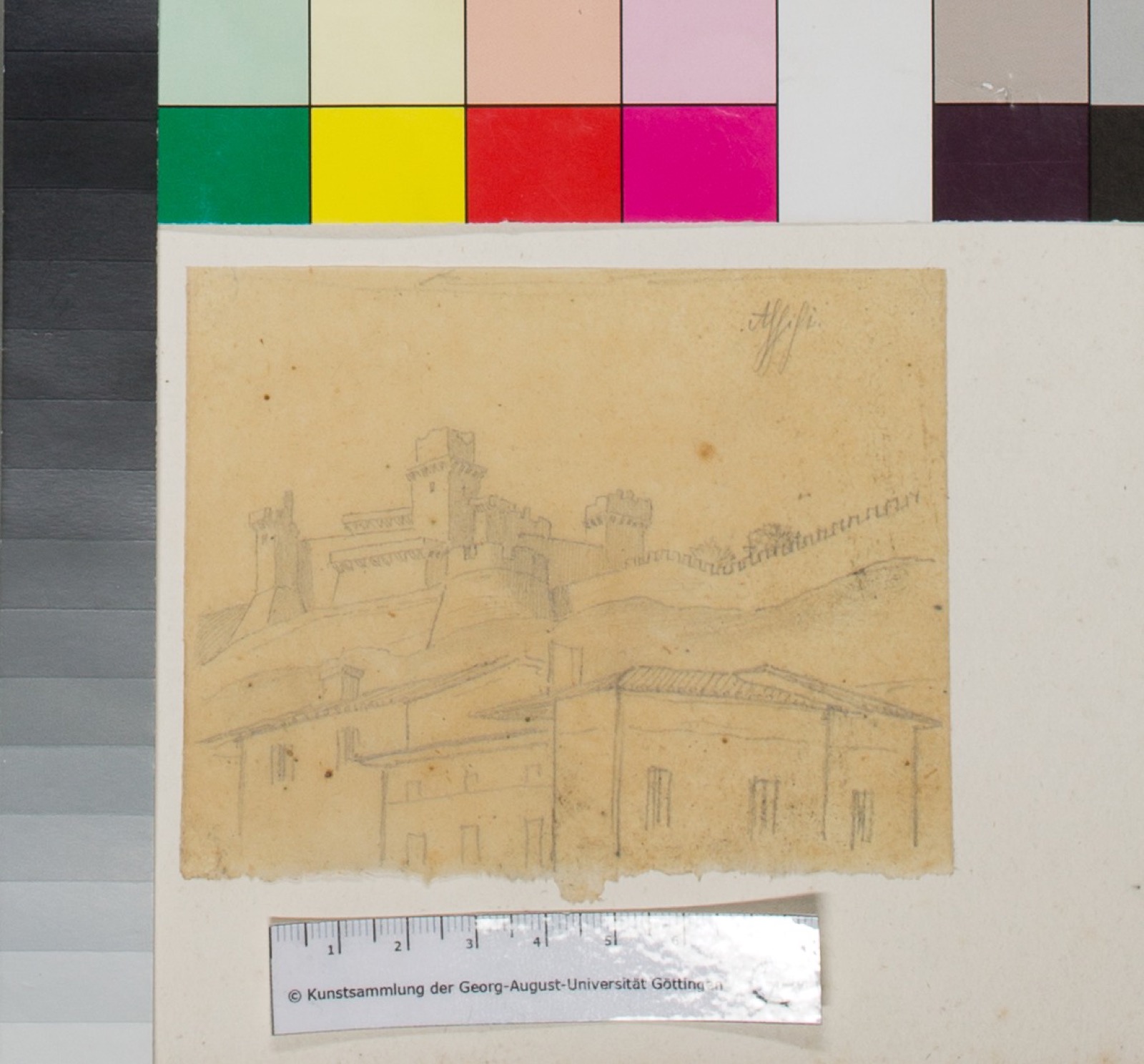
Assisi mit Blick auf die Festung Rocca Maggiore
· Art Collection of the University Göttingen (via Europeana)
CC BY-SA
Nearby


