
Norway · Restored
Akershus Fortress
Akershus slott og festning
Akershus Fortress is a medieval castle and fortified complex on a rocky promontory beside the Oslofjord in Oslo, Norway. Built from the late 13th century and modified over time, the site combines fieldstone curtain walls and Renaissance brick buildings and contains museums, a royal mausoleum and former prison facilities.
First raised
1300
Its prime
1625
Today
Restored
As it stood in 1625
What Akershus Fortress looked like in its prime.
Akershus presents a low, crenellated grey fieldstone curtain wall set on a rocky foreshore with a cluster of brick and stone buildings rising behind it. The roofs are steep and mostly dark slate, punctuated by slender copper-clad spires with green patina and a stepped-gable brick hall with a round opening. Small polygonal bastions and a conical-roofed pavilion punctuate the curtain; the complex sits directly above the Oslofjord with quays and moored vessels below.
Its story
The story of Akershus Fortress.
Alv Erlingsson's Raid and the Castle of 1300
In 1287 the rebel nobleman Alv Erlingsson of Sarpsborg attacked Oslo, and the old royal residence proved unable to defend the town. King Haakon V's answer rose on the Akersneset headland above the Oslofjord. Work is thought to have begun in the late 1290s and run on to about 1304; the castle first appears in writing in 1300, in a letter from Haakon to the Church of St Mary in Oslo.
Haakon V took to living in the keep rather than the old Kongsgård estate in Oslo, and the shift helped move Norway's capital from Bergen to Oslo. Olaf, the last Norwegian king before the Kalmar Union, was born at the castle in 1370.
Sieges from 1308 to the Northern Seven Years' War
The castle was first fought over in 1308, when the Swedish duke Erik Magnusson surrounded it along with a number of Norwegian magnates; a local Norwegian army broke the siege in battle. The Swedish king Karl Knutsson Bonde besieged it in 1449–1450 and gave up. In 1502 the Norwegian nobleman Knut Alvsson took Akershus with an army raised along the Swedish border; Scottish mercenaries in the Danish–Norwegian king's service failed to retake it, and the crown recovered it only when Knut was killed by the king's men on his way to peace talks.
Swedish soldiers came again in 1523 and withdrew after the townspeople of Oslo burned their own houses to deny them shelter. Lightning in 1527 badly damaged the inner castle, so it was a weakened place, held at the outset by some twenty or thirty men, that faced Christian II's siege from 1531; its captain Mogens Gyldenstjerne agreed a truce with the king, and forces from Denmark and Lübeck lifted the siege in March 1532. Swedish forces came once more in 1567, during the Northern Seven Years' War, and the king's lord lieutenant Christen Munk burned Oslo to deprive them of supplies.
Christian IV's Renaissance Castle and Charles XII's Attack
Christian IV, king from 1588, began a rebuilding in 1593 meant to keep pace with the growing firepower of artillery, done in part by compulsory labour, with women set to carrying brick. The first stage stood finished in 1604, the castle ringed by new works on the Italian bastion system with stone-clad earth ramparts, and further building ran to 1646, the old central tower Våghalsen coming down as the medieval fortress was recast into a Renaissance castle. When Oslo burned in 1624 the king ordered the town rebuilt against the fortress walls under the name Christiania, with Akershus as its citadel.
Territory lost at the peace of Brömsebro after the war of 1643–1645, and in the wars of 1657–1660, made Akershus more important still as a national fortress, and it was enlarged under Isaac van Geelkerck. After a town fire in 1686 it grew further still, its stone-clad ramparts and projecting bastions covering nearly as much ground as Christiania itself. On 8 March 1716 the enlarged works were attacked for the first time, when Charles XII of Sweden came against them with 10,000 men. The commandant, Colonel Jørgen Christopher von Klenow, gathered 3,000 defenders and held out until the Swedes drew off, and the king's first Norwegian campaign was reckoned a failure. No foreign army ever took the fortress by force.
Deactivation and the Slavery
The fortress was out of date by about 1750, and when Norway entered the union with Sweden in 1814 it was deactivated and parts of the outer walls demolished.
A large part of it served as a prison known as the Slavery, where convicts were set to forced labour instead of execution and could be hired out for work in the city; the escaper Gjest Baardsen and the thief Ole Høiland were held there, as were many early Norwegian socialists who followed Marcus Thrane. After the Kautokeino rising of 1852 the convicted men, except the two leaders beheaded at Alta, were sent to Akershus and the women to Trondheim, and several died in captivity. Lars Hætta, eighteen when he was imprisoned, was given the time and means there to make the first translation of the Bible into North Sámi.
The Occupation, 1940–1945
Akershus passed to German command without fighting in 1940, when the Norwegian government left the capital in the face of the German assault on Denmark and Norway. The German authorities executed people at the fortress during the occupation, among them members of the Pelle group, and forty-two Norwegians were shot at the execution ground on 9 and 10 February and 17 March 1945. It was handed over on 11 May 1945 to Terje Rollem on behalf of the Norwegian resistance. After the war eight men tried for war crimes and sentenced to death were executed there, among them Vidkun Quisling and Siegfried Fehmer.
Step inside
10 places to explore in 1625.
The record describes 10 distinct spots at Akershus Fortress, including 5 interiors: main building exterior and ceremonial hall, royal mausoleum interior, the slavery (prison cells) and more. Create your own photoreal reconstruction and explore every one, more scenes means more rooms, more angles, and more of the place to stand in.
Build Your Own Castle
Recreate Akershus Fortress with AI to explore it.
The artist rebuilds it as it stood in 1625, a photoreal reconstruction that belongs to you alone. Pay with coins, no subscription needed.
Recreate this castle →Defend this castle →From the archive
Akershus Fortress on paper: the measured plan and period views.
The survey plan and photographs below are the ground truth this page's reconstructions are checked against, drawn and photographed while the castle was still a working garrison. Every image is public-domain or openly licensed, with its source named.
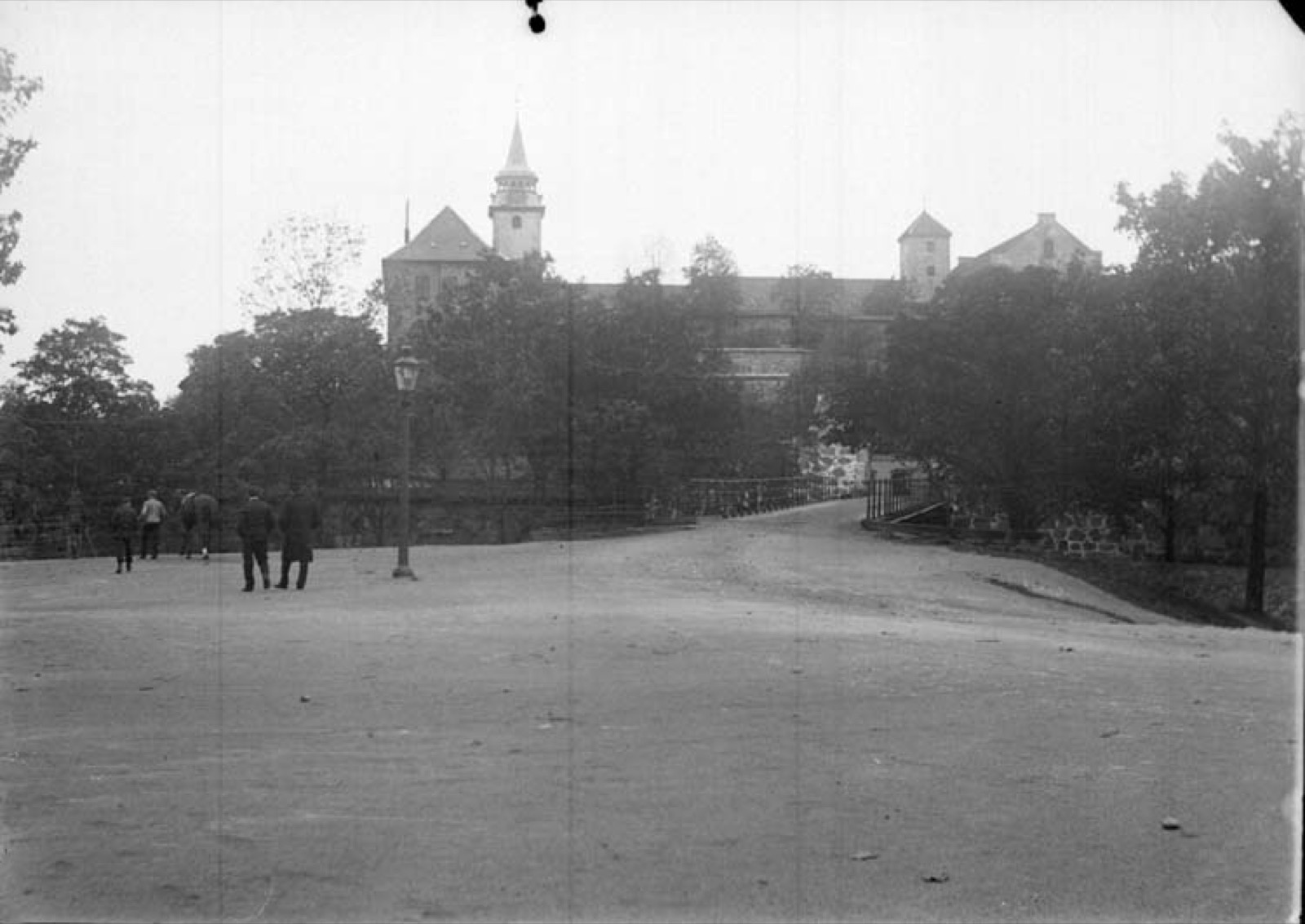
According to text accompanying the picture: “Christiania. Akershus Fortress 26/9-5/10 04.”
· Bohuslän Museum (via Europeana)
Public domain
Nearby


