Norway · Restored
Bergenhus Fortress
Bergenhus festning
Bergenhus Fortress is a historic stone fortress at the entrance to Bergen harbour in Norway, containing medieval buildings and later additions. Its surviving principal medieval structures are the large royal feast hall (Haakon's Hall) and a 13th-century defensive tower later known as Rosenkrantz Tower; the site remains a preserved and restored complex used for public events and visits.
First raised
1514
Its prime
1275
Today
Restored
As it stood in 1275
What Bergenhus Fortress looked like in its prime.
A low, crenellated stone fortress stretching along the harbourfront, dominated by a long rectangular medieval stone hall with a steep, copper-green pitched roof and a battlemented parapet, and by a tall multi-storey stone keep with small slit windows and a castellated top. Built of roughly coursed grey stone, the buildings sit directly on the quayside with an open inner courtyard (Koengen) behind them and a wooded hill rising immediately inland.
Its story
The story of Bergenhus Fortress.
The Kings' Holmen, Capital Seat of Norway
In the Middle Ages the headland at the mouth of Bergen harbour was called Holmen. Excavations have revealed foundations believed to pre-date 1100, perhaps laid under King Olav Kyrre, and in the twelfth century King Øystein Magnusson moved the royal seat here from Alrekstad. Alongside the king's residence stood Bergen's cathedral, Christ Church, several other churches, the bishop's residence and a Dominican monastery. Christ Church held the shrine of Saint Sunniva, patron saint of Bergen, hosted royal coronations and weddings through the twelfth and thirteenth centuries, and became the burial place of at least six kings; a memorial stone now marks the site of its altar.
Bergen was the capital of Norway through the thirteenth century, and during the long reign of Håkon Håkonsson (1217–1263) a stone ring wall was raised around Holmen in the 1240s. Around 1260 Håkon built the great royal hall: Gothic in style, the largest secular medieval building in Norway, and so close to English work of the period that it may have been designed by English architects, possibly from the court of Henry III. His saga records that the hall did not yet exist at his coronation in 1247, but that it hosted the wedding of King Magnus Håkonsson to the Danish princess Ingebjørg Eriksdatter on 11 September 1261. Magnus the Lawmender added a defensive keep in the 1270s, with a royal apartment on its top floor. When King Eirik Magnusson died in 1299, Bergen lost its status as the main royal residence.
The Victual Brothers and the Danish Rebuilding, 1429–1531
Under the union with Denmark from 1380 the royal castle gradually fell into decay, and in 1429 it was captured and burnt by the Victual Brothers. A stone portal from the mid-fifteenth century shows the hall was rebuilt after the attack, though it was soon reduced to a storehouse. In 1514 the site became a military area once more; the rebuilding was directed by Jørgen Hanssøn, who around 1520 enclosed the ground east of the keep with a ring wall, moats and a drawbridge.
Between 1526 and 1531 the medieval churches of Holmen (Christ Church among them) were torn down as the headland was refortified under Danish rule, and it was around this time that the name Bergenhus came into use. The old royal seat nonetheless remained the political and administrative centre for western and northern Norway; only with the introduction of absolutism in 1660 did Bergenhus become a purely military establishment.
Rosenkrantz's Tower and the Battle of Vågen, 1560–1700
Erik Rosenkrantz, governor of Bergenhus from 1560 to 1568, gave the medieval keep its present form, bringing in Scottish stonemasons and architects to expand it into the tower that now carries his name: dungeons on the ground floor, the governor's rooms above, and cannon positions at the top. On 2 August 1665 the fortress took part in the battle fought on Bergen's harbour, the Vågen. Through the seventeenth century the works were extended and strengthened, reaching their most complete state around 1700, with Bergenhus and the neighbouring Sverresborg forming a single fortress. In the 1740s the tower was converted into a gunpowder magazine, a role it kept until the 1930s.
The Voorbode Explosion and the Hall Restored, 1840–1961
In the nineteenth century Bergenhus lost its defensive function but was retained by the military as an administrative base. As romantic nationalism revived interest in Norway's medieval kingdom, it was proven in 1840 that the great stone building inside the fortress was Håkon Håkonsson's old feast hall. Henrik Wergeland first used the name Haakon's Hall in a poem and Henrik Ibsen wrote verses in its honour; after half a century of debate the hall was restored in the 1890s and decorated in the 1910s with frescos drawn from Håkon's saga.
In the Second World War the German navy used several of the fortress buildings as a local headquarters, and Soviet prisoners of war built a large concrete bunker within the walls. On 20 April 1944 the Dutch ship Voorbode, loaded with dynamite, exploded in the harbour; the fortress buildings were severely damaged and the hall's wooden roof burned, taking every decoration of the first restoration with it. Restoration led by Gerhard Fischer followed in the 1950s, and Haakon's Hall reopened on 11 September 1961, the 700th anniversary of the wedding feast that first filled it. The Rosenkrantz Tower has been open to the public since 1966, and the fortress remains a working military post, with around 150 personnel under the Royal Norwegian Navy.
Step inside
9 places to explore in 1275.
The record describes 9 distinct spots at Bergenhus Fortress, including 4 interiors: haakon's hall, great hall interior, rosenkrantz tower, top-floor royal apartment, rosenkrantz tower, ground-floor dungeons and more. Create your own photoreal reconstruction and explore every one, more scenes means more rooms, more angles, and more of the place to stand in.
Build Your Own Castle
Recreate Bergenhus Fortress with AI to explore it.
The artist rebuilds it as it stood in 1275, a photoreal reconstruction that belongs to you alone. Pay with coins, no subscription needed.
Recreate this castle →Defend this castle →From the archive
Bergenhus Fortress on paper: the measured plan and period views.
The survey plan and photographs below are the ground truth this page's reconstructions are checked against, drawn and photographed while the castle was still a working garrison. Every image is public-domain or openly licensed, with its source named.
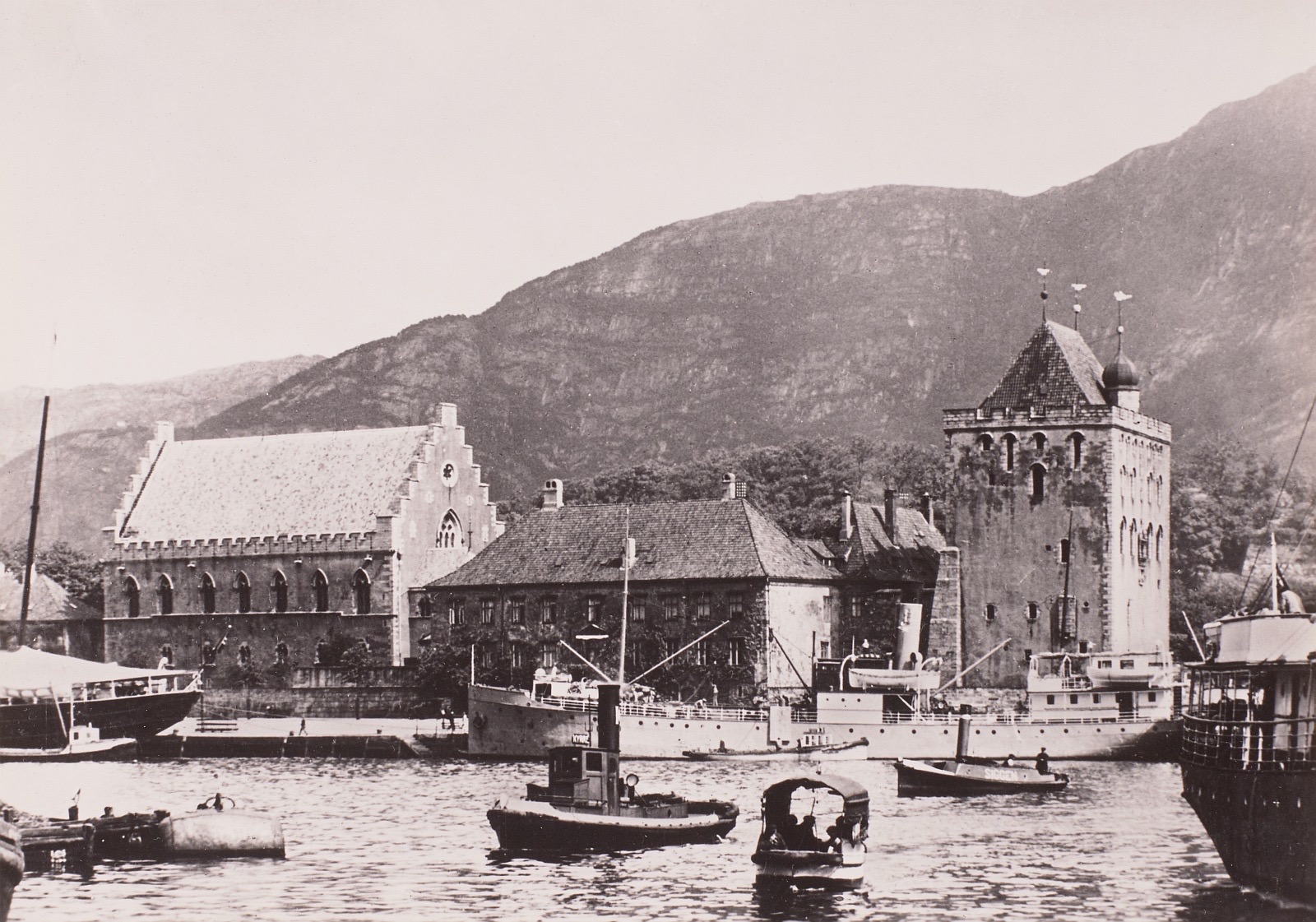
Fortress Bergenhus
· Deutsche Fotothek (via Europeana)
CC BY-SA
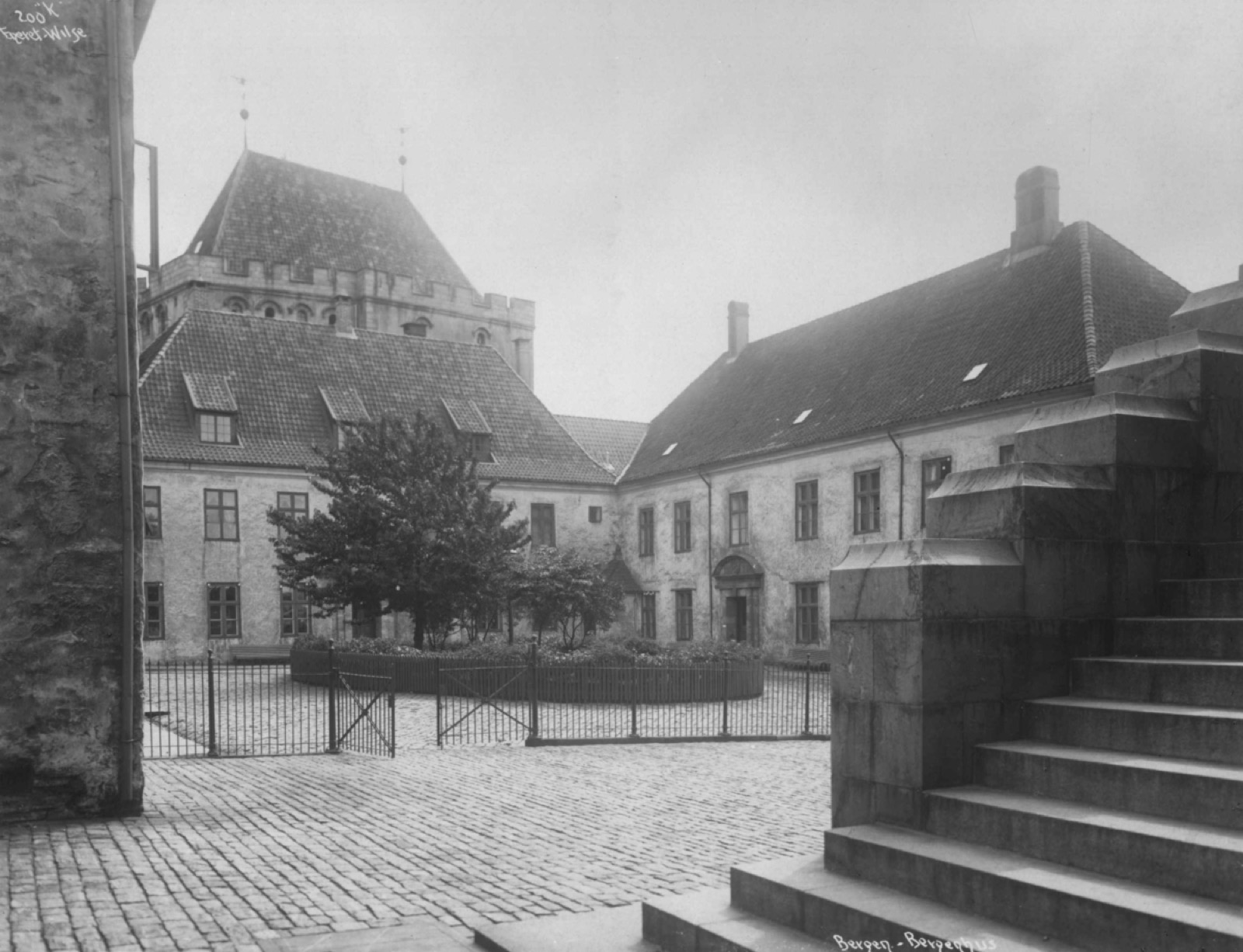
Bergenhus, Bergen B3.
· The Norwegian Museum of Cultural History (via Europeana)
Public domain

Questions about Bergenhus Fortress
What is the history of Bergenhus Fortress?
Why was Bergenhus Fortress built, and what was it used for?
What is inside Bergenhus Fortress?
Who owns Bergenhus Fortress now?
Where is Bergenhus Fortress?
When was Bergenhus Fortress built?
Was Bergenhus Fortress ever attacked or besieged?
What did Bergenhus Fortress look like in its prime?
Is Bergenhus Fortress still standing, or is it a ruin?
Can you visit Bergenhus Fortress?
More castles of Norway


Explore the city