
Poland · Still standing
Kórnik Castle
Zamek w Kórniku
Kórnik Castle is a historic residence in Kórnik, Poland, whose present Gothic Revival appearance dates from an 1855 remodelling. It houses a museum and the Kórnik Library and is set within the extensive Kórnik Arboretum.
First raised
1600
Its prime
1855
Today
Still standing
As it stood in 1855
What Kórnik Castle looked like in its prime.
A pale stone Gothic Revival mansion set on a low island in a reflective lake, rising from a red-brick plinth; compact towers and rectangular blocks are capped with crenellated parapets and corbelled eaves. The southern façade contains a very large recessed chaitya-style arch, the northern approach has a tall window with a four-centred arch above the entrance, and an eastern tower displays a contrasting red-brick face. A west-facing terrace overlooks the water and surrounding arboretum.
Its story
The story of Kórnik Castle.
From Bishop Mikołaj's Tower to the Działyńskis, 1426-1676
The first defensive building at Kórnik was a tower raised in the 14th century at the initiative of Mikołaj of Kórnik, bishop of Poznań. The earliest known document of the work is a 1426 contract with a carpenter, also called Mikołaj; the castle was probably finished around 1430. It stood on a marshy island inside a moat, entered over a drawbridge; the old walls and cellars survive from that phase.
In 1565 Stanisław Górka turned the Gothic castle into a Renaissance residence, building over the inner courtyard so that all the ranges joined under one broken roof, and keeping the drawbridge. The Górkas were among the most powerful magnate families of Renaissance Greater Poland, and in 1574 Henry of Valois broke his journey here on his way to be crowned at Kraków. Stanisław Górka died without issue in 1592 and the castle passed to the Czarnkowskis; in 1610 Andrzej Czarnkowski sold it to Zygmunt Grudziński, and from 1676 it belonged to the Działyński family.
Teofila Potulicka and the Legend of the White Lady
Teofila Szołdrska-Potulicka, born a Działyńska in 1714, was widowed by Stefan Maciej Szołdrski and divorced from Aleksander Potulicki. From the middle of the 18th century until her death in 1790 she gave herself to the cultural and economic development of Kórnik and to remodelling the residence as a Baroque palace, laying out beside it a French garden, tree nurseries and a menagerie of exotic plants and animals. She worked at the town's growth as well, bringing in German craftsmen as colonists.
Pesne's portrait of her in a white dress still hangs in the castle, and from it grew the legend of the White Lady, one of the best-known ghosts of the Polish castles. In the 19th century the country people told that shortly before midnight Teofila steps out of the frame in the dining room and walks into the park, where a rider on a black horse waits; the two go down the avenues and vanish with the first ray of sun.
Tytus Działyński's English Gothic, 1826-1855
After Teofila's death the castle passed briefly to the Szołdrskis, and a court judgment of 1801 returned it to the Działyńskis. From 1826 it was held by Tytus Działyński, of the Ogończyk arms. For his part in the November Uprising the Prussian authorities confiscated his property, and he could return from Galicia only in 1839, after winning his suit for restitution.
Tytus had planned a complete rebuilding before the uprising, ordering designs from Antonio Corazzi, Henryk Marconi and Karl Friedrich Schinkel. On his return he rebuilt in the English Gothic Revival the castle keeps today, drawing most heavily on Schinkel but reworking him with the architect Marian Cybulski; the remodelling was carried out in 1855 for Tytus and his son Jan Kanty. A leading man of the organic-work movement in Greater Poland, he meant the house to serve the nation as library and museum and not only as a private residence, and began the gathering of old prints and manuscripts, Chopin, Mickiewicz and Bonaparte among them, that the Kórnik Library still holds. Teofila's French garden he recast as the romantic park that is now the Kórnik Arboretum, the oldest and largest in Poland at around 40 hectares and more than 3,300 taxa.
Zamoyski's Bequest to the Nation, 1880-2001
Tytus died suddenly and Kórnik went to his son Jan, who carried on the work but was more taken up with enlarging the residence of his wife Izabela, born a Czartoryska, at Gołuchów. Jan died childless in 1880 and the castle was inherited by his sister's son, Władysław Zamoyski, a French citizen who was forced out of Kórnik in 1885 by the Prussian expulsions and settled in Galicia, at Kuźnice in Zakopane, where he made his name in the fight for Polish title to Morskie Oko; he came back only in 1920. In 1924, shortly before his death, the childless count made over his whole estate, castle, art collection, bibliophile holdings and arboretum alike, to the Polish nation, the gift administered by the Zakłady Kórnickie foundation.
Until the interwar years the way in was through the so-called babiniec, a vestibule shaped like a barbican, which was pulled down between 1925 and 1939. In 1939-1940, under the German occupation, a clandestine press of the Polish resistance worked in the castle and printed the underground paper Biuletyn Radiowy. Much of the collection was plundered during the war. The Zakłady Kórnickie foundation was wound up in 1953, as other foundations were under the People's Republic, and revived by statute in 2001.
The Kórnik Library and the Moor Room Today
The castle houses a museum and the Kórnik Library of the Polish Academy of Sciences, whose holdings include the original manuscript of the third part of Adam Mickiewicz's Dziady and Napoleon's hand-written novella Clisson et Eugénie. The Moor Room, which takes after the Court of the Lions at the Alhambra, was meant at first for the library and became a museum room of national relics. In the room below the tower stand the ethnographic and natural-history collections Władysław Zamoyski brought back from Australia and Oceania. Kórnik Castle was named a Historic Monument of Poland on 11 July 2011 and is entered on the register of immovable monuments of the Greater Poland voivodeship.
Step inside
9 places to explore in 1855.
The record describes 9 distinct spots at Kórnik Castle, including 3 interiors: moor room (interior), kórnik library (reading room and shelves), chamber below the tower with ethnographic and natural collections. Create your own photoreal reconstruction and explore every one, more scenes means more rooms, more angles, and more of the place to stand in.
Build Your Own Castle
Recreate Kórnik Castle with AI to explore it.
The artist rebuilds it as it stood in 1855, a photoreal reconstruction that belongs to you alone. Pay with coins, no subscription needed.
Recreate this castle →Defend this castle →Whose castle
Clans who held Kórnik Castle.
The families that held Kórnik Castle for a decade or more across its history, follow a name to its clan.
Działyński
Remodelled in 1855 for Tytus Działyński; the family held Kórnik until the death of Jan Kanty Działyński.
Zamoyski
Inherited by Count Władysław Zamoyski in 1881; willed to the Polish state on his death in 1924.
From the archive
Kórnik Castle on paper: the measured plan and period views.
The survey plan and photographs below are the ground truth this page's reconstructions are checked against, drawn and photographed while the castle was still a working garrison. Every image is public-domain or openly licensed, with its source named.
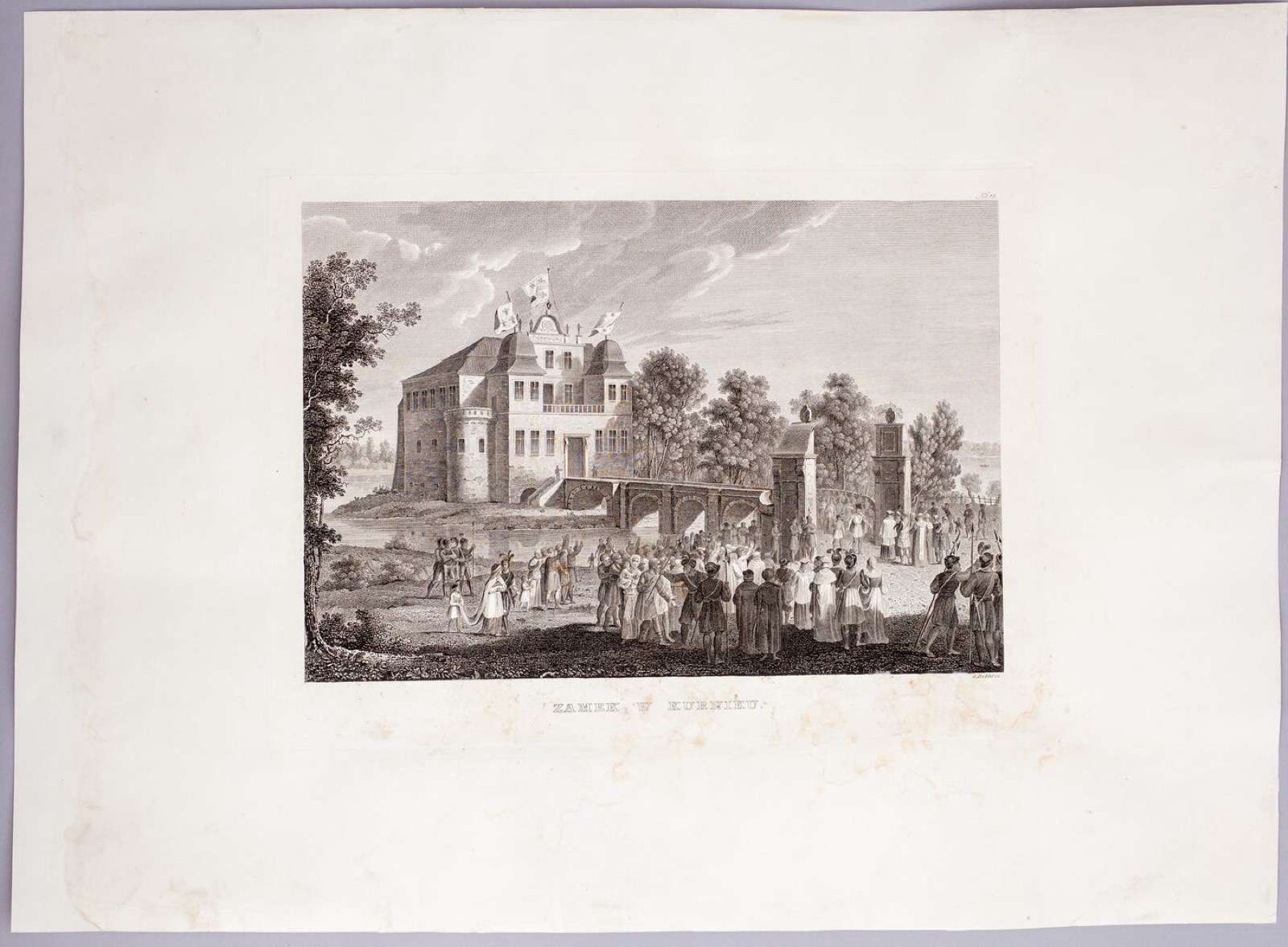
Kurniko pilis / The Kórnik Castle
2023 · Rokiškis Regional Museum (via Europeana)
Public domain


