Portugal · Restored
Castelo de Palmela
The Castle of Palmela is a hilltop medieval fortress in the Setúbal district of Portugal, classified as a National Monument. It occupies a prominent ridge in the Arrábida area, with extensive curtain walls, a tall battlemented keep and a fortified complex that includes a large courtyard and ancillary buildings.
Its prime
1150
Today
Restored
As it stood in 1150
What Castelo de Palmela looked like in its prime.
Perched on a wooded hilltop overlooking the Arrábida hills and distant estuaries, the castle is a compact complex of pale ochre-grey masonry: long crenellated curtain walls stepping along the ridge, a tall rectangular battlemented keep, an arched stone gateway into a cobbled inner bailey, and a substantial rectangular palace block with a low-pitched red clay tiled roof. Terraced stone walkways, planted beds and solid parapets define the outer slopes and approaches.
Its story
The story of Castelo de Palmela.
The hill of Palmela, on the east side of the Arrábida mountain range between the estuaries of the Tagus and the Sado, has been occupied since prehistory, abundant archaeological testimony reaches back to the Neolithic. Some scholars point to 310 BC for the founding of a settlement on the site, fortified at the time of the Romanization of the Iberian Peninsula in 106 by a praetor of Lusitania named Áulio Cornelius; occupation then continued uninterrupted, first under the Visigoths and later the Muslims.
The primitive fortification was the work of the Muslims between the eighth and ninth centuries, and was greatly expanded between the tenth and the twelfth. Today the castle, a National Monument in the Arrábida Natural Park, presents extensive curtain walls, a tall battlemented keep and a fortified complex with a large courtyard on its ridge above the village of Palmela.
Step inside
9 places to explore in 1150.
The record describes 9 distinct spots at Castelo de Palmela, including the full exterior approach. Create your own photoreal reconstruction and explore every one, more scenes means more rooms, more angles, and more of the place to stand in.
Build Your Own Castle
Recreate Castelo de Palmela with AI to explore it.
The artist rebuilds it as it stood in 1150, a photoreal reconstruction that belongs to you alone. Pay with coins, no subscription needed.
Recreate this castle →Defend this castle →From the archive
Castelo de Palmela on paper: the measured plan and period views.
The survey plan and photographs below are the ground truth this page's reconstructions are checked against, drawn and photographed while the castle was still a working garrison. Every image is public-domain or openly licensed, with its source named.
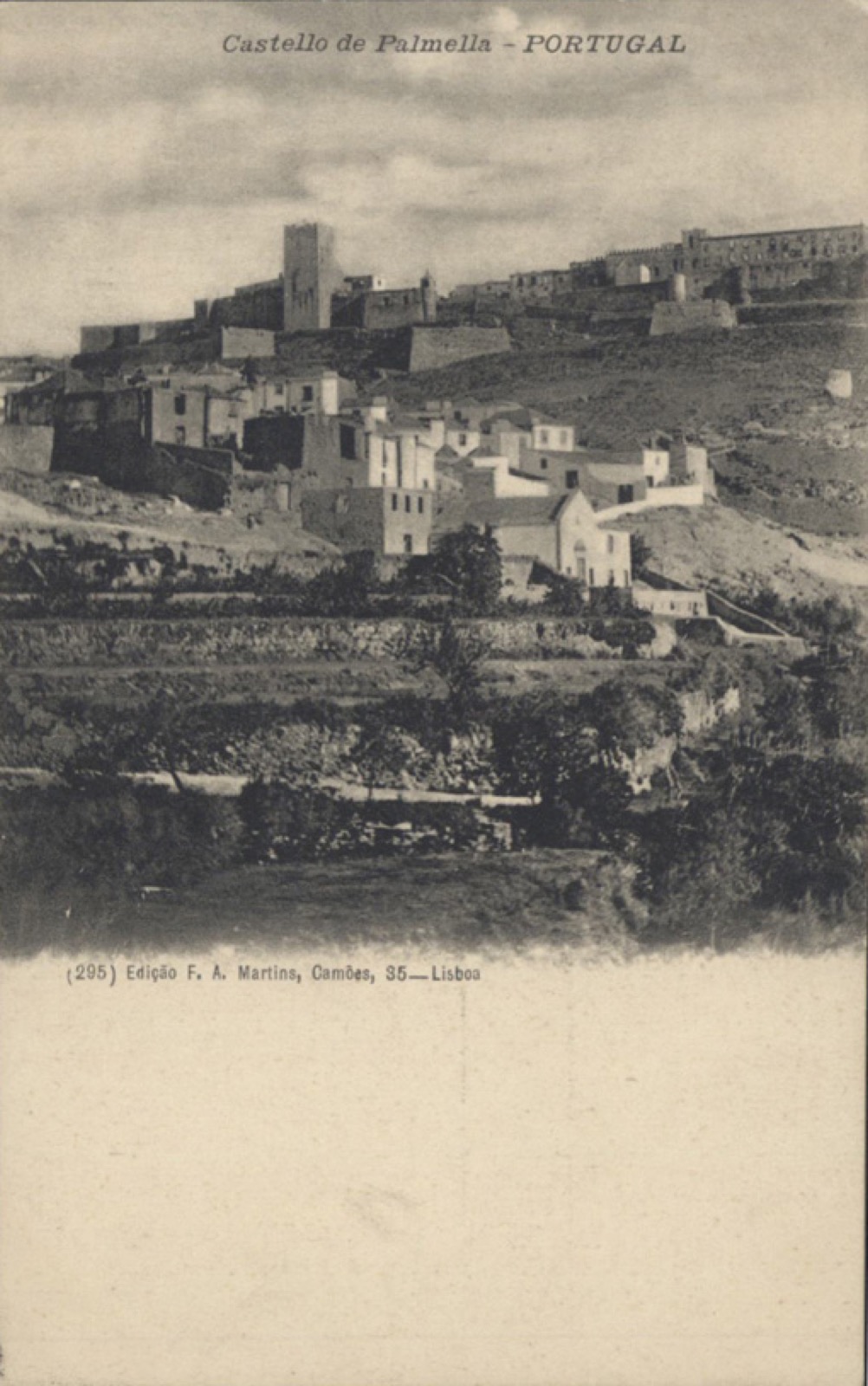
Castello de Palmella - Portugal
1902 · National Library of Portugal (via Europeana)
Public domain
Nearby