Clan Rising
Delgatie Castle today

Scotland · Restored

Delgatie Castle

Delgatie Castle is a white-harled Scottish castle near Turriff in Aberdeenshire, composed of a five-storey tower (keep) with an adjoining house and two later wings. The building preserves early modern painted ceilings and a very wide turnpike stair and remains set in estate grounds with a river running through the property.

Photograph via Wikimedia Commons

First raised

1049

Its prime

1743

Today

Restored

As it stood in 1743

What Delgatie Castle looked like in its prime.

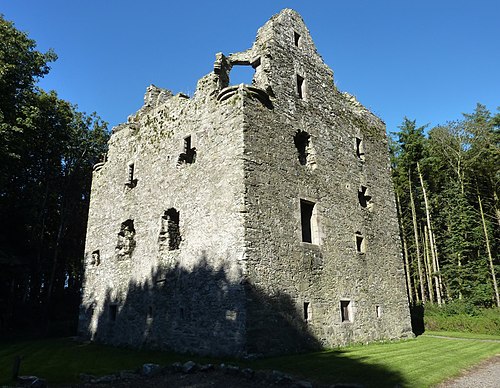
A white-harled, rectangular five-storey tower (the keep) linked to lower two-storey wings and an adjoining house, all with pale rendered stone and slate roofs; multiple chimneys punctuate the roofline. Windows range from narrow slit openings in the tower to larger mullioned apertures in the wings. The composition presents a tall central block with horizontally extending wings set within open estate grounds beside a small river; interiors include wide stone turnpike stairs and painted wooden ceilings.

Its story

The story of Delgatie Castle.

Delgatie Castle, near Turriff in Aberdeenshire, was stripped from Henry de Beaumont, Earl of Buchan, after the Battle of Bannockburn in 1314 and given to Clan Hay, the family later to become Earls of Erroll. The Hay arms appear in many places through the castle, including three cattle yokes recalling the farmer and his two sons who were instrumental in defeating a Danish raiding party at Cruden Bay.

The present castle is a white-harled, five-storey tower of the 16th century with later extensions, an adjoining house and two wings. Inside it preserves early modern painted ceilings and a very wide turnpike stair; restored, it stands in estate grounds with a river running through the property.

Step inside

10 places to explore in 1743.

The record describes 10 distinct spots at Delgatie Castle, including 6 interiors: very wide turnpike stair (keep interior), chamber with painted ceiling (dated 1592), chamber with painted ceiling (dated 1597) and more. Create your own photoreal reconstruction and explore every one, more scenes means more rooms, more angles, and more of the place to stand in.

South approach across the parklandBase of the keep, looking upExterior along the lateral wings and chapelVery wide turnpike stair (keep interior)Chamber with painted ceiling (dated 1592)Chamber with painted ceiling (dated 1597)Chamber traditionally associated with Mary, Queen of Scots1743 chapel (interior)Riverbank on the estate looking toward the castleUpper-floor family chamber / suite room

Build Your Own Castle

Recreate Delgatie Castle with AI to explore it.

The artist rebuilds it as it stood in 1743, a photoreal reconstruction that belongs to you alone. Pay with coins, no subscription needed.

Recreate this castle →Defend this castle →

Whose castle

Clans who held Delgatie Castle.

The families that held Delgatie Castle for a decade or more across its history, follow a name to its clan.

  • Hay

    Given to Clan Hay, later Earls of Erroll, after Bannockburn in 1314.
Questions about Delgatie Castle

What is the history of Delgatie Castle?

Delgatie Castle has stood on its site since the 11th century, while the earliest surviving parts date from the 16th century. After the Battle of Bannockburn in 1314, it was taken from Henry de Beaumont, Earl of Buchan, and given to Clan Hay. Additional wings and a chapel were added in 1743, and Mary, Queen of Scots, visited in 1562.

What is inside Delgatie Castle?

Inside Delgatie Castle are a very wide turnpike stair and chambers with painted wooden ceilings dated 1592 and 1597. It also includes a chamber traditionally associated with Mary, Queen of Scots, an upper-floor family chamber or suite room, and a chapel added in 1743. The interiors retain a domestic character.

Where is Delgatie Castle?

Delgatie Castle is near Turriff in Aberdeenshire. It stands in estate grounds beside a river running through the property, in the area of Aberdeenshire in Scotland. The nearest named town in the supplied material is Turriff.

When was Delgatie Castle built?

Delgatie Castle belongs to the 11th-century foundation period, but the earliest surviving parts date from the 16th century. The present tower was built between 1570 and 1579, with additional wings and a chapel added in 1743. The supplied dates for the castle’s first raising and its standing fabric therefore fall in different centuries.

Which family or clan held Delgatie Castle?

Delgatie Castle was held by Clan Hay after the Battle of Bannockburn in 1314. It was stripped from Henry de Beaumont, Earl of Buchan, and given to Clan Hay, whose family later became the Earls of Erroll. Hay arms appear in many places throughout the castle.

What did Delgatie Castle look like in its prime?

Delgatie Castle is a white-harled, rectangular five-storey tower linked to an adjoining house and lower two-storey wings. Pale rendered stone, slate roofs and multiple chimneys define the exterior, while narrow slit openings in the tower contrast with larger mullioned windows in the wings. The tall central block extends horizontally across open estate grounds beside a river.

Is Delgatie Castle still standing or is it a ruin?

Delgatie Castle is still standing and has been restored. The surviving building is a white-harled five-storey tower with an adjoining house, later extensions and two wings. It preserves early modern painted ceilings and a very wide turnpike stair, while the 1743 additions include further wings and a chapel.

Can you visit Delgatie Castle?

Delgatie Castle is open to the public as a visitor attraction. Visitors were first welcomed on 9 July 1994, and public access is managed by a private charitable trust. The castle is also recorded as a museum, with its grounds and café open to the public.
All castles of Scotland · Castles of Europe · the best castles in Europe · explore the finished reconstructions.