
Scotland · Partial ruin
Little Cumbrae Castle
Little Cumbrae Castle is a small 16th‑century tower house standing on a tidal islet off the east coast of Little Cumbrae in the Firth of Clyde. Built by the Earl of Eglinton, the compact rectangular tower is a Category A scheduled monument and was used as a hunting stronghold and refuge in the early modern period.
Its prime
1568
Today
Partial ruin
As it stood in 1568
What Little Cumbrae Castle looked like in its prime.
A compact rectangular three-storey stone tower house on a low tidal islet, built of rough grey-brown rubble with a continuous course of chequered corbelling below the parapet. Round angle turrets project at three corners, small slit windows and gunloops puncture the walls, and a first-floor entrance sits above ground level. The roof has a wall-walk and crenellated parapet; the immediate setting is short grass, rocky shore and shallow tidal pools reflecting the tower.
Its story
The story of Little Cumbrae Castle.
The castle sits on Castle Island, in Gaelic, the 'islet of the nobles' tower', a tidal island off the east coast of Little Cumbrae in the Firth of Clyde. The Hunters of Hunterston were for centuries Hereditary Foresters of the island, but in 1515 Hugh, Earl of Eglinton was made keeper, the Privy Council doubting Robert Hunter's means to resist those wasting the King's lands. Hunter won a Royal Charter of the island in 1527, yet soon after the Crown sold it to the Earl of Eglinton, whose rights were confirmed in 1555. The small square tower was built by Lord Eglinton in the 16th century, possibly as a base against deer and rabbit poaching.
The tower is strikingly similar to Fairlie, Law and Skelmorlie castles: a vaulted first-floor great hall and kitchen, two vaulted cellars, chequered corbelling and round angle turrets at three corners, with a first-floor entrance originally reached by a removable timber ladder. In 1568 the glasswright George Elphinstoun was employed by the Earl of Eglinton to fit glass windows. In 1599 Robert Boyd of Badinhaith lived here and planned a trading harbour, opposed by the island's Montgomery families, who had no wish to improve communications with the outside world.
In Cromwell's time the Earl of Eglinton sent his wife to the fortlet with a garrison of forty men-at-arms, its inaccessibility making it his principal stronghold while Ardrossan Castle lay vulnerable to artillery. The Earl was taken prisoner after Worcester in 1651, and the Marquis of Argyll advised Lady Montgomerie to offer the castle to the authorities or demolish it once munitions and cannon were removed. The 6th Earl imprisoned Archibald Hamilton, a friend and correspondent of Cromwell, in the dungeon here before he was taken to Stirling and hanged.
Step inside
8 places to explore in 1568.
The record describes 8 distinct spots at Little Cumbrae Castle, including 3 interiors: vaulted great hall (first floor), first-floor kitchen, vaulted ground-floor cellars. Create your own photoreal reconstruction and explore every one, more scenes means more rooms, more angles, and more of the place to stand in.
Build Your Own Castle
Recreate Little Cumbrae Castle with AI to explore it.
The artist rebuilds it as it stood in 1568, a photoreal reconstruction that belongs to you alone. Pay with coins, no subscription needed.
Recreate this castle →Defend this castle →Whose castle
Clans who held Little Cumbrae Castle.
The families that held Little Cumbrae Castle for a decade or more across its history, follow a name to its clan.
Montgomerie
Held by the Montgomerie Earls of Eglinton, who bought the island from the Crown after 1527, rights confirmed 1555, and built the tower in the 16th century.
From the archive
Little Cumbrae Castle on paper: the measured plan and period views.
The survey plan and photographs below are the ground truth this page's reconstructions are checked against, drawn and photographed while the castle was still a working garrison. Every image is public-domain or openly licensed, with its source named.
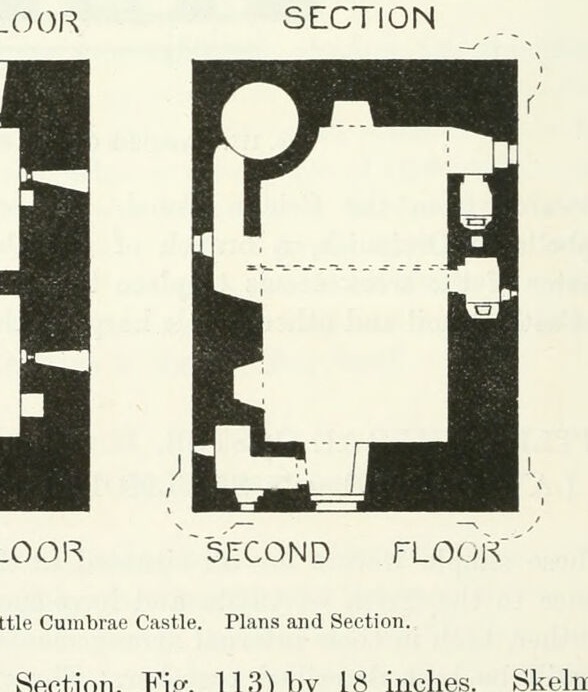
FIRST FLOOR
1889 · MacGibbon & Ross, vol. 3 (1889)
Public domain
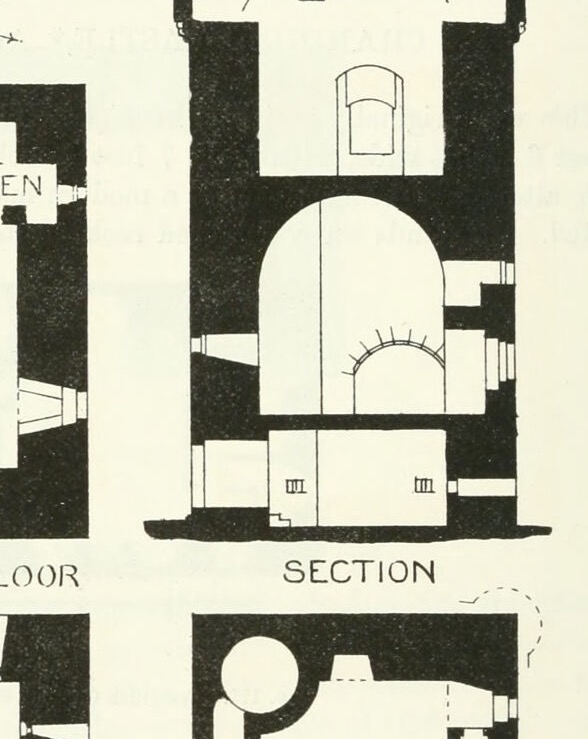
SECTION
1889 · MacGibbon & Ross, vol. 3 (1889)
Public domain
GROUND FLOOR
1889 · MacGibbon & Ross, vol. 3 (1889)
Public domain


