
Scotland · Partial ruin
Scalloway Castle
Scalloway Castle is a late 16th-century stone tower-house in Scalloway, Shetland (inception recorded 1599). The surviving fabric today is a partial ruin of the original three-storey block with projecting corner turrets and a prominent chimney stack.
First raised
1599
Its prime
1599
Today
Partial ruin
As it stood in 1599
What Scalloway Castle looked like in its prime.
Solid rectangular three-storey stone tower-house occupying a compact footprint, built of pale grey, weathered masonry. Cylindrical, corbelled angle turrets project at corners, rising above the main wall line; a tall rectangular chimney or stack pierces the centre of the roofline. Window openings are a mix of narrow slits and larger rectangular windows with plain stone surrounds. The castle sits amid low grassy hills with a small village immediately adjacent; in its prime the roofs and upper floors would have been complete, with conical turret caps.
Its story
The story of Scalloway Castle.
The Stewarts Take Shetland, 1564-1600
In 1564 Robert Stewart, illegitimate son of King James V, was granted lands in Orkney and Shetland, and established himself there as a powerful but unscrupulous figure. Despite numerous complaints against him for seizing lands and misusing taxes, James VI later made him Earl of Orkney and Lord of Shetland. He remained unpopular with the local lairds, who in turn turned the king against him. His earldom was revoked in 1587, and he died impoverished in 1593.
His son Patrick, born about 1566, had been on unfriendly terms with his father and stayed in the king's favour, being created Lord of Shetland in 1590. He effectively succeeded as Earl of Orkney when Robert died, though the succession was not formalised until 1600. In Shetland he went on appropriating lands and feuding with the lairds, his chief opponent being Laurence Bruce of Cultmalindie, son of his father's ally.
Raised by Summoned Labour, 1600-1607
Following his charter of the earldom in 1600, Patrick Stewart began the construction of Scalloway Castle, which was completed around 1607. The work was done by unpaid labourers summoned from the parishes of Shetland, and overseen by his master of works, Andrew Crawford, who was probably also responsible for Patrick's Earl's Palace in Kirkwall and for Muness Castle on Unst, built for Bruce of Cultmalindie.
Scalloway was not the earl's own seat. His main residence was the Earl's Palace his father had built at Birsay in Orkney, and the Shetland tower was used by his representative in the islands. Above the door ran an inscription, illegible today but recorded in the 18th century as naming "Patrick Stewart, Earl of Orkney and Shetland. James V King of Scots", and declaring that a house whose foundation is on a rock shall stand, but if on sand shall fall. The new castle also served as a meeting place for the thing, Shetland's parliament, during Earl Patrick's ascendancy.
The Lairds' Complaint and Earl Patrick's Execution, 1609-1615
In 1609 the Shetland lairds complained to the king of Earl Patrick's misrule of the islands. Patrick was subsequently imprisoned at Edinburgh Castle. Control of the islands was given over to James Law, Bishop of Orkney, who held his first court at Scalloway Castle in August 1612. Patrick was executed in 1615 for encouraging his son Robert to retake his Orkney possessions.
Garrison, Quarry and State Care, 1653-1980
In 1653 troops were stationed in the castle. By the early 18th century its condition was described as poor. Some of the ornamental stonework was removed to be incorporated into the Haa of Sand, an 18th-century house to the north-west of Scalloway. The roofless ruin was placed into state care in 1908, is a scheduled monument, and is maintained by Historic Scotland. Excavations in 1979-1980 uncovered the remains of 17th-century outbuildings to the north of the tower.
Step inside
4 places to explore in 1599.
The record describes 4 distinct spots at Scalloway Castle, including the full exterior approach. Create your own photoreal reconstruction and explore every one, more scenes means more rooms, more angles, and more of the place to stand in.
Build Your Own Castle
Recreate Scalloway Castle with AI to explore it.
The artist rebuilds it as it stood in 1599, a photoreal reconstruction that belongs to you alone. Pay with coins, no subscription needed.
Recreate this castle →Defend this castle →Whose castle
Clans who held Scalloway Castle.
The families that held Scalloway Castle for a decade or more across its history, follow a name to its clan.
Built in 1600 by Patrick Stewart, 2nd Earl of Orkney; after the lairds' complaints of his misrule, Bishop James Law held court at the castle by 1612.
From the archive
Scalloway Castle on paper: the measured plan and period views.
The survey plan and photographs below are the ground truth this page's reconstructions are checked against, drawn and photographed while the castle was still a working garrison. Every image is public-domain or openly licensed, with its source named.
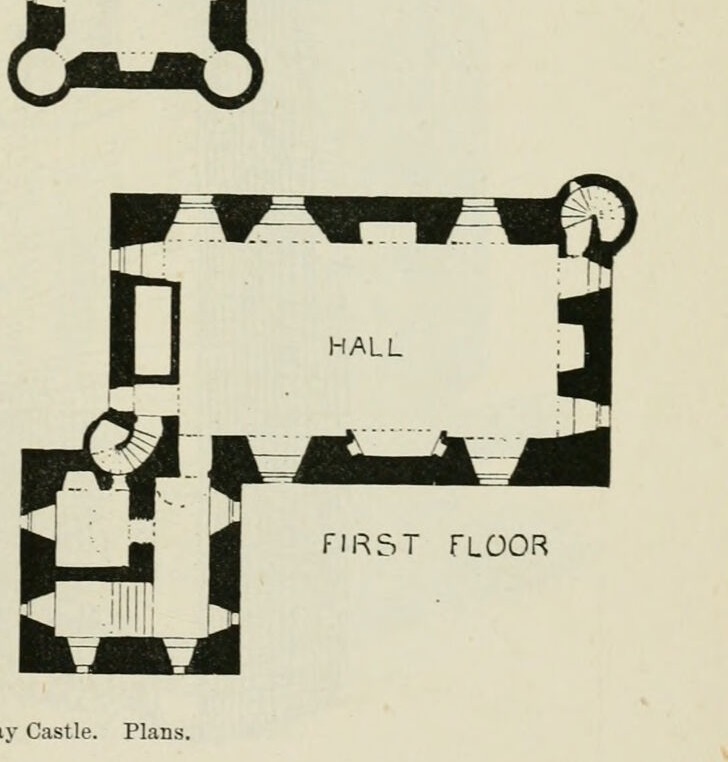
SECOND FLOOR
1887 · MacGibbon & Ross, vol. 2 (1887)
Public domain
UPPER FLOOR
1887 · MacGibbon & Ross, vol. 2 (1887)
Public domain
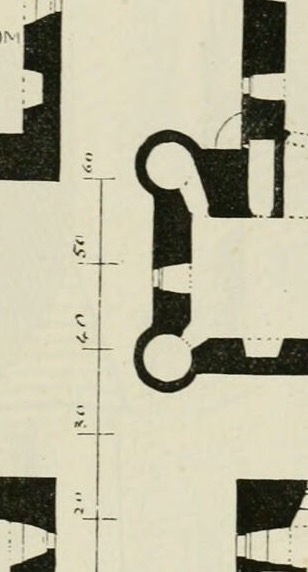
Drawn view
1887 · MacGibbon & Ross, vol. 2 (1887)
Public domain


