Clan Rising
Tarbert Castle today

Scotland · Ruin

Tarbert Castle

Tarbert Castle stands on a rocky promontory above East Loch Tarbert at the north end of Kintyre in Argyll, Scotland. A medieval royal stronghold, its most visible fabric is a late medieval tower house added by the late 15th century; the site once included an outer bailey and additional towers. The remains today are limited to standing walls and the tower stump, overlooking the harbour and loch.

Photograph via Wikimedia Commons

Its prime

1494

Today

Ruin

As it stood in 1494

What Tarbert Castle looked like in its prime.

A compact stone stronghold sited on a grassy rocky promontory above the harbour, dominated by a tall rectangular late-medieval tower house at one corner linked to lower curtain walls that form the outer bailey; several projecting tower positions break the curtain line. Masonry is coarse grey-brown rubble with larger arched window openings in the curtain and smaller vertical slits on the tower; grassy slopes fall away to the loch and village below, the whole encircling a small open courtyard.

Its story

The story of Tarbert Castle.

Tarbert Castle commands a rocky promontory above East Loch Tarbert at the north end of Kintyre, where it served as a strategic royal stronghold through the Middle Ages, one of three castles at Tarbert. The fabric is pre-14th-century in construction, but its most visible remnant is the tower, which dates to 1494 and the visit of James IV to the Western Highlands.

That date marks the castle's sharpest moment: James IV captured Tarbert from John MacDonald of Islay, Lord of the Isles, in 1494, part of his campaign to destroy the power of the Lords of the Isles. Nearly two centuries later Walter Campbell of Skipness Castle seized it as a stronghold for Archibald Campbell, 9th Earl of Argyll, during actions in support of the Monmouth Rebellion.

The outer bailey and additional towers once recorded at the site have gone; what remains are standing walls and the stump of the tower house, overlooking the harbour and the loch. The castle is now owned by the community and forms part of a volunteer-maintained heritage park.

Step inside

5 places to explore in 1494.

The record describes 5 distinct spots at Tarbert Castle, including 1 interior: view through principal arched window (interior opening). Create your own photoreal reconstruction and explore every one, more scenes means more rooms, more angles, and more of the place to stand in.

Approach from grassy slope (exterior)Seaward overlook on curtain wall (exterior)West face of the tower house (exterior)View through principal arched window (interior opening)Outer bailey grassy courtyard (exterior)

Build Your Own Castle

Recreate Tarbert Castle with AI to explore it.

The artist rebuilds it as it stood in 1494, a photoreal reconstruction that belongs to you alone. Pay with coins, no subscription needed.

Recreate this castle →Defend this castle →

Whose castle

Clans who held Tarbert Castle.

The families that held Tarbert Castle for a decade or more across its history, follow a name to its clan.

  • MacDonald

    Held by John MacDonald of Islay, Lord of the Isles, until captured by James IV in 1494.

From the archive

Tarbert Castle on paper: the measured plan and period views.

The survey plan and photographs below are the ground truth this page's reconstructions are checked against, drawn and photographed while the castle was still a working garrison. Every image is public-domain or openly licensed, with its source named.
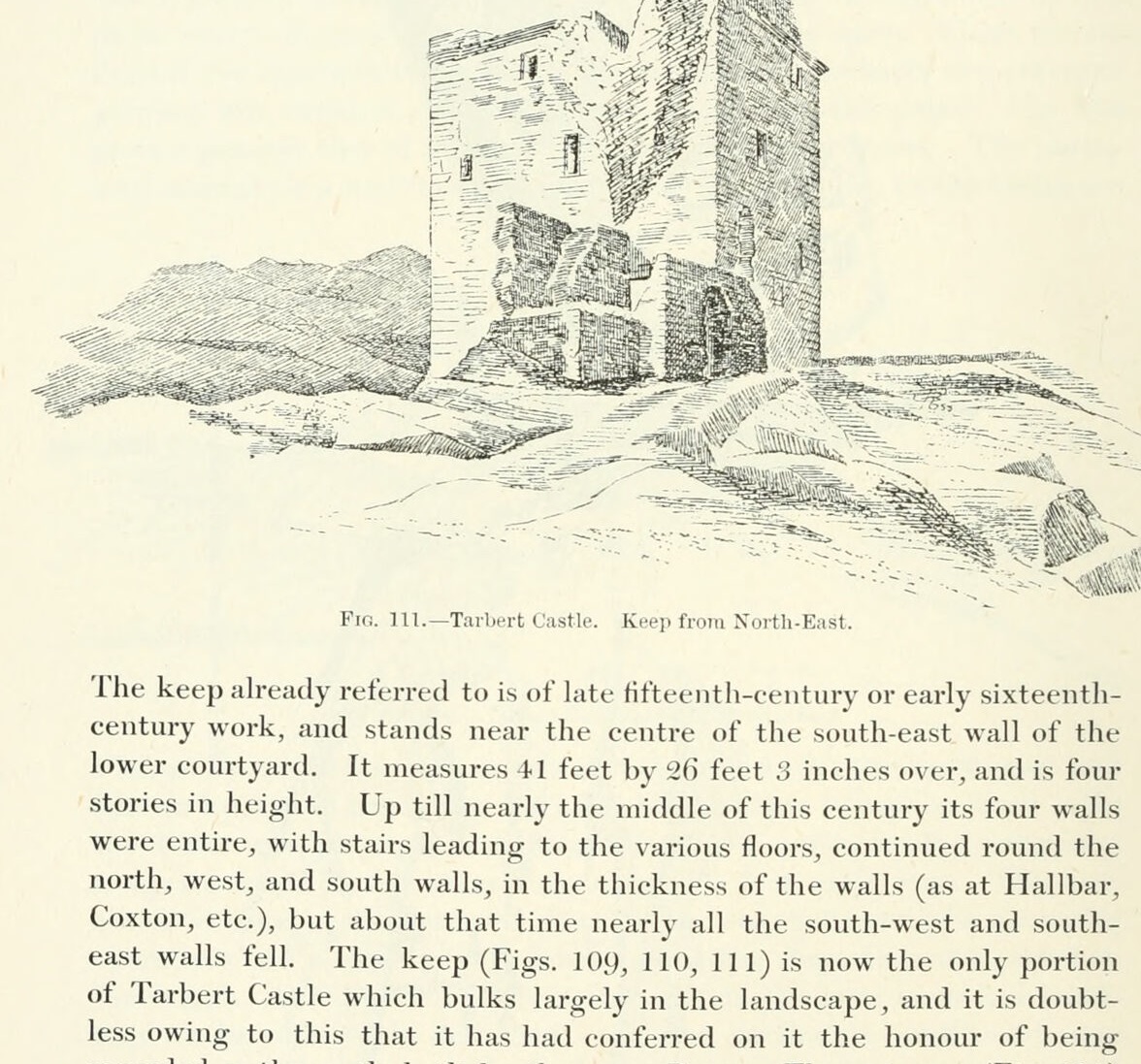
Fig. 111. — Tarbert Castle. Keep from North-East., Tarbert Castle

Fig. 111. — Tarbert Castle. Keep from North-East.

1887 · MacGibbon & Ross, Castellated and Domestic Architecture of Scotland, vol. 1 (1887)

Public domain

Questions about Tarbert Castle

What is the history of Tarbert Castle?

Tarbert Castle was a medieval royal stronghold on a rocky promontory above East Loch Tarbert. Its fabric is pre-14th-century, while the most visible tower dates to 1494, when James IV visited the Western Highlands and captured the castle from John MacDonald of Islay, Lord of the Isles. In 1687, Walter Campbell of Skipness Castle seized it for Archibald Campbell, 9th Earl of Argyll, during actions supporting the Monmouth Rebellion.

Why was Tarbert Castle built, and what was it used for?

Tarbert Castle was built and used as a strategic royal stronghold during the Middle Ages. Its position above East Loch Tarbert provided control over the harbour and water approaches, while the outer bailey and additional towers strengthened the site. It later served as a stronghold for Archibald Campbell, 9th Earl of Argyll, during actions supporting the Monmouth Rebellion.

Where is Tarbert Castle?

Tarbert Castle is at Tarbert, on the southern shore of East Loch Tarbert at the north end of Kintyre, in Argyll and Bute. It stands above the harbour and village, with views over the loch and its water approaches. The site is on a rocky promontory overlooking East Loch Tarbert.

When was Tarbert Castle built?

Tarbert Castle was constructed before the 14th century, with a later tower house dating to 1494. The earlier fortified structure was built during the 13th century, and an outer bailey and towers were added in the 1320s. The site's first-raised year is not recorded, so the castle developed in several stages.

Was Tarbert Castle ever attacked or besieged?

Tarbert Castle was captured in 1494 by James IV from John MacDonald of Islay, Lord of the Isles. In 1687, Walter Campbell of Skipness Castle seized it as a stronghold for Archibald Campbell, 9th Earl of Argyll, during actions supporting the Monmouth Rebellion. The supplied account describes these attacks as captures or seizures rather than using the word siege.

Which family or clan held Tarbert Castle?

Tarbert Castle was held by MacDonald, specifically John MacDonald of Islay, Lord of the Isles, until James IV captured it in 1494. This was part of James IV's campaign to destroy the power of the Lords of the Isles.

What did Tarbert Castle look like in its prime?

In its prime, Tarbert Castle was a compact stone stronghold on a grassy, rocky promontory above the harbour. A tall rectangular late-medieval tower house stood at one corner, linked to lower curtain walls enclosing an outer bailey and small courtyard. Coarse grey-brown rubble, arched window openings, vertical tower slits and projecting tower positions defined its appearance.

Is Tarbert Castle still standing, or is it a ruin?

Tarbert Castle is a ruin, with only standing walls and the stump of the tower house surviving. The outer bailey and additional towers once recorded at the site have gone. Its remains overlook the harbour and loch, and the site forms part of a volunteer-maintained heritage park owned by the community.
All castles of Scotland · Castles of Europe · the best castles in Europe · explore the finished reconstructions.