Scotland · Still standing
Wemyss Castle
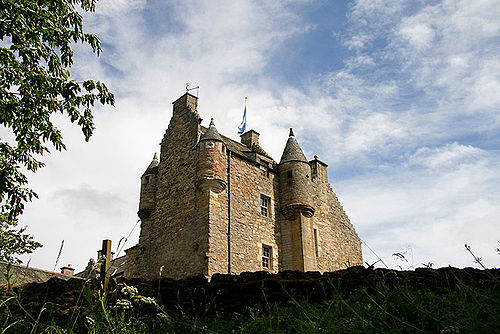
Wemyss Castle is a multi-period stone castle on sea cliffs at Wemyss in Fife, Scotland, long the seat of the Earls of Wemyss. The building incorporates a 15th-century tower (later used as a windmill and dovecote) and 19th-century additions such as stables and gatepiers, and has hosted royal visitors including Mary, Queen of Scots. An oval-shaped dungeon lies within the fabric of the castle.
Its prime
1895
Today
Still standing
As it stood in 1895
What Wemyss Castle looked like in its prime.
Perched atop sea cliffs overlooking the Firth of Forth, Wemyss Castle is a compact cluster of stone buildings combining a medieval tower and later 19th-century ranges. At least one older tower (15th century) is visibly incorporated and was later used as a windmill and dovecote. The composition includes 19th-century stables and gatepiers, varied rooflines of pitched roofs against the tower, and an internal oval-shaped dungeon reached by a stone passage; overall complete and occupied at its prime.
Its story
The story of Wemyss Castle.
Sir John Wemyss Builds, 1421
Accounts date the castle to 1421, when Sir John Wemyss set about building a fortified castle to replace one the Duke of Rothesay had destroyed at Kilconquhar in 1402. The site he chose is high on the sea cliffs between the villages of East Wemyss and West Wemyss, looking out over the Firth of Forth, and it became the ancient seat of the Earls of Wemyss and their families.
What stands is the work of several periods rather than one. A tower from an earlier building was kept and put to other uses, serving first as a windmill and later as a dovecote; an oval dungeon lies within the castle, connected to it by a passage; the stables and gatepiers date from the 19th century.
Mary Meets Darnley, 17 February 1565
Wemyss is perhaps best known for a single day. On 17 February 1565 Mary, Queen of Scots met Lord Darnley here, the man she would go on to marry. The court of James VI stayed at the castle in July 1583.
On 11 May 1590 it lodged a more official party: Danish commissioners led by Peder Munk, with the Scottish lawyer John Skene, whose task was to view and take sasine of Falkland, Dunfermline and Linlithgow, the palaces James VI had given Anne of Denmark as a morning gift.
A Bride Locked In, a Lady Sheltered
In April 1591 the king used Wemyss as a prison of a domestic kind, shutting away Lilias Ruthven, a daughter of William Ruthven, 1st Earl of Gowrie, to stop her marrying Ludovic Stewart, 2nd Duke of Lennox. It did not hold. Lennox got his bride out of the castle and married her at Dunkeld, and after ten days James allowed the couple to come to court.
The following year Sir John Wemyss of Wemyss used the place the other way about, giving refuge to Margaret Vinstarr, the queen's Danish lady-in-waiting, whose partner John Wemyss of Logie had plotted with Francis Stewart, 5th Earl of Bothwell, against the king. The episode is celebrated in the ballad The Laird o Logie.
The King's Prisoners and the Coaltown
John Wemyss was obliged to keep prisoners for the king at Wemyss. In 1597 that meant Archie Armstrong of Whitehaugh from the Scottish borders, a duty he and other lairds complained of; in April the king wrote asking him to bring Armstrong instead to Falkland Palace, to be kept there.
Three centuries later, in the 1890s, the Coaltown of Wemyss was established on castle land as an estate village, housing the men working the several mines in the area. The castle carries a ghost story as well (a Green Lady in a trailing dress of green silk, green being a colour Scottish folk belief long tied to misfortune), though a news report in 2007 suggested the sightings had ceased.
Step inside
6 places to explore in 1895.
The record describes 6 distinct spots at Wemyss Castle, including 4 interiors: 15th-century tower (reused as dovecote), oval-shaped dungeon, passage to the dungeon and more. Create your own photoreal reconstruction and explore every one, more scenes means more rooms, more angles, and more of the place to stand in.
Build Your Own Castle
Recreate Wemyss Castle with AI to explore it.
The artist rebuilds it as it stood in 1895, a photoreal reconstruction that belongs to you alone. Pay with coins, no subscription needed.
Recreate this castle →Defend this castle →Whose castle
Clans who held Wemyss Castle.
The families that held Wemyss Castle for a decade or more across its history, follow a name to its clan.
Wemyss
Built by Sir John Wemyss in 1421; the ancient seat of the Earls of Wemyss and their families.
Nearby