
Slovakia · Partial ruin
Devín Castle
Devínsky hrad
Devín Castle is a hilltop fortress on a limestone cliff at the confluence of the Danube and Morava rivers near Bratislava. The site was fortified from prehistoric and Roman times and later developed into a medieval stone castle with a palace and a pre‑Romanesque church; it was partly destroyed in 1809 and has been subject to excavation and restoration. Today the site is a museumized ruin with reconstructed sections and visible archaeological remains.
Its prime
1600
Today
Partial ruin
As it stood in 1600
What Devín Castle looked like in its prime.
Perched on a jagged pale limestone crag, the castle presents multi-level curtain walls and terraces climbing the cliff, with ruined rectangular tower remnants at the summit. The masonry is light-grey local stone laid in irregular courses; many walls step down the rock in terraces with visible stair runs and narrow embrasured openings. A tiny separate watchtower (the Maiden Tower) sits on a lone rock below the main enceinte. Open courtyards and fragments of palace walls occupy the flatter terraces.
Its story
The story of Devín Castle.
The Rock Above Two Rivers: Celts, Romans and the Amber Road
The limestone crag at the confluence of the Danube and Morava has been settled since the Neolithic and fortified since the Bronze and Iron Ages. The 212-metre cliff commands the Danube trade route where it crossed a branch of the Amber Road. A Hallstatt-era village covered the hilltop in the 7th and 6th centuries BC, and by the last century BC the Celts held it, their hillfort forming a triangle of strongholds with Braunsberg near Hainburg and the oppidum at Bratislava.
After Augustus annexed Pannonia in AD 6–9 the middle Danube became the imperial frontier, and a Roman camp within the Limes Romanus rose on the Celtic foundations as a forward post for Carnuntum and its legions; the Romans left the first masonry buildings on Slovak soil, work probably connected with the Marcomannic Wars of 166–180. The last Roman construction came under Valentinian I (364–375): Ammianus Marcellinus records the emperor building fortified posts in the land of the Quadi, a report that may concern Devín. The Roman presence ended around 400.
Dowina, 864: Louis the German Besieges Rastislav
The castle's first written mention may come in 864, when the East Frankish king Louis the German besieged Prince Rastislav of Moravia in the "castle of Dowina" (a name the Annals of Fulda glossed from the Slavic deva, "a girl"), though the identification of Dowina with Devín remains debated. Under Great Moravia the fort was the centre of a larger settlement, its defences deepened by smaller outlying hillforts on Devínska Kobyla at Na pieskach and Nad lomom.
Between roughly 850 and the 860s a pre-Romanesque church rose within the ramparts, its east end closed by three apses in a trefoil plan, a rare design closest to churches of Dalmatia and Noricum, its frescoes painted with pigments that chemical analysis traces to northern Italy. Six graves of the Great Moravian era near the church are attributed to a local ruler's retinue and their families. The church is thought to have vanished within a century.
Frontier Stone of the Hungarian Kings
At the end of the 12th century or the start of the 13th a stone fortress in royal hands replaced the old rampart: a massive hexagonal tower crowning the crag, reachable only along the eastern ridge. It guarded the western frontier of the Hungarian Kingdom, documented in 1271, with a castelanus de Devin named in 1326. After the Árpád dynasty died out in 1301, Otto of Tallesrunn held Devín until 1322, when he surrendered it to the Hungarian crown.
On 26 May 1419 King Sigismund of Luxembourg granted the castle to Palatine Nicholas Garay, a favour probably owed in part to Garay's wife Anna of Celje, elder sister of Sigismund's queen. Garay rebuilt the border post as a late-Gothic seat: a palace with two upper storeys, a semicircular bastion, a curtain wall with polygonal tower, a western gate with drawbridge and moat. The defences were reinforced again during the wars against the Ottoman Empire, and the castle was never taken.
Pawned for 40,000 Guilders, Destroyed in 1809
Once Hungary joined the Habsburg monarchy and the Ottomans were defeated, Devín ceased to matter as a border fortress. Keglević pawned the castle to the Palocsai family for 40,000 guilders and spent the money; in 1609 Matthias II confirmed Keglević as owner, but he could never redeem the pledge, and in 1635 Palatine Pál Pálffy took the castle out of pawn. The Counts Pálffy were its last private owners.
In 1809, after the Siege of Pressburg, the retreating forces of Napoleon destroyed the castle, which may still have been judged a threat. Napoleon and Leopold Pálffy then negotiated an agreement under which Pálffy would supply Vienna with provisions. The family sold the ruins to the state in 1932.
A Nation's Ruin on the Iron Curtain
From the 19th century the ruin became a national symbol for Slovaks, taken up by Romantic poets and the followers of Ľudovít Štúr; it later appeared on the 500 Czechoslovak koruna banknote and Slovakia's 50-halier coin. Hungarians read the rock the other way, as the western gateway of their kingdom.
Under communist Czechoslovakia the Iron Curtain ran just in front of the castle: the ruin stayed open to visitors, but the ground around it was a restricted military zone of watchtowers and barbed wire, part of the border strip that kept people from escaping the country. It was demilitarised after the Velvet Revolution of 1989. Restoration has continued since the end of the Second World War, and the most recent improvements for visitors were completed in 2023. The Maiden Tower, the tiny watchtower balanced on its lone rock, still carries its legends of imprisoned lovelorn daughters leaping to their deaths.
Step inside
8 places to explore in 1600.
The record describes 8 distinct spots at Devín Castle, including 2 interiors: 15th-century palace (palace hall), pre‑romanesque church. Create your own photoreal reconstruction and explore every one, more scenes means more rooms, more angles, and more of the place to stand in.
Build Your Own Castle
Recreate Devín Castle with AI to explore it.
The artist rebuilds it as it stood in 1600, a photoreal reconstruction that belongs to you alone. Pay with coins, no subscription needed.
Recreate this castle →Defend this castle →Whose castle
Clans who held Devín Castle.
The families that held Devín Castle for a decade or more across its history, follow a name to its clan.
Keglević
Owners into the early 17th century, confirmed by Matthias II in 1609, though the castle lay pawned.
Palocsai
Held the castle in pledge from Keglević until Palatine Pál Pálffy redeemed it in 1635.
Pálffy
Palatine Pál Pálffy took the castle out of pledge in 1635; the Pálffys held Devín until selling the ruins to the state in 1932.
From the archive
Devín Castle on paper: the measured plan and period views.
The survey plan and photographs below are the ground truth this page's reconstructions are checked against, drawn and photographed while the castle was still a working garrison. Every image is public-domain or openly licensed, with its source named.
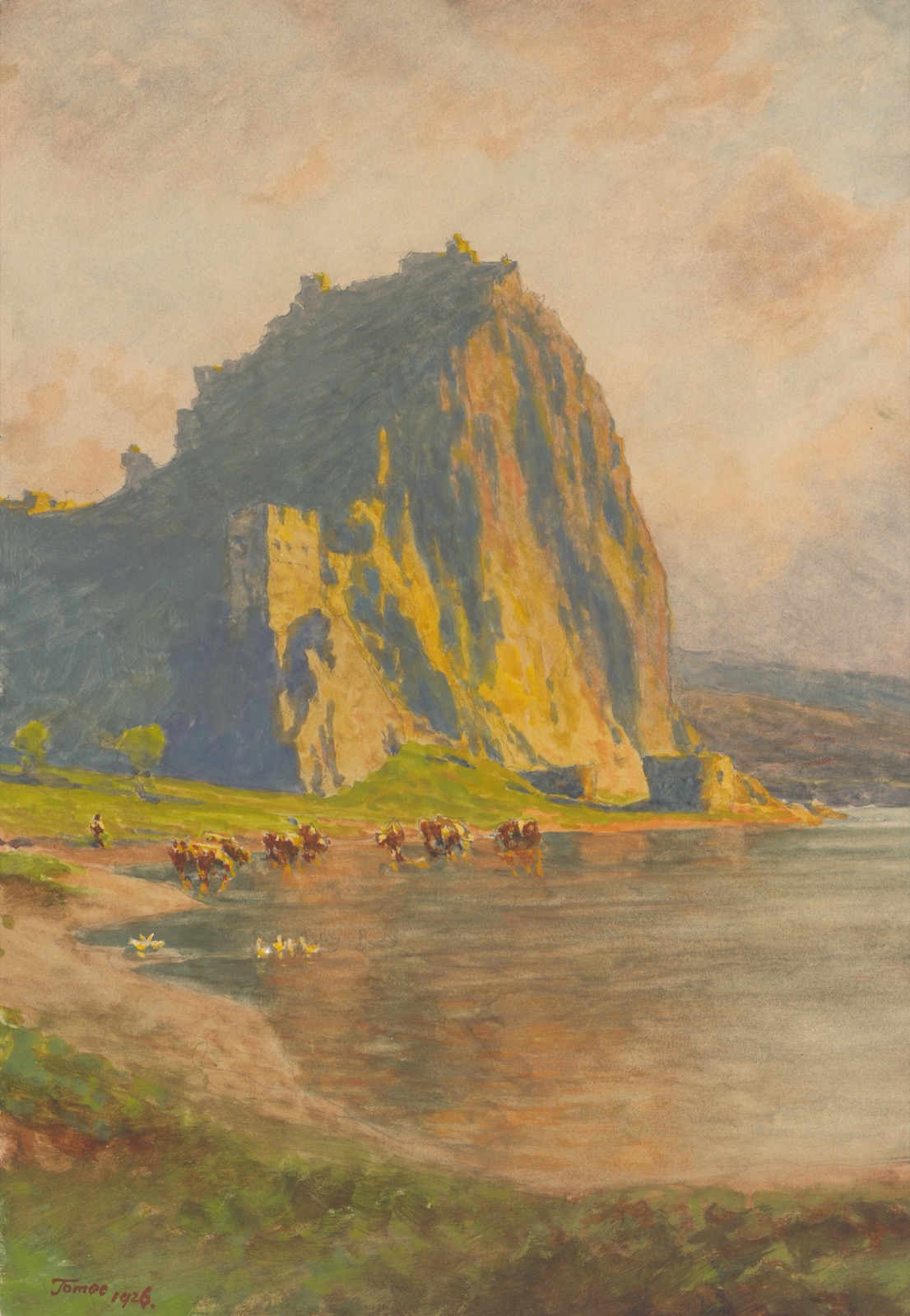
Hrad Devín
· Slovak national gallery (via Europeana)
Public domain

Questions about Devín Castle
What is the history of Devín Castle?
What is inside Devín Castle?
Why was Devín Castle built, and what was it used for?
Where is Devín Castle?
Was Devín Castle ever attacked or besieged?
Which family or clan held Devín Castle?
What did Devín Castle look like in its prime?
Is Devín Castle still standing, or is it a ruin?
Can you visit Devín Castle?
More castles of Slovakia


Explore the city
