
Slovakia · Partial ruin
Spiš Castle
Spišský hrad
Spiš Castle is a large medieval hilltop fortress in eastern Slovakia, occupying a travertine limestone plateau above the town of Spišské Podhradie. The complex grew from a Romanesque stone stronghold into a fortified residence with expanded extramural settlements and later Gothic additions. It was partly rebuilt and archaeologically investigated in the twentieth century and is administered by the Spiš Museum.
First raised
1200
Its prime
1650
Today
Partial ruin
As it stood in 1650
What Spiš Castle looked like in its prime.
At its prime the castle formed a continuous ring of pale travertine limestone curtain walls crowning a steep grassy hill, interrupted by a cluster of towers, both cylindrical and rectangular, and an elevated keep at the eastern summit. A broad upper ward contained the two-story palace ranges with pitched roofs and the chapel and church ranges; lower terraces held walled extramural settlements. Approaches climbed the southern slope along a paved road, and battlement walks ran atop the heightened walls.
Its story
The story of Spiš Castle.
A Frontier Fort of the Hungarian Kings
The travertine hill rises some two hundred metres above the country around it, its cliffs falling away 20 to 40 metres almost sheer, a place that needed no masonry to be hard to reach. Building of the medieval castle began early in the 12th century as a boundary fort on the northern frontier of the Kingdom of Hungary, and it served for centuries as the seat of the head of Szepes county.
The date of the first written notice is disputed: 1120 by some accounts, 1209 by others, the later date that of a charter recording a sale of land to the Spiš provost Adolf that was removed from the county head's jurisdiction, which implies the county seat already stood on the rock. A charter of Béla IV dated 19 September 1249 records permission to raise a tower and a palace “in castro nostro Scypus”, on our castle of Spiš. A round residential tower on the summit had by then been lost, probably to a tectonic fault, and was replaced in the first third of the 13th century, the years that also produced the two-storey Romanesque palace on the neck of the rock.
The Mongols in 1241, Matúš Čák in 1312
Spiš was one of the few castles to hold out against the Mongol invasion of 1241, and its defences were strengthened afterwards all the same, by north Italian masons who also worked at Spišská Kapitula and Spišský Štvrtok. When the Árpád dynasty died out with Andrew III in 1301 the war of succession reached Spiš. Omodej Aba took the castle and the county office, and his family soon went over to Charles I. In 1312, after the battle of Rozhanovce, Matúš Čák of Trenčín laid siege to the place, and the county head Filip Druget held it against him.
Jiskra's Round Fort and the Zápolya Grant of 1465
In the succession crisis that opened with Albrecht II's death in 1439, Elizabeth of Luxembourg called in Ján Jiskra of Brandýs and his Bratrík troops to defend the interests of her infant son Ladislaus. Jiskra reached Spiš in 1441; a first attempt on the castle failed, and he took it instead by arrangement with the castle captain Peter Basko. He made it his seat, refortified the lower courtyard and raised there a circular fortlet seventeen metres across. His captain Peter Aksamit left the castle in 1453.
In 1465 Matthias Corvinus rewarded the Zápolyas with Spiš in hereditary tenure, the title of hereditary count and eleven free Spiš towns. They rebuilt in the late Gothic manner, keeping the Romanesque palace as the principal building, adding a chapel around 1470 and turning the upper castle into a comfortable family residence. On 2 February 1487 the palatine Stephen Zápolya and his wife Hedvig had a son here, John, later king of Hungary.
Guns on the Walls, Then the Fire of 1780
The Thurzós held Spiš through most of the 16th century and built in the Renaissance taste their foreign trade had made familiar; when their Spiš line failed in the male succession in the 1630s a royal decision handed the castle to the Csákys, its last noble owners, who held it until 1945. Their remodelling, running from the 1640s to 1663, put an armoury in the Romanesque palace and rebuilt the entrance for defence by cannon. During the anti-Habsburg risings of Thököly and Rákóczi imperial troops quartered here broke through the high walls of the upper castle beside the palace so that guns could bear on the road from Branisko to Levoča, and set a second gun position in the middle of the courtyard. When they marched out only a small garrison remained, paid for by the family, who were already moving down to new manor houses below the rock.
In 1780 fire destroyed the castle. Its cause is unknown: that the Csákys burned it to escape the tax then levied on roofed buildings, that lightning struck it, and that soldiers distilling spirits in the castle set it alight are all told. Nobody lived there afterwards, and villagers carried off the loosened masonry as building stone. An imperial commission examined the ruin in 1865 and judged it too far gone to conserve. The state took it over in 1945, made it a national cultural monument in 1961 and began the long rescue, backed by archaeological research, that followed; in 1993 the castle joined the UNESCO World Heritage list with Spišská Kapitula and Žehra.
Step inside
8 places to explore in 1650.
The record describes 8 distinct spots at Spiš Castle, including 4 interiors: upper ward, two-storey palace, three-nave basilica, nave, late gothic chapel and more. Create your own photoreal reconstruction and explore every one, more scenes means more rooms, more angles, and more of the place to stand in.
Build Your Own Castle
Recreate Spiš Castle with AI to explore it.
The artist rebuilds it as it stood in 1650, a photoreal reconstruction that belongs to you alone. Pay with coins, no subscription needed.
Recreate this castle →Defend this castle →Whose castle
Clans who held Spiš Castle.
The families that held Spiš Castle for a decade or more across its history, follow a name to its clan.
Zápolya
Held by the Zápolya family until 1528, who turned the upper castle into a Renaissance residence.
Thurzó
Held by the Thurzó family, 1531–1635.
Csáky
Held by the Csáky family from 1638 until 1945, its last noble owners.
From the archive
Spiš Castle on paper: the measured plan and period views.
The survey plan and photographs below are the ground truth this page's reconstructions are checked against, drawn and photographed while the castle was still a working garrison. Every image is public-domain or openly licensed, with its source named.
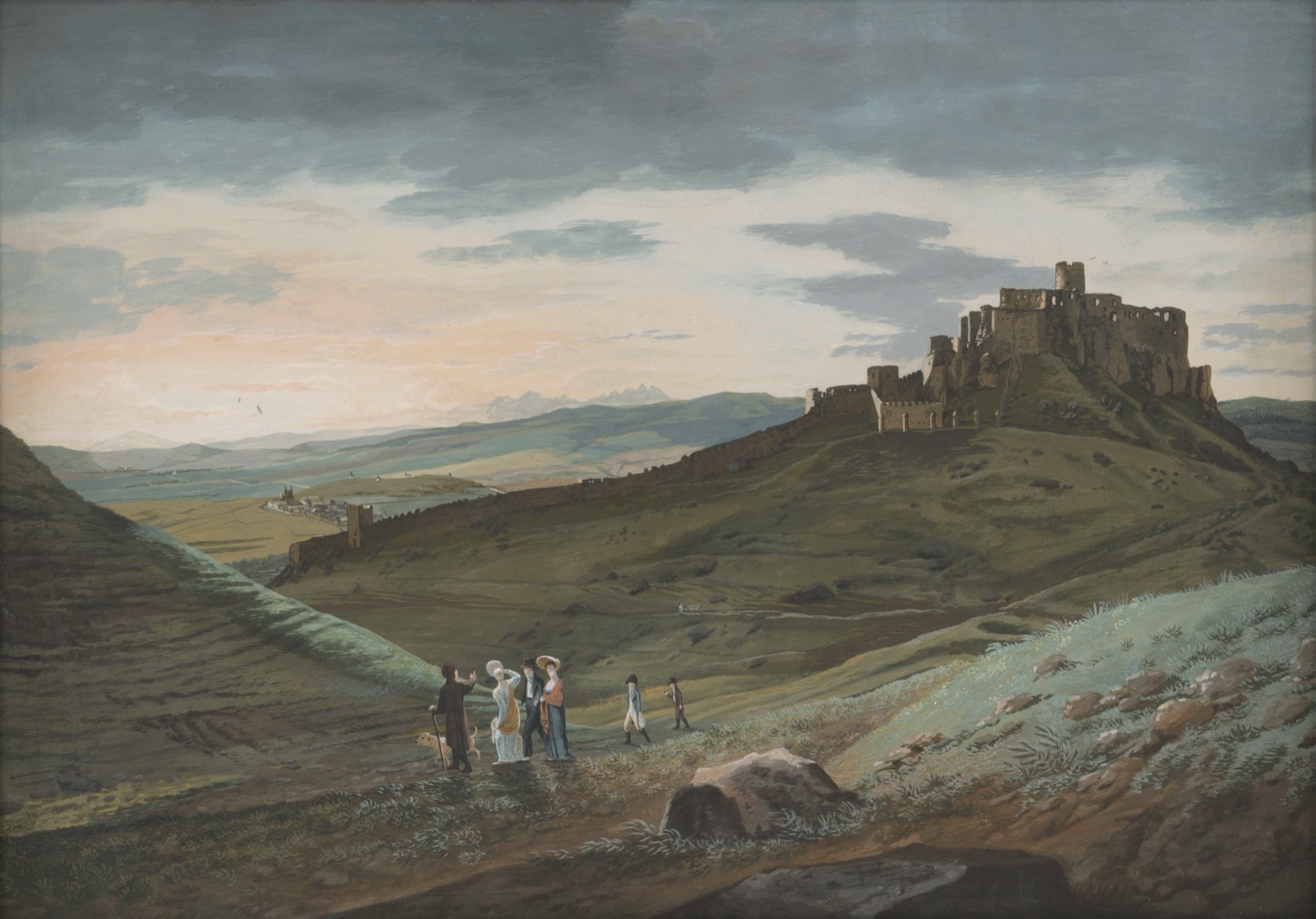
Krajina so spišským hradom
· Slovak national gallery (via Europeana)
Public domain


