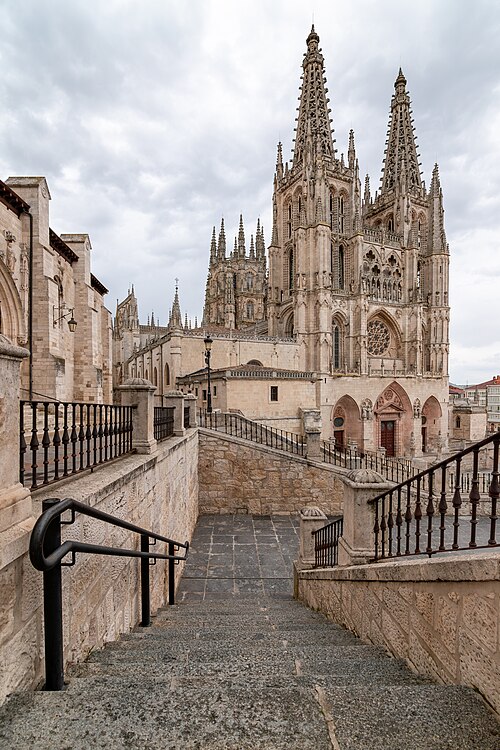
Spain · Ruin
Castle of Burgos
Castillo de Burgos
The Castle of Burgos is a medieval fortress and royal alcázar sited on the hill of San Miguel above the city of Burgos. Built and altered from Roman and Visigothic origins through the Middle Ages, it served as a royal residence, prison and military strongpoint before being nearly destroyed by French demolition in 1813; its remains survive as an archaeological site and interpretation centre.
First raised
900
Its prime
1470
Today
Ruin
As it stood in 1470
What Castle of Burgos looked like in its prime.
Perched atop the rounded San Miguel hill, the castle presents a compact mass of high ashlar limestone curtain walls with crenellated parapets, punctuated by a mix of square and semicircular towers and a dominant rectangular tower of homage; northern gatehouses and vaulted entrance passages lead into an inner bailey. Behind the walls low-pitched tiled roofs of palace ranges and a chapel sit slightly lower than the battlements, all set above the surrounding Castilian plain.
Its story
The story of Castle of Burgos.
The Hill of San Miguel and the Founding of Burgos
The castle occupied the hill of San Miguel, 75 metres above the city. Archaeological study in the mid-1980s placed the oldest settlement on record in Burgos, dated around 2000 BC, on the hill itself, and excavations of 1925 and 1926 put the origin of the castle with the Visigoths and its oldest parts with the Romans.
In the early 860s the Muslim historian Ibn 'Idhari records an expedition that defeated "Gundisalvo", lord of Burdgia. Eduardo de Oliver Copons held that a great fortress already stood by 865, when Al-Mundhir of Córdoba led the Muslims onto the Castilian plateau. Twenty years later the Asturian king Alfonso III ordered Count Diego Rodríguez Porcelos to repopulate and refortify Burgos; the first tower on the hill is dated to 884.
Kings, Palace and Prison: Alfonso VIII, Henry IV and the Infante Frederick
The first great transformation came probably under Alfonso VIII of Castile, when expert builders reworked the castle to the Mudéjar taste of the day; Henry IV made the second, largely for beautification, turning it into a palace of halls, chambers and chapel. The palace known as Alfonso X's was lived in by Henry III and by his son John II.
It also served as a state prison. Its captives included the kings García II of Galicia and Alfonso VI of León and Castile, and Tomás de Gournay, murderer of Edward II of England. In 1277, as the Annals of the reign of Alfonso X record, the Infante Frederick of Castile, son of Ferdinand III, was executed here by order of his brother Alfonso X, along with Simón Ruiz of Cameros, Frederick's son-in-law. The Annals say the king had his brother "put in a chest that was filled with sharp irons", and that he died there. After years in an unworthy place, Frederick's remains were moved in 1282, by order of his nephew Sancho IV, to the Burgos convent of the Santísima Trinidad.
Ferdinand's Siege to the Gunpowder School, 1474–1542
Ferdinand the Catholic besieged the castle in the war against Joanna la Beltraneja, opening the blockade in August 1474 and holding it until January 1476. Luciano Serrano records some of the hardest fighting in the castle's history: miners worked with the double purpose of intercepting the well, to cut the garrison's water, and bringing down the walls. The well itself, over 60 metres deep and dated to the 12th and 13th centuries, is first reported in 1475, in the middle of that siege.
Under Ferdinand the castle was converted into an artillery fort. As military technique changed and Spain's wars moved overseas it lost its defensive function; the first training school for gunners in Spain was established inside the walls, producing twenty quintals of gunpowder a day by 1542.
Fire, French Occupation and the Explosion, 1730s–1813
A fire in the 1730s gutted the interior, coffered ceilings among it. In the Peninsular War the French strengthened the castle as a strong point commanding the Castilian plain and sited their imperial battery there: the position chosen, it is said, by Napoleon himself. Between September and October 1812, after the Battle of Salamanca, the castle was the centre of the Siege of Burgos, pressed by the Anglo-Portuguese troops of Arthur Wellesley, the future Duke of Wellington; during the siege the French blew up the church of San Román. Difficulties of supply and French reinforcements coming up from Andalusia forced Wellington to abandon the siege after a series of failed attacks and fall back to the Portuguese frontier.
In June 1813 Wellington's rapid advance caught the French off balance, and they chose to evacuate rather than be cut off. Demolition parties were to erase any military or documentary material of use to the enemy. Such was their haste that the castle was blown up before the last soldiers had got clear: more than two hundred French troops died in a blast that shook the city. The church of Santa María la Blanca was destroyed, the cathedral lost most of its windows and San Esteban was damaged. The French dead lie buried in the chopera del Carmen.
Semaphore Station to Interpretation Centre, from the 19th Century
The ruined castle became position 27 on the Line of Castile, the optical telegraph chain devised in 19th-century Spain to link Madrid with Irún. It was used sporadically during the Carlist Wars, and in the civil war of 1936 the city's anti-aircraft defence was installed within its walls.
Reconstruction was attempted between 1955 and 1958, and the excavation of 1985 uncovered the deep well and its spiral stair. The ruins are owned by Burgos City Council, protected as a bien de interés cultural and part of a UNESCO World Heritage Site; the interpretation centre opened in 2003, and visitors may also see the well and the underground galleries known as the Cueva del Moro.
Step inside
10 places to explore in 1470.
The record describes 10 distinct spots at Castle of Burgos, including 6 interiors: northwestern gatehouse and vaulted entrance passage, main inner courtyard and cistern, deep well (cueva del moro) with spiral stair and more. Create your own photoreal reconstruction and explore every one, more scenes means more rooms, more angles, and more of the place to stand in.
Build Your Own Castle
Recreate Castle of Burgos with AI to explore it.
The artist rebuilds it as it stood in 1470, a photoreal reconstruction that belongs to you alone. Pay with coins, no subscription needed.
Recreate this castle →Defend this castle →From the archive
Castle of Burgos on paper: the measured plan and period views.
The survey plan and photographs below are the ground truth this page's reconstructions are checked against, drawn and photographed while the castle was still a working garrison. Every image is public-domain or openly licensed, with its source named.
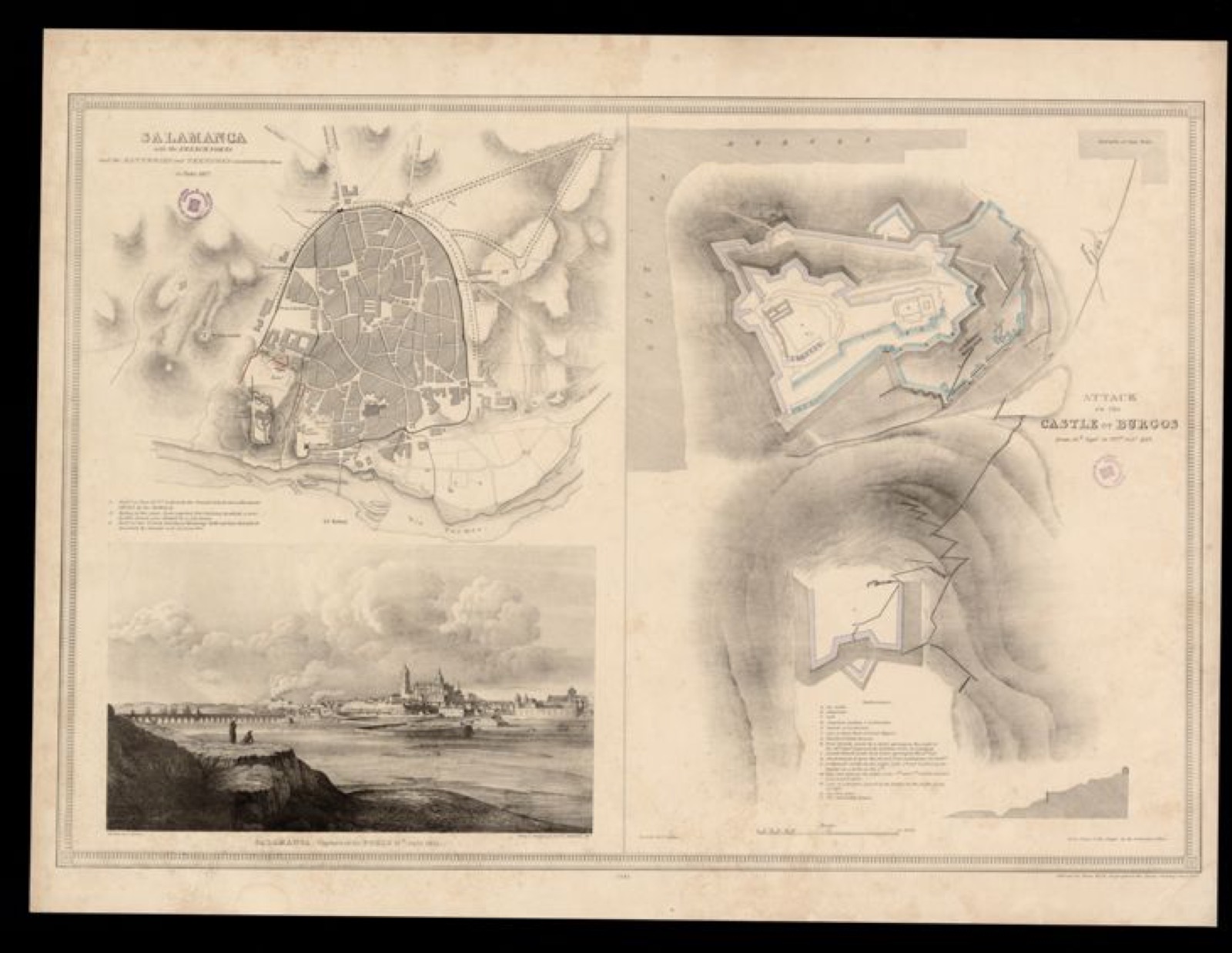
Attack on the castle of Burgos, from 19th Sept. to 22nd Oct. 1812 ; Salamanca with the French forts and the ba
· Cartographic and Geological Institute of Catalonia (via Europeana)
Public domain