
Spain · Restored
Castle of Coca
Castillo de Coca
The Castle of Coca is a 15th–16th century Mudéjar brick castle in Coca, central Spain, notable for its hybrid Moorish–Gothic brickwork and a rectangular three-ring defensive plan with a central keep. Built beside a plain above a meander of the River Voltoya, it retains an inner enceinte, a north-side Torre del Homenaje (keep), moat and talus and today is a restored national monument open to visitors.
First raised
1453
Its prime
1512
Today
Restored
Ranked among Europe’s castles
As it stood in 1512
What Castle of Coca looked like in its prime.
Rectangular plan of hardened reddish-brown brick laid smooth with visible mortar lines, pierced by a high brick arched gate framed by an alfiz; white limestone used for column decoration in the central courtyard and on the keep. Three-tiered defences: outer curtain and towers (originally rectangular), inner curtain with centered cylindrical towers and smaller intervening turrets, machicolations and crenellated battlements with projecting crests, a sloping talus descending to a deep wide moat, and a 25-metre Torre del Homenaje on the north side.
Its story
The story of Castle of Coca.
Coca Exchanged for Saldaña, 1439–1493
Coca belonged to the crown of Castile until 1439, when it was granted to the Marquis of Santillana, who exchanged it with Alonso de Fonseca y Ulloa, bishop of Ávila and later archbishop of Seville, for the town of Saldaña. In 1453 Juan II of Castile gave Fonseca royal licence to raise a castle there. Alonso handed his rights over Coca to his brother Fernando in 1460, and Fernando held them until his death in 1463; when Alonso himself died in 1473, Coca went to Fernando's son, Alonso de Fonseca y Avellaneda, who is credited with building most of the castle. The work was substantially finished by 1493, and the family kept the place as a lordly residence.
It is one of the few Spanish fortresses not set on a hilltop, built instead at the edge of a plain above a meander of the River Voltoya, about 45 kilometres north of Segovia, and ringed by a wide, deep moat. A Moorish master builder, an alarife, supervised the work, and the walls went up almost entirely in brick, though not the ordinary brick of houses: these were hardened to take punishment in a siege, and laid flush with the mortar so the courses themselves read as pattern. Limestone was used in the arrow-slits and embrasures.
Antonio de Fonseca and the Marquis of Cenete
In 1502 the Catholic Monarchs made sure that on Alonso's death the castle would pass to his brother Antonio de Fonseca, and the following year Isabella decreed that only male heirs could inherit the town of Coca, shutting out Alonso's two daughters. Antonio, a captain of the Catholic Monarchs, took possession in 1504 and enlarged the defences, which were later needed. The Marquis of Cenete attacked the castle hoping to carry off his betrothed, María de Fonseca, whom her uncle was holding there; the attempt failed. Sevillian alarifes worked at Coca in 1512, and much of its ornament is probably theirs.
The Comuneros Turned Away, 1521
In 1521 comunero troops came against Coca in reprisal for the burning of Medina del Campo, a town that had held a large store of artillery and was razed after its people resisted, an act laid at Antonio de Fonseca's own door. They could not get into the castle. They destroyed the nearby fortress of Alaejos instead.
From State Prison to French Barracks, 1645–1812
In 1645 the castle held a prisoner of the first rank: Gaspar Alfonso Pérez de Guzmán, 9th Duke of Medina Sidonia, accused of treachery for instigating the Andalusian independence conspiracy of 1641, of having meant to have himself proclaimed king of Andalusia. Coca later passed by marriage to the House of Alba. Building went on through these centuries: galleries around the Patio de Armas in the sixteenth, a gallery linking the Torre del Homenaje to the Pedro Mata tower in the seventeenth, further work in 1715.
After 1730 the castle's archive was carted off to Madrid and the place fell to neglect and pilfering. French troops occupied Coca in 1808 and quartered themselves in the castle; a fire during the occupation destroyed the chapel ceiling, and when they left in 1812 much of the building was ruin. In 1828 an administrator for the House of Alba sold off its fabric, marble columns from the courtyard among them, to the highest bidder.
Columns Bought Back, and a Forestry School, 1926–1958
Coca was declared a national monument by decree-law on 9 August 1926, and given further protection as a historic monument in 1931. In 1952 eight of the balustrade columns that had been sold out of the castle were bought back from Olmedo and Íscar at 35,000 to 40,000 pesetas apiece. Two years later the House of Alba ceded the castle to the Ministry of Agriculture for a hundred years less a day. Restoration followed under the architect Miguel de los Santos Nicolás, with Francisco Pons Sorolla on the team and a free hand from the General Directorate of Fine Arts; the work was completed in 1958, and the Escuela de Capacitación Forestal, a forestry training school, opened in the castle that year.
Step inside
12 places to explore in 1512.
The record describes 12 distinct spots at Castle of Coca, including 2 interiors: chapel interior, weapons room / armory. Create your own photoreal reconstruction and explore every one, more scenes means more rooms, more angles, and more of the place to stand in.
Build Your Own Castle
Recreate Castle of Coca with AI to explore it.
The artist rebuilds it as it stood in 1512, a photoreal reconstruction that belongs to you alone. Pay with coins, no subscription needed.
Recreate this castle →Defend this castle →Whose castle
Clans who held Castle of Coca.
The families that held Castle of Coca for a decade or more across its history, follow a name to its clan.
Alba
Owned by the House of Alba de Tormes until the mid-twentieth century, when control passed to the government of Spain.
Fonseca
Passed to Antonio de Fonseca after Alonso's death, under the 1502 decree restricting succession to male heirs.
From the archive
Castle of Coca on paper: the measured plan and period views.
The survey plan and photographs below are the ground truth this page's reconstructions are checked against, drawn and photographed while the castle was still a working garrison. Every image is public-domain or openly licensed, with its source named.
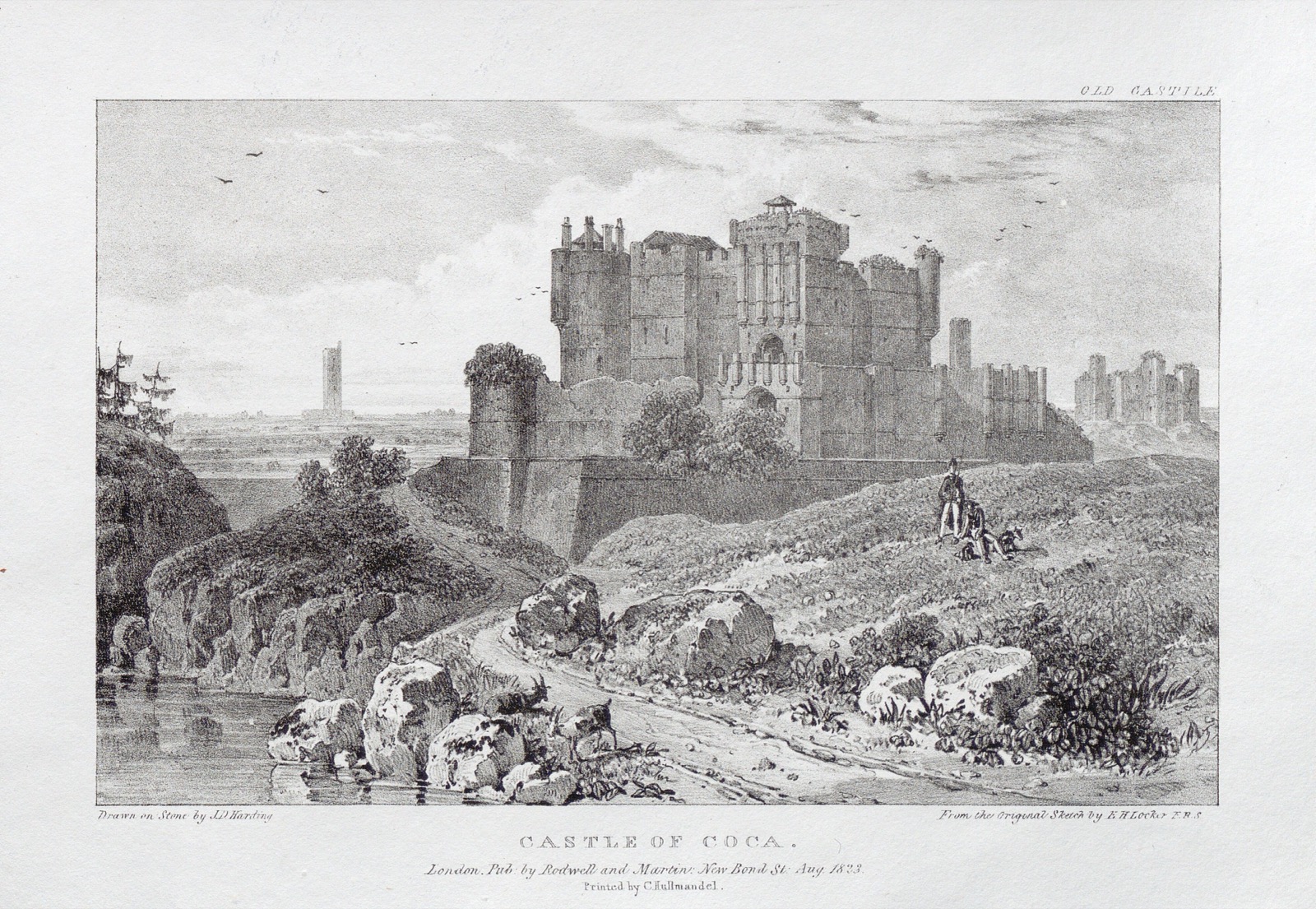
Castle of Coca
1823 · Digital Library of Castilla y León (via Europeana)
CC0 (no rights reserved)
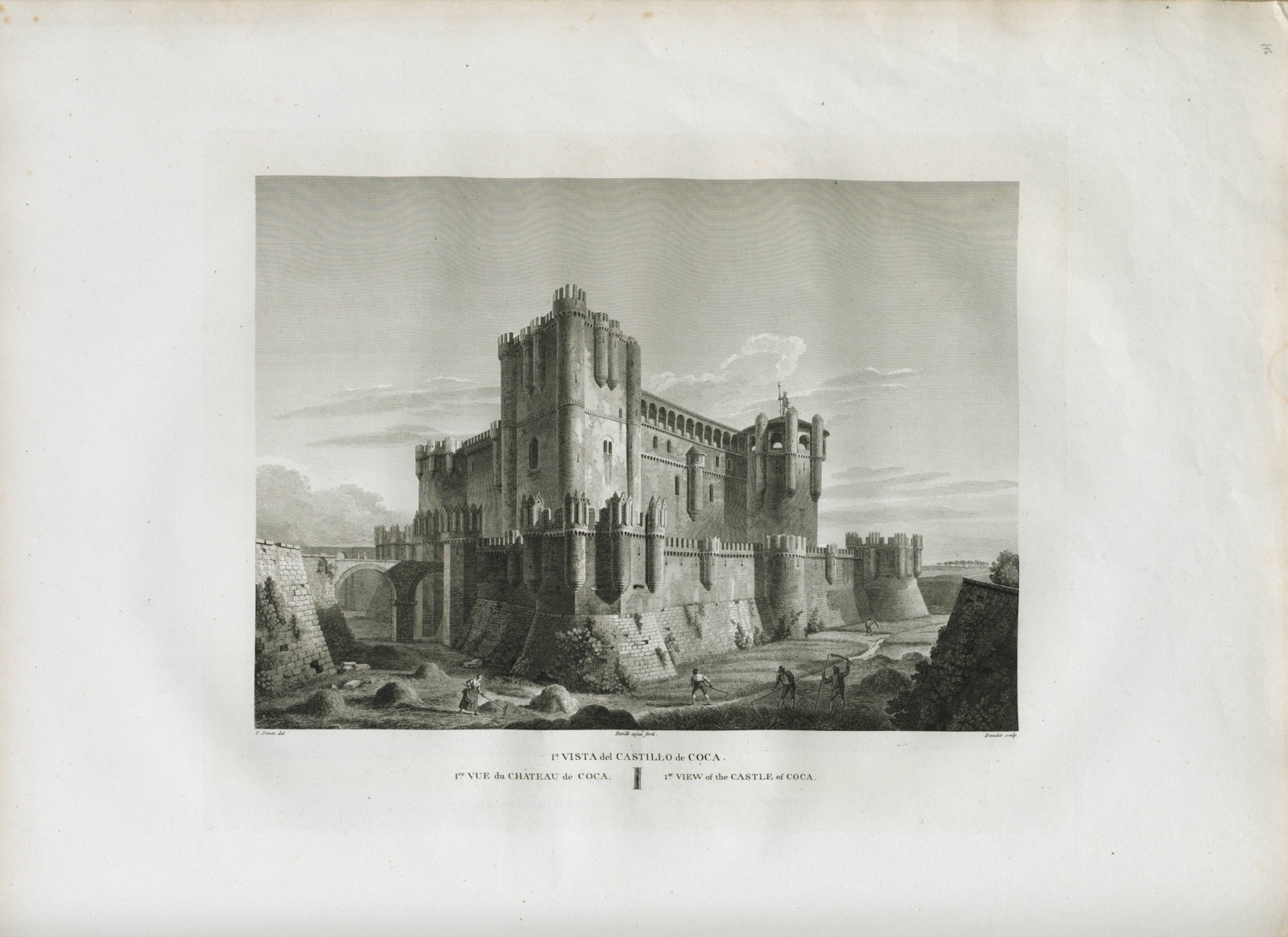
1ª vista del Castillo de Coca= 1re. vue du Château de Coca = 1st. view of the Castle of Coca
1820 · Digital Library of Castilla y León (via Europeana)
CC0 (no rights reserved)
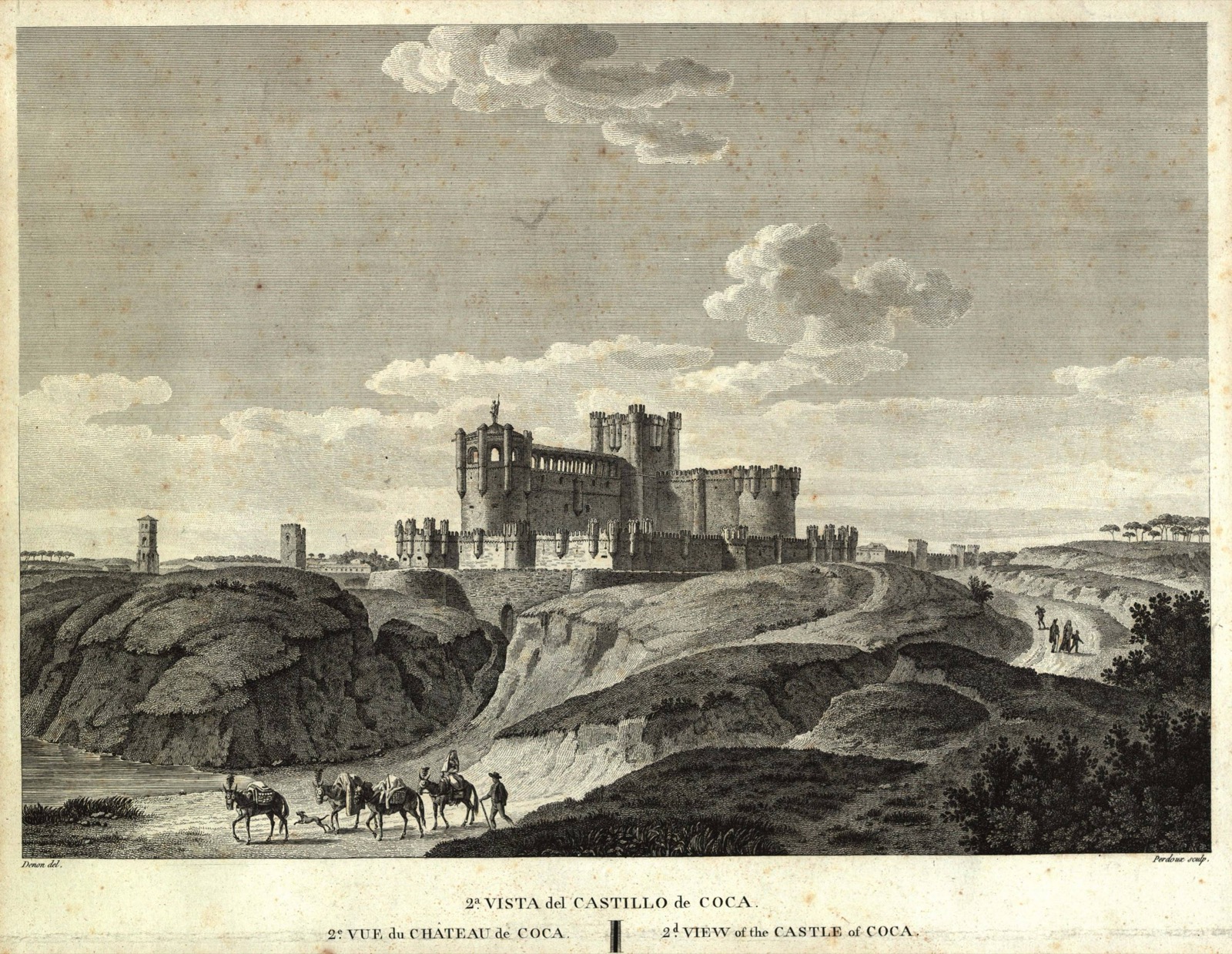
2ª vista del Castillo de Coca= 2e. vue du Château de Coca = 2d. view of the Castle of Coca
· Digital Library of Castilla y León (via Europeana)
CC0 (no rights reserved)


