
Spain · Restored
Reales Alcázares
The Royal Alcázar of Seville is a historic royal palace complex in Seville, Spain, combining Mudéjar, Gothic and later elements. Much of the present visible complex dates to the mid-14th century when Pedro I rebuilt large sections in an ornate Mudéjar style; the palace continues to be used by the Spanish royal family and is part of a UNESCO World Heritage Site.
Its prime
1366
Today
Restored
As it stood in 1366
What Reales Alcázares looked like in its prime.
A two-storey Mudéjar courtyard built around a long, narrow reflective water channel, flanked by low planted beds and terracotta paving. Ground-floor arcades of slender marble columns carry scalloped, multi-lobed horseshoe arches and dense carved stucco reliefs; a tiled dado runs at wall base. The upper storey is an open loggia with rounded arches and a balustrade. Pale stone and stucco surfaces, patterned tilework and ornate plasterwork dominate the visible surfaces, all appearing complete and coherent.
Its story
The story of Reales Alcázares.
The Citadel of Abd al-Rahman III and the Taifa Enclosure
Seville was taken by the Umayyad Caliphate in 712, and the Alcázar is traditionally dated to 913–914, when, after a revolt against the government of Córdoba, Abd al-Rahman III is said to have raised a fortified enclosure on the site of a Visigothic basilica, a roughly square circuit about 100 metres on a side, walled with rectangular towers and tied into the city walls. Excavation has complicated that account: the oldest enclosure, under the present Patio de Banderas, is now dated to the middle or end of the 11th century, and radiocarbon testing of the Alcázar wall in 2009 returned a date near 1090, which would put it in the taifa of Seville or the first years of Almoravid rule. The palace beneath the Patio de Banderas, the oldest in the complex, is credited either to the Abbadid ruler al-Mu'tamid at the end of his reign or to the Almoravids at the start of theirs, and may be the original al-Mubarak, the Blessed.
The Almohad Capital and the Fall of the City in 1248
From about 1150 the Almohads built Seville up as their capital in al-Andalus, and the governor pushed the fortified complex westwards, nearly doubling it. In 1163 the caliph Abu Ya'qub Yusuf made the Alcázar his principal residence in the region, and in 1169 added six new enclosures to the north, south and west under the architects Ahmad Ben Baso and Ali al-Ghumari; apart from the walls, nearly everything standing was demolished and about a dozen palaces built in its place, among them the great garden courtyard now called the Patio del Crucero. A vast congregational mosque went up on the north side between 1171 and 1198, later the cathedral, with a shipyard in 1184 and a textile market in 1196.
The Almohads also wove the palace into the defence of the whole city, running walls from the Alcázar to other fortifications down to the Guadalquivir, work that culminated early in the 13th century with the Torre del Oro. Ferdinand III of Castile took Seville in 1248. He made no alterations to the Alcázar, and for decades the Christian court simply occupied the Almohad rooms; almost nothing of the Islamic-era building has survived the rebuilding that followed, though remains of the al-Mubarak palace lie preserved beneath the Patio de la Montería.
Pedro I's Mudéjar Palace and the Civil War of 1366
Alfonso X raised a Gothic palace on the site in the 1250s, keeping the Almohad courtyard beneath it and its garden quartered by two crossing paths, and roofing the whole with pointed arches and vaults. In the middle of the 14th century Alfonso XI added a throne hall, the Hall of Justice, to mark his victory at the Río Salado in 1340, Mudéjar work, its stucco and its arrangement taken directly from contemporary Andalusi building. Then came the palace that defines the place. An Almohad palace of about 1150, found beneath the Patio de la Montería in 1997, was pulled down in 1356 to clear the ground, the year an earthquake badly damaged the city. A Latin inscription on the façade carries the year 1364 and an Arabic one in the Hall of the Ambassadors the year 1366, read as the start and the completion of the work.
Pedro's palace stands close enough to the Nasrid work at the Alhambra that the direction of influence between the two is hard to untangle; his ally Muhammad V of Granada probably sent craftsmen to Seville, and the Arabic inscriptions in the courtyard name Pedro as Sultan Don Bidru. The court he kept here received the Granadan envoys Ibn Khaldun and Ibn al-Khatib between 1363 and 1365 to settle a peace treaty, and in 1367 the Prince of Wales sent Neil Loring, Richard Punchardoun and Thomas Balastre to the Alcázar to meet the king and collect payments owed. Pedro cannot have enjoyed it long: the first Castilian civil war against his half-brother Henry began in 1366 and ended with his death in 1369.
Isabella's Repairs and the Casa de Contratación
The Catholic Monarchs reached Seville on 28 July 1477, the first royal visit in ten years, and lodged in the Alcázar; finding the fabric in poor condition, Isabella ordered works to put it back in use. Their son Prince Juan was born in the palace on 30 June 1478, the birth attended by a Sevillian midwife known as la Herradera and witnessed, as Castilian custom required, by four men Ferdinand named for the purpose, so that no doubt could be raised about the child. The upper floor was extended and made their main residence. In 1503 the Casa de Contratación was installed in rooms off the Patio de la Montería, where merchants drew their contracts as the American and Philippine trade grew. Charles V married Isabella of Portugal in the Hall of the Ambassadors in 1526, and had the upper storey of the Patio de las Doncellas added by Luis de Vega between 1540 and 1572. The Mudéjar garden and pool of that courtyard were buried under a marble pavement between 1581 and 1584, and lay hidden until the excavations of 2002–2005 uncovered them largely intact.
Earthquake, the Cortes in Flight, and the Handover of 1931
The court moved into the Alcázar between 1729 and 1733: Philip V, Elisabeth Farnese and the future Charles III lived here, and their daughter Maria Antonietta was born in the palace in 1729 while the king was in the city for the signing of the Treaty of Seville, which ended the war with Britain. Much of Alfonso X's Gothic palace was destroyed by the Lisbon earthquake of 1755, after which the Belgian architect Sebastian Van der Borcht rebuilt the eastern side of the Casa de Contratación.
During the Peninsular War the Seville junta met in the Alcázar, and after it the Junta Suprema Central. In 1823, with the French army of the Hundred Thousand Sons of St Louis marching in, the government and the Cortes moved Ferdinand VII and the royal family to Seville; they arrived on 10 April, the infante Enrique was born in the palace on 17 April and made Duke of Seville two days later, and as the French advanced the whole court left for Cádiz on 12 June. By decree of 22 April 1931 the government of the Second Republic ceded the Alcázar and its gardens to the municipality of Seville. The upper floors remain in use by the royal family when they visit the city, and the palace was inscribed by UNESCO in 1987 together with the cathedral and the General Archive of the Indies.
Step inside
8 places to explore in 1366.
The record describes 8 distinct spots at Reales Alcázares, including 6 interiors: patio de las doncellas (central courtyard), upper loggia overlooking the central courtyard, salón de los embajadores (hall of the ambassadors) and more. Create your own photoreal reconstruction and explore every one, more scenes means more rooms, more angles, and more of the place to stand in.
Build Your Own Castle
Recreate Reales Alcázares with AI to explore it.
The artist rebuilds it as it stood in 1366, a photoreal reconstruction that belongs to you alone. Pay with coins, no subscription needed.
Recreate this castle →Defend this castle →From the archive
Reales Alcázares on paper: the measured plan and period views.
The survey plan and photographs below are the ground truth this page's reconstructions are checked against, drawn and photographed while the castle was still a working garrison. Every image is public-domain or openly licensed, with its source named.
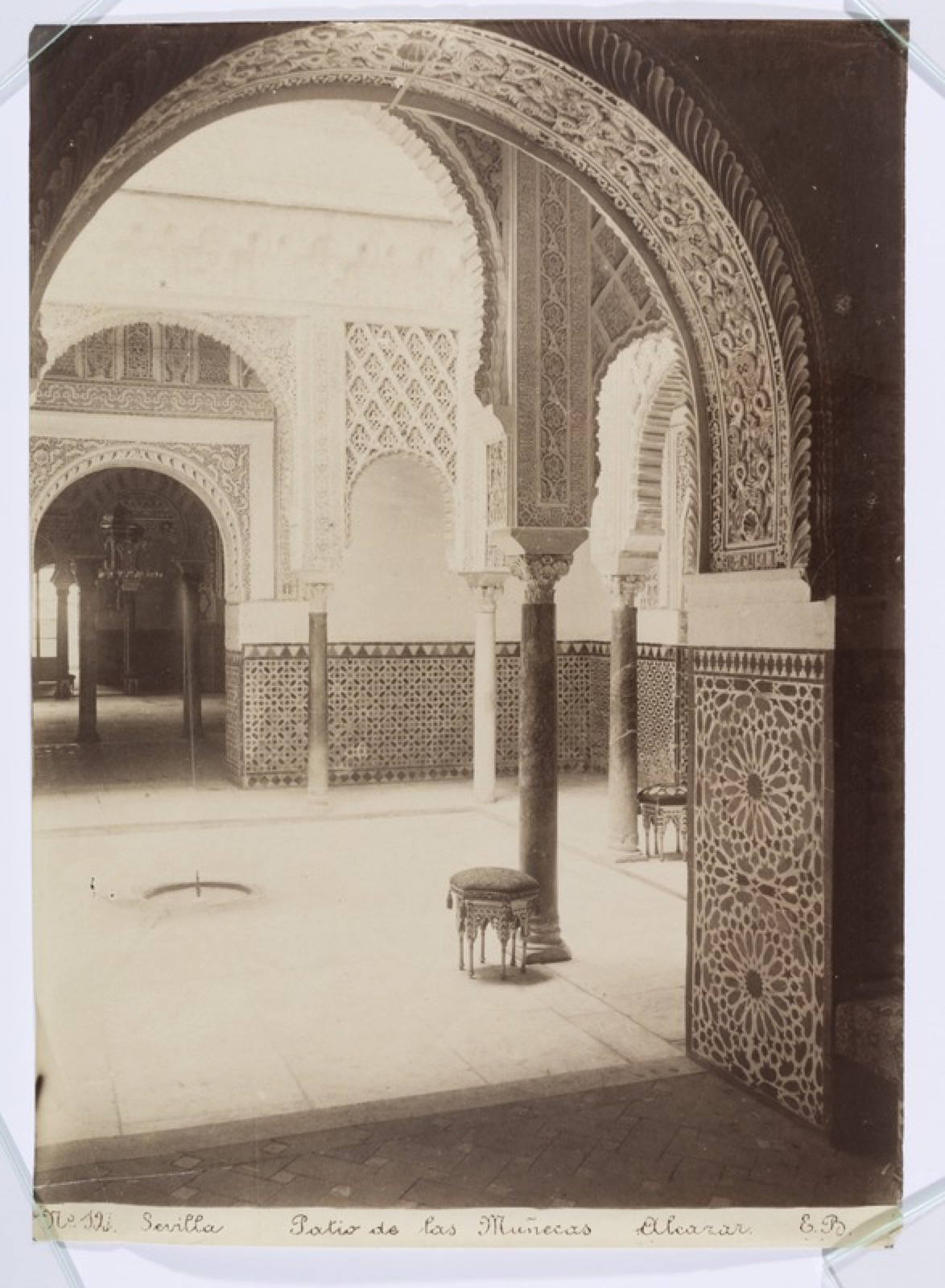
Royal Palace courtyard in Seville (Reales Alcázares de Sevilla)
1850 · University of Tartu Art Musuem (via Europeana)
CC0 (no rights reserved)
Nearby
Landmarks within reach of Reales Alcázares.


Questions about Reales Alcázares
What is the history of Reales Alcázares?
What is inside Reales Alcázares?
Why was Reales Alcázares built?
Does anyone live in Reales Alcázares now?
Where is Reales Alcázares?
What did Reales Alcázares look like in its prime?
Is Reales Alcázares still standing?
Can you visit Reales Alcázares?
More castles of Spain


Explore the city


