
Spain · Restored
Montjuïc Castle
Castillo de Montjuic
Montjuïc Castle is a large military fortress on Montjuïc hill in Barcelona whose core dates from the mid-17th century and whose present form was completed in the late 18th century. It occupies a compact, rectangular plan of thick stone curtain walls, bastions and a central square keep and today functions as a municipal facility and cultural site.
First raised
1641
Its prime
1799
Today
Restored
As it stood in 1799
What Montjuïc Castle looked like in its prime.
A compact late-18th-century hilltop fortress of pale sandstone blocks: broad, straight curtain walls with slit windows and embrasures, angular bastions at the corners, a squat square keep/watchtower with a low crenellated parapet and signal mast, and a classical pedimented gate reached by a three-arched stone bridge over a dry moat. Low rooflines are hidden behind parapets, with continuous rampart walks and arched service galleries along the inner faces, complete and maintained in 1799.
Its story
The story of Montjuïc Castle.
Mons Judaicus and the Fort Raised in Thirty Days
A medieval beacon tower that signalled the approach of ships was the first structure on the summit above Barcelona. The hill's name descends from mons judeiqus, for the cemetery of the city's medieval Jewish community, documented there at least from the ninth century to the fourteenth and abandoned after the destruction of the Call in 1391.
Fortification came in 1640, during the war against Philip IV: a quadrilateral of earth faced with stone and clay, thrown up in thirty days and improved by French engineers in January 1641. That provisional work saw its first battle on 26 January 1641, when it threw back the Castilian army of Pedro Fajardo, Marquis of los Vélez (26,000 men sent to crush the Catalan revolt) with the Catalan defence led by Francesc de Tamarit. The dry-stone fort decayed and was pulled down in 1643; by 1651 a new one stood in its place, two square enclosures with bastions at the corners and a stockade outside.
Four Changes of Hand, 1705–1714
In 1694 the fort was converted into a castle, with three bastions facing inland and a saw-toothed line of merlons facing the sea, the earlier work left as an inner redoubt. During the War of the Spanish Succession, on 17 September 1705, Charles Mordaunt, Lord Peterborough, took it for the Catalans, a capture that helped turn them towards the cause of the Archduke Charles and opened the way to the siege of Barcelona; Lieutenant-Colonel William Southwell, who led the British 6th Regiment of Foot in the assault, was afterwards made governor.
Philip V's forces recovered it on 25 April 1706 against seven hundred redcoats under Arthur Chichester, Lord Donegall, and the Catalans retook it on 12 May. It did not return to Bourbon hands until five in the afternoon of 12 September 1714, when the citizens of Barcelona surrendered it under the fifth article of the Capitulations imposed on the city that day by the Duke of Berwick.
Cermeño's Star and the French Occupation of 1808
Giovanni Antonio Medrano drew up designs for the castle in 1730, and in 1751 the military engineer Juan Martín Cermeño demolished the old fort of the Reapers' War and gave the fortifications the form they still hold: a star-shaped plan of bastions and outworks around a deep excavated moat, laid out to the systems of the French engineer Vauban. Works between 1779 and 1799 doubled the number of men it could house, added kitchens for 3,000 places and armed it with no fewer than 120 guns. In the same years it served as one of the vertices in the triangulation of the meridian through Dunkirk, Paris and Barcelona that fixed the length of the metre.
On 13 February 1808 Napoleonic troops under Guillaume Philibert Duhesme and Giuseppe Lechi entered Barcelona with 5,427 men and 1,830 horses. On 29 February a unit under Colonel Floresti climbed the hill and occupied the castle without a shot: the captain general of the Principality had orders from the Court to receive the French benevolently, and the garrison did not resist.
Bombardments and the Prison Years, 1842–1940
In 1842, during Espartero's regency, Barcelona was bombarded from the castle to put down a revolutionary rising, and the following year, during the Jamància revolt, General Prim ordered a second bombardment against the shipyards and the city walls.
From the closing years of the 19th century the castle held prisoners of political and social repression. Workers caught up in the anarchist violence of the 1890s were imprisoned and tortured there, in the proceedings known as the procés de Montjuïc. Detainees from the Setmana Tràgica followed, and on 13 October 1909 the pedagogue Francesc Ferrer i Guàrdia, regarded as the founder of the Escola Moderna, was shot at the castle, held responsible for the events of that week. In 1919 it held more than 3,000 workers imprisoned during the La Canadenca dispute. In 1936 it filled with victims of revolutionary repression and, after the Civil War, with prisoners of the Franco state; among them Lluís Companys, President of the Generalitat of Catalonia, who was held there, tried by summary court and, on the orders of the Spanish State, shot on 15 October 1940.
From Military Prison to the City, 1960–2011
The castle remained a military prison until 1960, when it was ceded to the city, and after three years of conversion work Francisco Franco presided over the opening of the army museum on 24 June 1963. It passed to Barcelona City Council between 2007 and 2008, and the museum closed on 24 May 2009. On 15 October 2011 the flag that President Companys had raised on the Santa Amàlia bastion in 1936 was hoisted there again.
Step inside
7 places to explore in 1799.
The record describes 7 distinct spots at Montjuïc Castle, including 2 interiors: gatehouse passage, principal interior hall / armory. Create your own photoreal reconstruction and explore every one, more scenes means more rooms, more angles, and more of the place to stand in.
Build Your Own Castle
Recreate Montjuïc Castle with AI to explore it.
The artist rebuilds it as it stood in 1799, a photoreal reconstruction that belongs to you alone. Pay with coins, no subscription needed.
Recreate this castle →Defend this castle →From the archive
Montjuïc Castle on paper: the measured plan and period views.
The survey plan and photographs below are the ground truth this page's reconstructions are checked against, drawn and photographed while the castle was still a working garrison. Every image is public-domain or openly licensed, with its source named.
![[Montjuic Castle], Montjuïc Castle](/heritage/montjuic-castle/photo-euro-0.jpg)
[Montjuic Castle]
-1923 · Ajuntament de Girona (via Europeana)
Public domain
![[Castell de Montjuïc], Montjuïc Castle](/heritage/montjuic-castle/photo-euro-1.jpg)
[Castell de Montjuïc]
· Ajuntament de Girona (via Europeana)
Public domain
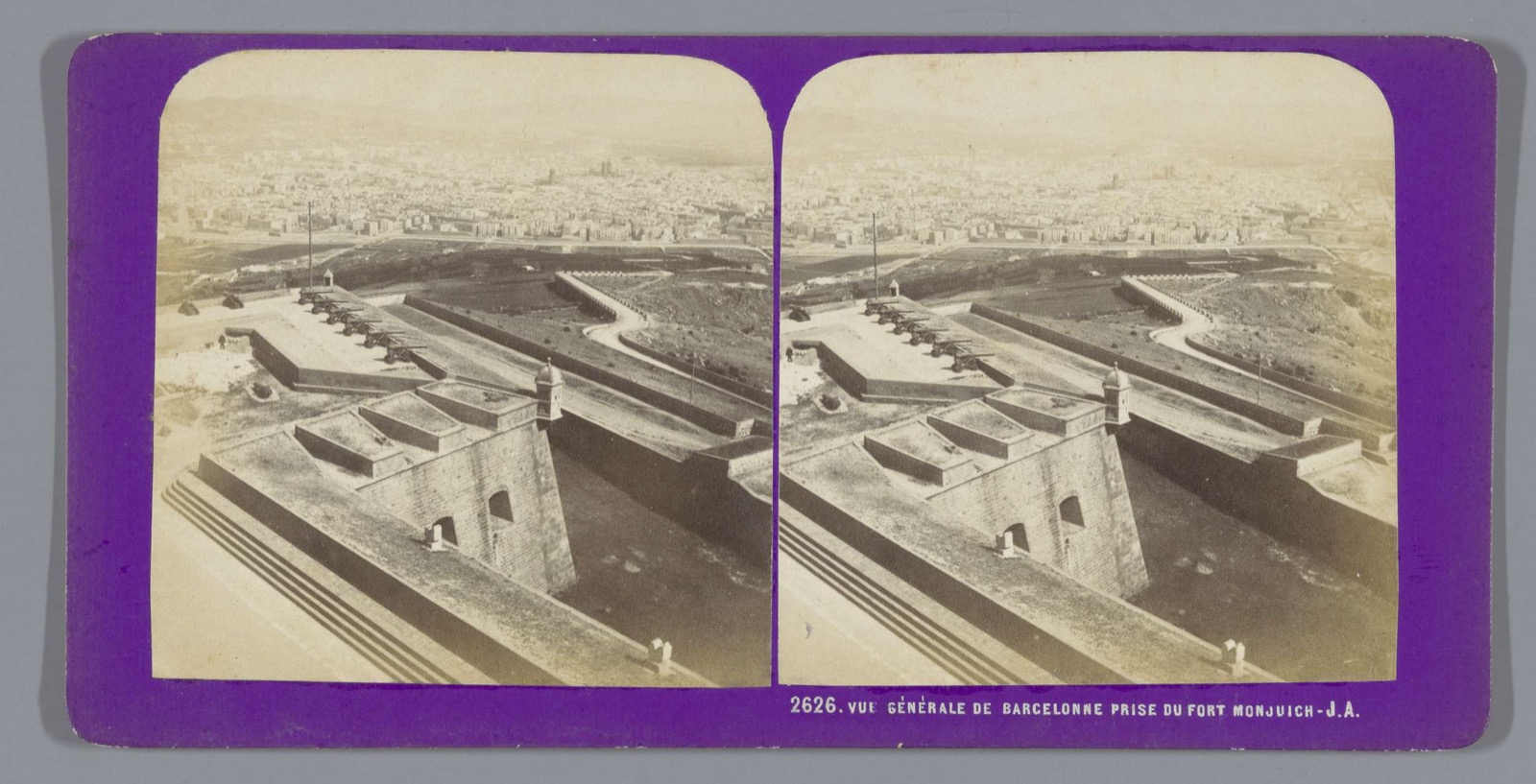
Gezicht op Barcelona, gezien vanaf het Kasteel van Montjuïc
· Rijksmuseum (via Europeana)
Public domain
Nearby
Landmarks within reach of Montjuïc Castle.


Questions about Montjuïc Castle
What is the history of Montjuïc Castle?
What is inside Montjuïc Castle?
Who owns Montjuïc Castle now?
Why was Montjuïc Castle built, and what was it used for?
Where is Montjuïc Castle?
When was Montjuïc Castle built?
Was Montjuïc Castle ever attacked or besieged?
What did Montjuïc Castle look like in its prime?
Is Montjuïc Castle still standing, or is it a ruin?
Can you visit Montjuïc Castle?
Who built Montjuïc Castle?
More castles of Spain


Explore the city


