Historic Cities · Spain
Madrid through the ages
Madrid is the capital and most populous city of Spain. It had a population of over 3.4 million in the city proper in 2025, and a metropolitan area population of approximately 6.8 million. Madrid is the second-largest city in the European Union (EU), after Berlin, and its metropolitan area is the second-largest in the EU, after Paris.

Madrid in 1630
Habsburg Madrid
Madrid in 1630 is the bustling, irregular capital of a far‑flung monarchy, still a compact walled town clustered around the royal Alcázar and the Plaza Mayor. The walk moves from the river's low meadows through city gates and theatre corrals to the alleys of merchants and to the open lands where a great royal retreat will soon be set out.
A low, compact skyline of tiled roofs, church towers and the squat masonry bulk of the Alcázar rises within stout medieval walls; pale plaster and exposed timber frame façades cluster along narrow, dusty streets. Public squares are framed by wooden‑gallery balconies and arcaded market façades, the river plain and distant scrubby hills give a low horizon, and the whole city gleams under a high, dry Iberian light.
The route: 22 streets, squares and views
Manzanares Approach → Puente de Segovia → Puerta de Segovia → Calle de Segovia → Plaza de la Villa → Plaza Mayor → Casa de la Panadería → Calle Mayor → Royal Alcázar → Cuesta de la Vega → …
Step inside, 12 interiors
Puerta de Segovia Guardroom · Council Hall of the Villa · High Balcony of Plaza Mayor · Bakery Guild Chamber · Alcázar Painter's Studio · Corral de la Cruz Stage · Corral del Príncipe Pit · Market Hall of La Cebada · Leatherworker's Workshop · Main Nave of Atocha · Mentidero Tavern Backroom · Hall of Realms
Planned from the Wikipedia record: History of Madrid.
Madrid in 1800
Goya's Madrid
Madrid in 1800 is a compact Bourbon capital of tile roofs, narrow lanes and new neoclassical monuments, still shaped by Charles III's reforms and the court's presence. The walk traces river crossings, the San Isidro meadow, the new Prado and botanical promenade, palace approaches and busy markets where majos and majas animate the streets.
The skyline is low and domestic: red clay tile roofs, angled chimneys and church towers rising above dense, irregular medieval blocks within the old walls, while the Paseo del Prado offers a wide, tree‑lined ribbon of gravel, stone balustrades and nascent urban sculptures. Streets are narrow, shuttered and ochre‑washed, punctuated by granite bridges, the pale stone of new neoclassical gates and fountains, and gardens of the Buen Retiro and the Royal Botanical that give the city visible pockets of green.
The route: 25 streets, squares and views
Casa de Campo Hillside → Puente de Segovia → Puerta de Segovia → Pradera de San Isidro → Paseo de la Florida → San Antonio de la Florida (exterior) → Monteleón Barracks → Campo del Moro → Plaza de la Armería → Palacio Real (exterior) → …
Step inside, 12 interiors
Hermitage Worship Chamber · Low Candlelit Botillería · Frescoed Chapel Dome · Barracks Guard Room · Royal Armory Display Hall · Royal Stair and Antechamber · Decorated Civic Salon · Painter's Studio and Working Room · Covered Meat Market Hall · Great Greenhouse Conservatory · Colonnaded Central Hall · Main Weaving Hall
Planned from the Wikipedia record: History of Madrid.
Madrid in 1925
Silver Age Madrid
Madrid in 1925 is a city stretching its nineteenth-century grid into a new modernity: the Gran Vía cleaves through older streets, the Metro hums beneath, and the Residencia de Estudiantes gathers poets and filmmakers. Walkers will pass emerging skyscrapers, crowded cafés where tertulias meet, theatres and the familiar plazas and parks of the historic city.
The skyline is a low city of red-tiled roofs interrupted by the new vertical gestures of Gran Vía: early steel-and-concrete framed buildings and the rising skeleton of the Telefónica. Streets are paved and narrow in the old core, broader boulevards lined with plane trees. Horse-drawn carts, double-decker trams and black-clad pedestrians move beneath gas and electric street lamps at varied scale.
The route: 23 streets, squares and views
Casa de Campo View → Puerta de Toledo → Ribera de Curtidores → Plaza Mayor → Puerta del Sol → Calle del Carmen → Plaza del Callao → Gran Vía by Teatro Eslava → Edificio Telefónica → Gran Vía Cinema Facades → …
Step inside, 14 interiors
Panadería Hall · Popular Screening Hall · Theatre Foyer · Exchange Floor · Cinema Palace Auditorium · Ateneo Salon · Main Banking Hall · Postal Sorting Hall · Glass Palace Interior · Velázquez Gallery · Iron Concourse · Students' Common Room · Tertulia Salon · Main Auditorium
Planned from the Wikipedia record: History of Madrid.
Its story
The story of Madrid.
Majrit, a Frontier Citadel Guarding Toledo
The documented history of Madrid begins in the second half of the 9th century, when a citadel was raised on the steep left bank of the Manzanares on behalf of Muhammad I, emir of Córdoba, largely to quarter troops. Like the other fortresses along the frontier north of the Tagus, it existed to make it hard for the rebellious inhabitants of Toledo to draw reinforcements from the Asturian kingdom. Majrit covered roughly 8 hectares (the alcázar and the wider walled citadel, the al-Mudayna), and the most generous estimates put its 10th-century population at around 2,000, a figure offered only tentatively.
Writing in the first half of the 12th century, al-Idrisi called it a "small city and solid fortress, well populated". When the Caliphate of Córdoba disintegrated in the early 11th century Madrid passed to the Taifa of Toledo.
Conquered, Chartered and Made a Royal Residence, 1083–1471
Madrid changed hands during Alfonso VI's campaign against the taifa of Toledo, and historians dispute when: in 1083, during negotiations with al-Qadir and before Toledo itself fell, or in 1085 as a direct consequence of Toledo's seizure. The mosque was reconsecrated as the church of the Virgin of the Almudena, the name taken from the almudín, the garrison's granary. Christians took the centre and Muslims and Jews were moved to the suburbs. The town stayed frontier country for some time, suffering raids in the Almoravid period. It was confirmed as a villa de realengo, held directly of the Crown, in 1123, Alfonso VIII granted its first charter regulating the municipal council in 1202, and from 1188 it had the right of representation in the Cortes of Castile, holding by the end of the Middle Ages one vote out of eighteen.
Before the 15th century this was a farming town with a notable amount of irrigated cropland and two industries of consequence, building materials and leather; from the mid-13th century to the late 14th it contested the Real de Manzanares with Segovia, a stronger town whose stock-rearing economy and skill at repopulation outmatched it. The Jewish community was probably smaller than the mudéjar one and stood out for its physicians until the expulsion; the best-placed mudéjares were the alarifes, master builders who ran the public works, including the viajes de agua that watered the town. Under the Trastámaras Madrid became a favoured royal residence (Henry IV spent more time there than in any other town and died there), and a mint worked from 1467 to 1471.
Conversion, Expulsion and the Comuneros, 1492–1521
Faced with the 1492 decree of expulsion, few of Madrid's Jews left; most converted, remaining a converso community that was never fully assimilated and was rejected by Old Christians. Conversion was likewise widespread among the mudéjares after the pragmatic of 1502 imposed it, and the council, protecting the town's economic interests, encouraged it with tax breaks and gifts.
The Revolt of the Comuneros succeeded here: the rebels deposed the corregidor Antonio de Astudillo by 17 June 1520 and Juan Zapata took command of the local militias, while Pedro de Montemayor was captured by royalists and executed later that year. After the comunero defeat at Villalar the town was besieged and occupied by imperial troops, though the revolt ended in negotiation. Madrid was afterwards granted the titles of Coronada and Imperial.
The Court Settles, 1561–1710
In June 1561 Philip II installed his court in the old alcázar. He made no formal declaration, but the seat of the court became the capital in fact. From about 18,000 inhabitants in 1561 the population rose to some 80,000 by 1598. What Madrid now did for a living was govern: administration, banking and small-scale manufacturing clustered around the court, and the city consumed far more than it produced or traded, cut off from the coast as it was until the railways came. When the court moved to Valladolid between 1601 and 1606 the population was reportedly halved, an estimated 50,000 to 60,000 people leaving. The move was pressed by Philip III's valido, the Duke of Lerma, who had bought heavily into Valladolid property and, once Madrid housing prices had collapsed, bought cheaply in Madrid and urged the king back; the town put up a further 250,000 ducats towards the cost of the return.
Seventeenth-century Madrid was an estate society crowded around the royal court, in which household slaves were kept as a mark of status. By the end of the Ancien Régime the slave population was tentatively estimated at between 6,000 and 15,000 in a city of more than 150,000, and unusually for Spanish cities it was weighted towards men. The court drew Cervantes, Lope de Vega and Velázquez during the Siglo de Oro, while extreme poverty remained rampant. The city then changed hands repeatedly in the War of the Spanish Succession before Philip V re-entered it on 3 December 1710.
Bourbon Works, the Esquilache Riots and the Dos de Mayo, 1739–1812
Philip V began building new palaces in 1739, among them the Palacio Real, and founded the Royal Tapestry Factory and the main Royal Academies. Charles III, remembered in the saying that the best mayor is the king, gave the city sewers, street lighting, cemeteries outside the built-up area and the Prado. The reforms cost his minister dear. Amid one of the worst subsistence crises of the Bourbon monarchy the new street lanterns pushed up the price of oil and taxes were rising on a populace already close to famine, and when the Marquis of Esquilache banned the traditional long cape and wide-brimmed hat to make suspects easier to identify, mass rioting broke out in March 1766.
French troops entered Madrid in May 1808, and on 2 May a crowd gathered at the Palacio Real as the remaining Bourbons were removed to Bayonne. When the crowd saw the infante Francisco de Paula struggling with his captor it rushed the carriages; French soldiers fired into it and fighting went on for hours across the city. The Spanish garrison stayed passive apart from the artillery barracks at Monteleón, where Captain Luis Daoíz y Torres and Pedro Velarde y Santillán armed civilians, repelled a first attack and were killed by the reinforcements Murat sent. Hundreds of Spanish men and women died alongside French soldiers, and the repression that followed included summary executions. At Bayonne on 5 May Napoleon forced Charles IV and then Ferdinand VII to abdicate in favour of his brother Joseph Bonaparte. English and Portuguese troops entered on 12 August 1812 and took the surrender of 1,700 French in the fortified Retiro district, but the city was given up again that autumn and Joseph re-entered it on 2 November.
Capital of the Liberal State, 1823–1931
The administrative reforms of 1833 devised by Javier de Burgos, which created the province of Madrid, made the city the capital of the new liberal state. In 1835–36 the confiscations ordered by Finance Minister Juan Álvarez Mendizábal stripped the Church of its property, and the demolition of churches, convents and their orchards let streets and squares be widened. Twice the city was subdued by force: a French army entered on 24 May 1823 to restore Ferdinand VII's absolute rule, and a popular revolt that raised barricades in July 1854 was crushed. On the night of 10 April 1865, students protesting against a ministerial decree and the removal of the rector of the Central University clashed with the civil guard: fourteen were killed, seventy-four wounded and 114 arrested, in what became known as the Night of Saint Daniel. The revolution that deposed Isabella II reached Madrid on 29 September 1868, and on 27 December 1870 unidentified gunmen shot Prime Minister Juan Prim beside the Congress of Deputies; he died three days later.
Water from the Lozoya reached the city when the Canal de Isabel II was inaugurated on 24 June 1858, and a royal decree of 19 July 1860 approved Carlos María de Castro's Ensanche, an extension that sorted the well-off, the middle class and the artisans into separate zones. Its southern part, in the path of the sewage runoff, was described as a space of urban degradation and misery, and beyond it slums grew at Tetuán, Prosperidad and Vallecas. The economy modernised into a service and financial centre with publishing and construction alongside, and the railways confirmed Madrid as the country's distribution node. Work on the Gran Vía began in April 1910, cutting a thoroughfare through the centre and demolishing a great deal of housing, and the Metro opened its first line in 1919, the years in which the largest wave of strikes the city had yet seen laid the ground for the unrest of the 1930s. Across the first third of the century the population nearly doubled, passing 850,000.
Siege, Dictatorship and the 11 March Bombings
The Spanish Constitution of 1931 was the first to legislate where the capital should be, naming Madrid explicitly. Housing was desperately short, and the insurrection of 1934 largely failed in the city. So did the military uprising of July 1936: loyal troops and armed workers stormed the one centre of resistance, the Cuartel de la Montaña, on 20 July, killing over a hundred rebels after their surrender. Madrid then stayed in Republican hands until 1939. It was bombed from the air for the first time on the night of 27–28 August 1936, when a Junkers Ju 52 dropped bombs on the Ministry of War and the Station of the North; it was to become the first large European city bombed by aircraft.
Franco's detour in late September 1936 to relieve the Alcázar of Toledo gave the defenders time to build works and receive foreign support. The city was besieged from October 1936 and fought a major battle in its western suburbs that November. Through that summer and autumn communist and socialist groups carried out heavy repression inside the Republican city, murdering prisoners in the checas and sacas, directed mostly at military personnel and politicians linked to the rebels and culminating in the Paracuellos massacres during a simultaneous rebel offensive; the killings were halted by early December. In the war's last weeks Colonel Segismundo Casado, backed by the PSOE leader Julián Besteiro, who had held talks with the Falangist fifth column in the city, mounted a coup against his own government on the pretext of communist dominance, and the fighting between 5 and 10 March 1939 left roughly 2,000 casualties. Madrid fell to the Nationalists on 28 March 1939.
Under the dictatorship the repression of anyone with a Republican past stripped the city of trade unionism and intellectual life. Ration coupons were in widespread use, the autarkic economy lasted into the mid-1950s, and meat and fish were so scarce that malnutrition drove mortality high. Because Madrid had been a left-wing stronghold the victors considered moving the capital elsewhere, most often to Seville, but never did, choosing instead to present the city as the capital of an imperial past. Between 1948 and 1954 the municipality annexed thirteen neighbouring towns and grew from 68.42 to 607.09 square kilometres, while mass migration from the countryside filled substandard peripheral housing: as many as 50,000 shacks stood around the city by 1956, and from the mid-1950s the poblados de absorción were built to replace them. The population peaked in 1975 at 3,228,057.
The 1978 constitution confirmed Madrid as the capital and the 1979 municipal election produced its first democratically elected mayor since the Republic. From the late 1970s the city was the centre of the cultural movement known as la Movida, while a heroin crisis took its toll in the poor neighbourhoods. On 11 March 2004, three days before a general election, an al-Qaeda-inspired cell placed bombs on commuter trains during the morning rush hour, killing 191 people and injuring 1,800. Madrid is the capital of Spain and of the Community of Madrid, with a population of over 3.4 million in the city proper in 2025.
From the archive
Madrid on paper: the old town as it was mapped.
A period plan or bird's-eye view of the old town, drawn between 1500 and 1850, the streets this page's reconstructions walk. Public domain, with its source named.
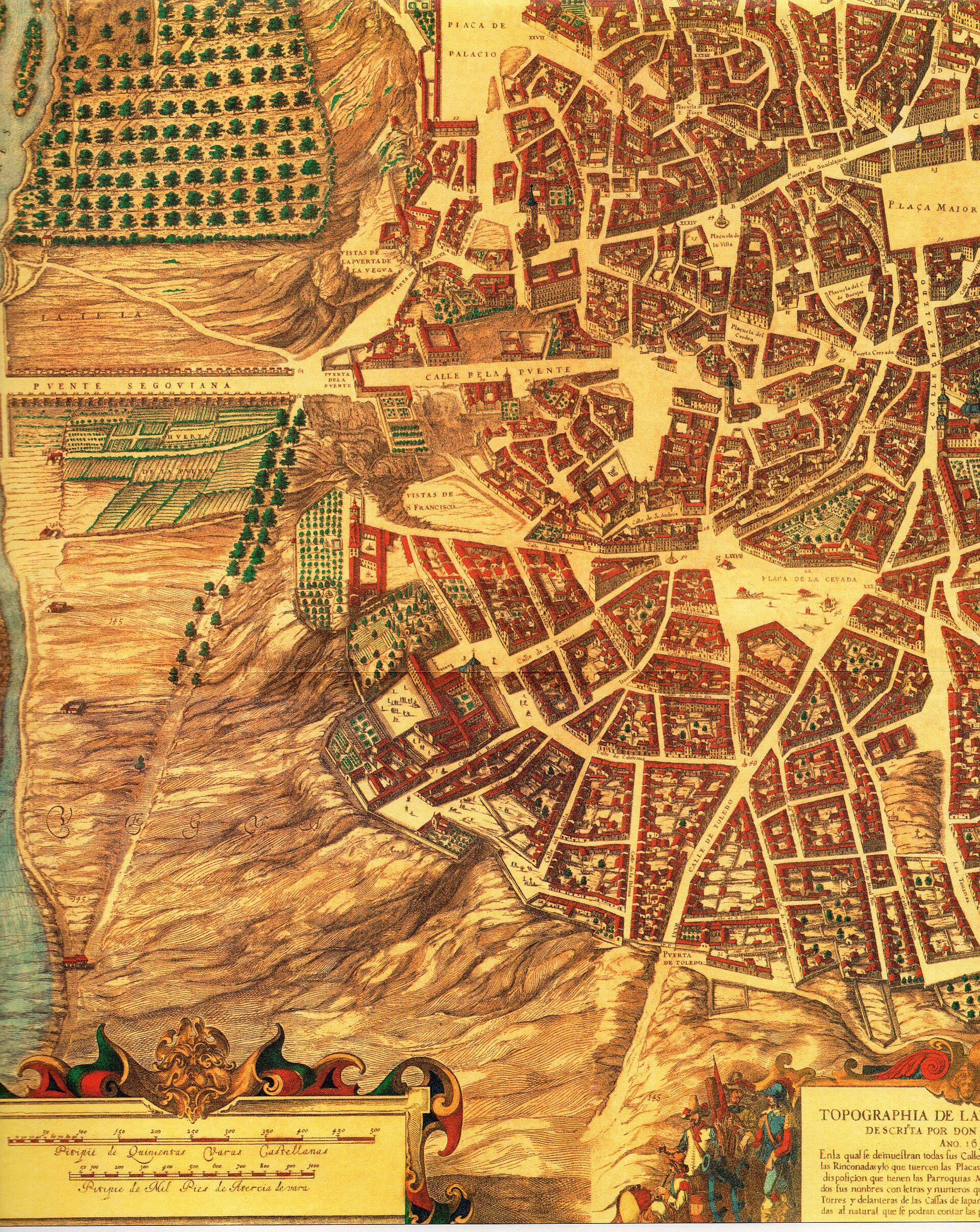
Topographia de la Villa de Madrid, by Pedro Texeira (1656)
Detailed bird's‑eye plan showing Madrid’s dense street network with the Plaza Mayor, city gates, Puente Segoviana over the river and palace gardens.
1656 · Jojagal · Wikimedia Commons
CC0 (plate dated 1656)
In this city
Landmarks of Madrid, see each in its prime


More cities to explore
 SpainToledoExplore it in 1080 · 1250 · 1580
 SpainSalamancaExplore it in 1580
 SpainBarcelonaExplore it in 1350 · 1888 · 1915
 SpainSevilleExplore it in 1200 · 1570 · 1929
Castles of Europe · Landmarks of Europe · create your own reconstruction.