Historic Cities · Spain
Barcelona through the ages
Barcelona is a city on the northeastern coast of Spain. It is the capital and largest city of the autonomous community of Catalonia, as well as the second-most populous municipality of Spain after Madrid.

Barcelona in 1350
Gothic Barcelona
Barcelona in 1350 is a compact, walled Mediterranean port ruled by its Consell de Cent as Gothic churches and merchant palaces push the skyline upward. The walk follows the harbour and the Ribera merchants into the Gothic heart, past the rising Santa Maria del Mar and the royal shipyards, through the Jewish call and the narrow lanes under the cathedral's shadow.
The skyline is a dense sawtooth of steep terracotta roofs, church towers and scaffolds: the cathedral and Santa Maria del Mar rise in dressed stone with flying buttresses and temporary timber platforms, the long low sheds of the Drassanes crowd the waterfront, and the Roman and medieval walls fence a compact town of narrow shaded lanes, pale limestone façades, ochre plaster and the glitter of the Mediterranean beyond.
The route: 22 streets, squares and views
Montjuïc Hill View → Portal de Mar → Port of Barcelona → Drassanes Reials → La Ribera Quay → Santa Maria del Mar → Plaça del Born → Carrer de Montcada → El Call → Carrer de la Llibreteria → …
Step inside, 12 interiors
Consulate of the Sea · Great Shipbays · Ribera Warehouse Hall · Soaring Nave · Merchant Guild Hall · Merchant's Courtyard · Synagogue of the Call · Royal Stair of the Palau · Saló del Tinell · Saló de Cent · Cloister of the Cathedral · Great Meat Hall
Planned from the Wikipedia record: History of Barcelona.
Barcelona in 1888
Exposition Barcelona
Barcelona in 1888 is a city reshaping itself: the hated citadel has become the Ciutadella park and the city is hosting Spain’s first Universal Exposition. Walkers will pass the red‑brick Arc de Triomf, the new Columbus monument at the harbour and the expanding Eixample grid, moving between gaslit Ramblas, iron market halls and the new exhibition pavilions in the park.
The city presents a low, dense skyline of tiled roofs, church spires and industrial chimneys under bright Mediterranean light, punctuated by recent red‑brick and ironwork monuments from the Exposition. Passeig and Eixample boulevards carry horse trams and promenading bourgeois in dark coats and bustled skirts; La Rambla is shadowed by plane trees and gas lamps; the Ciutadella shows ornate fountains, glasshouses and the Neo‑Mudéjar Arc de Triomf in warm brick.
The route: 22 streets, squares and views
Port Vell → Columbus Monument → La Rambla Lower → Gran Teatre del Liceu → Mercat de la Boqueria → Plaça Reial → Plaça Sant Jaume → Cathedral (La Seu) → Plaça del Rei → Passeig del Born → …
Step inside, 14 interiors
Column Base Rotunda · Auditorium of the Gran Teatre · Iron-and-Glass Market Hall · Arcaded Café Gallery · Saló de Cent Council Chamber · Cathedral Nave and Choir · Saló del Tinell Great Hall · Silversmith's Workshop · Born Market Iron Hall · International Exhibition Main Hall · Castle Café Hall · Hivernacle Tropical Conservatory · Triumphal Arch Vaulted Passage · Chamfered-Corner Café
Planned from the Wikipedia record: 1888 Barcelona Universal Exposition.
Barcelona in 1915
Modernisme Barcelona
Barcelona in 1915 is a city mid-construction: Modernista palaces and trencadís mosaics stand beside factory chimneys, while Gaudí's Sagrada Família rises with scaffolds over the new Eixample grid. The walk passes docks and promenades, the busy Passeig de Gràcia of the bourgeoisie, the crowded workshops of the Raval and Poblenou, and the glass-and-iron theatres where Catalan Modernisme shows its richest detail.
The skyline is a low Mediterranean tapestry of red-tiled roofs, church spires, and tall factory chimneys pierced by scaffolding at the Sagrada Família; broad avenues are lined with plane trees, cast-iron balconies, and stone façades scored with sinuous Modernista ornament. Sunlight falls on glazed ceramics and green-wrought iron, electric tram wires stitch the streets, and the scale alternates between intimate market lanes and the sweeping, bourgeois boulevards of the Eixample.
The route: 22 streets, squares and views
Collserola Ridge View → Port Vell Quay → Passeig de Colom → Barceloneta Strand → La Rambla → Plaça Reial → Els Quatre Gats (Montsió) → Plaça de Sant Jaume → Portal de l'Àngel → Plaça de Catalunya → …
Step inside, 14 interiors
Maritime Customs Hall · Opera House Auditorium · Great Gothic Banquet Hall · Bohemian Café Salon · Sala de Cent Council Hall · Piano Nobile Drawing Room · Grand Salon and Staircase · Central Courtyard and Stairwell · Nativity Nave under Scaffolds · Hall of a Hundred Columns · Covered Market Nave · Concert Hall with Skylight · Central Parabolic Hall · Textile Mill Weaving Floor
Planned from the Wikipedia record: Modernisme.
Its story
The story of Barcelona.
Barkeno on the Tàber Hill, and the Roman Colony of Veterans
The site is a defensible coastal plain between the Collserola ridge and the Mediterranean, on the coastal route between central Europe and the rest of the Iberian Peninsula. In the 3rd and 2nd centuries BC the Laietani, an Iberian people, held Barkeno on the Tàber hill in what is now the Ciutat Vella, and Laie, thought to have stood on Montjuïc; both settlements struck coinage that survives. A founding myth crediting the Carthaginian general Hamilcar Barca has circulated since the 15th century, but there is no evidence Barcelona was ever a Carthaginian settlement, and the name is usually accepted to derive from the Iberian Barkeno.
The Romans settled the site as Barcino, the name formalised about AD 14 as a shortening of Colonia Faventia Julia Augusta Pia Barcino. As a colonia it existed to distribute land among retired soldiers. It mattered far less than Tarraco, capital of the province, and lacked the theatre, amphitheatre and circus of greater centres, but its position on a branch of the Via Augusta let it trade, and it was exempt from imperial taxation. By the 2nd century it held some 3,500 to 5,000 people, living chiefly by cultivating the surrounding land and exporting its wine widely. Germanic raids began around 250, and late in the 3rd century the walls were rebuilt as a double circuit punctuated by seventy-eight towers, the strongest fortifications in Tarraconensis.
Ataulf's Court, the Visigothic Laws and Muslim Barshiluna, 415–801
Ataulf led the Visigoths across the Pyrenees into Tarraconensis after a defeat at Narbona in 414 and established his court at Barcino, where one of his own troops murdered him in 415. His successors became federate allies of Rome, charged with controlling the other Germanic peoples who had invaded Hispania, and moved their capital to Tolosa in 417. Barcino remained an important provincial centre, largely because of its walls, and briefly held the capital again after 507, before Leovigildus fixed it at Toledo in 573. The Visigoths were a minority holding the positions of authority; their first rulers were Arians, and the city's Catholic practice was tolerated until Catholicism became the state religion in 589. A letter to the city's treasurers known as De fisco Barcinonensi describes the tax system administered from Barcelona and remains the most informative source on Visigothic taxation.
A Jewish population is attested at Barchinona from the mid-4th century at the latest. Tolerated under Rome, Jews suffered varying degrees of discrimination and persecution under the Visigoths: in his law code of 654 King Recceswinth outlawed circumcision of males, the dietary laws, Jewish marriage law and ceremony, and the celebration of Passover. Expecting his successor Wamba to continue those policies, the Jews of the province took an important political and military part in the revolt raised by the general Flavius Paulus, and the community at Barchinona was considerable enough that Wamba issued limited expulsion orders against them. The rebellion was quelled, but Wamba, understanding the Jewish place in the economic structure of the provinces, reached a reconciliation with them; when Erwig deposed him in 680 he legislated against the Jews again, subjecting converts to minute regulation of their faith.
Moorish forces reached the peninsula in 711 and, after the conquest and devastation of Tarraco in 717, Barchinona surrendered peacefully and was spared major destruction. Muslim rule in Barshiluna lasted roughly 85 years. The cathedral was converted into a mosque and taxes were levied on non-Muslims, but religious freedom and civil government were largely respected: the walī handled military matters while the count and the local bishop kept day-to-day control.
From the Spanish March to the Crown of Aragon, 801 to the 15th Century
Louis the Pious, son of Charlemagne, took Barcelona in 801 after a siege of several months. It proved the most southerly gain from the Moors, and the border country was organised as the Spanish Marches until Charles the Bald made the territory the hereditary County of Barcelona in 865. Wilfred the Hairy was the last count appointed by Carolingian authority, in 878, and on his death in 897 his lands were divided among his sons. The counts' primacy rested on conquest from the Moorish walís and on repopulating inland lands emptied by two centuries of war, but in 985 the army of Almanzor sacked Barcelona, and most of the city's population was killed or enslaved.
The marriage of Ramon Berenguer IV, Count of Barcelona, to Petronila of Aragon in 1137 joined the two houses, and their son Alfonso II inherited the Crown of Aragon in 1162. Barcelona was by far the largest settlement in the Principality of Catalonia, at least four times the size of Girona, and a vital source of royal income. Its economy turned increasingly on trade: in 1258 James I of Aragon let the merchant guilds draw up ordinances regulating maritime trade in the port, and in 1266 he allowed the city to appoint its own consuls in every major Mediterranean port of the day. The Taula de canvi, often called the oldest public bank in Europe, was established by the city magistrates in 1401.
Barcelona held the largest Jewish community in the Crown of Aragon, in the quarter called the Call after its many narrow streets, which was later enclosed. Jews lived in the city until the massacre of 1391 diminished their numbers, and the Spanish Inquisition later forced those who remained and refused to convert either to be burned at the stake or to sell their property and leave. The city was also the leading slave-trading centre of the Crown of Aragon until Valencia eclipsed it in the 15th century, drawing first on eastern and Balkan captives and later on Maghribian and sub-Saharan ones.
The Sieges, the Nueva Planta Decree of 1716, and the Bullangues
The marriage of Ferdinand II of Aragon and Isabella I of Castile in 1469 united the two royal lines; Madrid became the centre of political power, and the colonisation of the Americas reduced the relative weight of Mediterranean trade. Then came war after war: the bombing of 1691, sieges in 1697, 1704, 1705 and 1706, and the blockade of 1713 followed by the siege and assault of 1714. The Catalan institutions had sided with the Habsburgs against the Bourbon Philip V in the War of the Spanish Succession, and the last of the Nueva Planta decrees, in 1716, abolished the separate status of the Principality of Catalonia and cut the city's political influence in Spain.
The population nonetheless grew through the 18th century from 30,000 to about 100,000 as Barcelona became a key mercantile centre of the western Mediterranean, and a fortress was raised at Montjuïc over the harbour. In 1812 Barcelona was annexed by Napoleonic France and made part of the department of Montserrat until Napoleon's defeat. Under the early regency of Isabel II the populace was repeatedly in conflict with the Spanish government in the revolts known as the bullangues of 1835 to 1843, ending with the bombardment of 1842 and the Jamància insurrection of 1843, when the city's population was brought into submission.
Slave Money, Cerdà's Grid and Tragic Week, 1817–1929
Through the 19th century Catalan business interests, many based in Barcelona, moved into the Atlantic slave trade, taking the space left by British abolition in 1807, while Catalan emigrants in Spanish America owned and ran slave plantations in Cuba and Puerto Rico. Between 1817 and 1867 Catalans were involved in transporting 700,000 slaves from West Africa to the Caribbean, money that "financed much of the industrialisation of Catalonia and the 19th-century building boom in Barcelona". Spain had abolished slave trading in 1817 but turned a blind eye to the illicit trade; when slavery was abolished in the Spanish Empire in 1886 many Catalans came home and put their fortunes into opulent mansions in districts such as La Rambla.
By the mid-1850s the city was packed at 856 people per hectare, more than double the density of Paris, and mortality was rising. The civil engineer Ildefons Cerdà proposed extending the city beyond the medieval wall the citizens had begun demolishing, in a grid uniting the old city with the surrounding villages. The city council gave the commission to another architect, and it was the Spanish government that imposed Cerdà's plan, laying groundwork for further tension between the two administrations. The Exposición Universal of 1888 extended the built-up area towards Barceloneta, and in 1897 the city absorbed six surrounding municipalities, with Horta following in 1904 and Sarrià in 1924.
In the last week of July 1909, remembered as Tragic Week, the Spanish army clashed with the working classes of Barcelona after Prime Minister Antonio Maura mobilised reservists to fight in the Spanish colony of Morocco. Workers, backed by anarchists, socialists and republicans, rioted in the streets, and more than 100 citizens were killed. A second international exhibition in 1929 urbanised the area around Plaça Espanya; the metro had been inaugurated in 1924.
Republic, the Bombing of March 1938, and Franco's City
Barcelona became the capital of the autonomous region of Catalonia within the Second Spanish Republic and the seat of the Generalitat, and had built an Olympic Stadium and developed Montjuïc to host the People's Olympics in the summer of 1936 when the army's insurrection in July plunged Spain into civil war. The city and Catalonia were resolutely Republican; enterprises and public services were collectivised by the CNT and UGT unions, and as the authority of the Republican government and the Generalitat weakened, much of the city fell under the effective control of anarchist groups, who lost it to their own allies, the Communists and government troops, after the street fighting of the Barcelona May Days.
The city was bombed repeatedly from the air. The most severe attack lasted three days from 16 March 1938: Italian aircraft stationed on Mallorca, under the command of Benito Mussolini, bombed the city thirteen times and dropped 44 tons of bombs aimed at civilians, at the request of General Franco as retribution against the Catalan population. More than 1,000 people died, many of them children, and over 2,000 were injured; the medieval cathedral was hit, and several blocks of the Barri Gòtic in front of it were damaged. Barcelona fell to the Nationalists on 26 January 1939, and its fall caused a mass exodus of civilians towards the French border.
The city's resistance to Franco's coup had lasting consequences. Catalonia's autonomous institutions were abolished and the use of Catalan in public life was suppressed and effectively forbidden, though never formally criminalised. Barcelona remained the second largest city in Spain at the heart of a relatively industrialised region, and drew large-scale immigration from the poorer regions of Spain, particularly Andalusia, Murcia and Galicia; by 1970 it held 1,557,863 people at 15,517 per square kilometre, often in very poor housing. The immigration also told against Catalan itself: private use was tolerated in the dictatorship's later years, but there was no Catalan-language education and the newcomers spoke only Spanish.
A Million in the Street, 1977, and the Olympic Rebuild
Franco died in 1975, and pressure for change was particularly strong in a city that considered itself punished through nearly forty years of Francoism for supporting the Republic. Massive but peaceful demonstrations on 11 September 1977 gathered over a million people in the streets to demand the restoration of Catalan autonomy, which was granted less than a month later; municipal elections were held again in 1979. Two events in 1986 shaped what followed: Spain's accession to the European Community, and Barcelona's designation as host of the 1992 Summer Olympics and Paralympics, for which industrial buildings along the sea-front were demolished and three kilometres of beach created.
Housing costs pushed families out to the suburbs and the population fell by 16.6 per cent over the last two decades of the 20th century, a decline reversed since 2001 by a new wave of immigration, particularly from Latin America and Morocco. Barcelona is the capital of the autonomous community of Catalonia and, with 1,620,943 people, the second largest city in Spain.
From the archive
Barcelona on paper: the old town as it was mapped.
A period plan or bird's-eye view of the old town, drawn between 1500 and 1850, the streets this page's reconstructions walk. Public domain, with its source named.
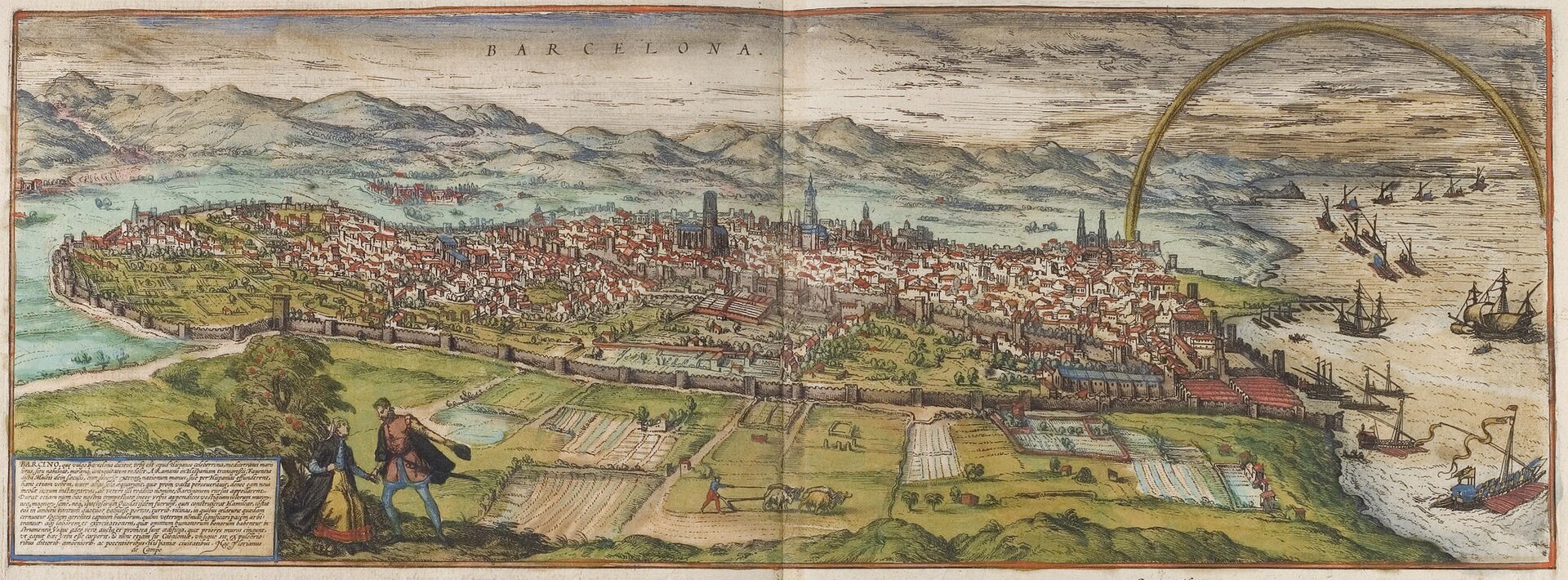
Bird's-eye view of Barcelona, from Braun & Hogenberg's Civitates Orbis Terrarum
Walled old town showing streets and blocks, prominent church towers, sea harbour with galleys and the city walls and gates.
1572 · Georg Braun; Frans Hogenberg · Wikimedia Commons
Public domain (plate dated 1572)
In this city
Landmarks of Barcelona, see each in its prime

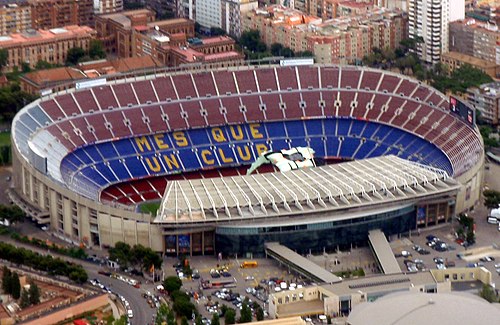


Castles of Barcelona

More cities to explore
 SpainGironaExplore it in 1350
 FranceCarcassonneExplore it in 1300 · 1890
 SpainMadridExplore it in 1630 · 1800 · 1925
 SpainSevilleExplore it in 1200 · 1570 · 1929
Castles of Europe · Landmarks of Europe · create your own reconstruction.