
Cathedral · Spain · Restored
Cathedral of the Holy Cross and Saint Eulalia
Catedral de Santa Eulalia de Barcelona
The Cathedral of the Holy Cross and Saint Eulalia (Barcelona Cathedral) is the Gothic seat of the archbishop of Barcelona. Construction began in 1298 and the medieval fabric was completed in the 15th century; a neo‑Gothic west façade and central tower were finished in 1913. The building contains a high choir, multiple chapels, a cloister with the Well of the Geese, and the crypt housing the relics of Saint Eulalia.
First raised
1298
Its prime
1913
Today
Restored
As it stood in 1913
What Cathedral of the Holy Cross and Saint Eulalia looked like in its prime.
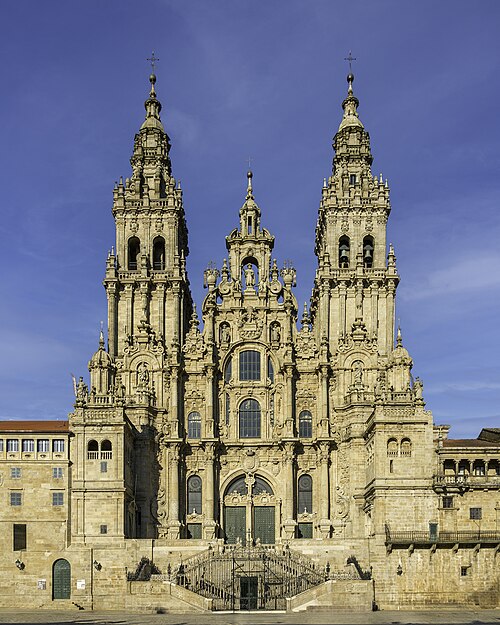
A broad neo‑Gothic west façade of pale, weathered stone with three deep pointed portals beneath layered archivolts; tall traceried lancet windows and slender colonnettes rise to a windowed choir level. A soaring openwork cimborio and central spire puncture the skyline, surrounded by smaller pinnacles and flanking bell towers. Elaborate stone tracery, carved gargoyles and sculpted statuary animate the roofline; broad steps descend to a paved forecourt where visitors gather.
Its story
The story of Cathedral of the Holy Cross and Saint Eulalia.
Three Churches on One Site, 4th Century-1284
Under the present cathedral lie the remains of an early Christian and Visigothic episcopal complex: a baptistery of the fourth century, square in plan around an octagonal pool, a basilical hall of the fifth, and a cross-shaped church and bishop's palace of the sixth and seventh. They are displayed in the archaeological undercroft of the Barcelona City History Museum, with further fragments beneath the plaza de Sant Iu and the carrer dels Comtes. The earliest basilica had three naves and was dedicated to the Holy Cross; a document of the Second Council of Barcelona in 599 records that dedication, against a separate report that the Visigothic chapel here was dedicated to Saint James and was the proprietary church of the viscounts of Barcelona. The building survived into the Visigothic period, and may have been turned into a mosque during the Muslim occupation of the city between 718 and 801. Around 877 Bishop Frodoí had it restored, on the occasion of the translation of the relics of Eulalia of Barcelona into the cathedral crypt; the inscription of 877 recording the finding of those relics at Santa Maria de les Arenes, later Santa Maria del Mar, is kept in the crypt beside her ninth-century tomb. Little else is known of the church at that date beyond two altars, to Saint Coloma and to Saint Mary.
The church was damaged in one of al-Mansur's campaigns against Barcelona, and the accounts differ about when and how badly: one dates the attack to 985 and calls the damage severe, another places it in the invasion of 997 and puts the damage no higher than probable, resting on a donation made soon afterwards ad restaurationem nostre matris ecclesie. A Romanesque replacement was begun in 1046 by Count Ramon Berenguer I and his wife Almodis together with Bishop Guislabert, raised over the crypt of the older church, and consecrated in November 1058. A viscount of Barcelona, Mir Geribert, is reported to have sold the site to Bishop Guislabert in 1058, a date that does not sit with the reported start of the works twelve years earlier. Little is recorded of what was built. It probably occupied the central space of the present Gothic church, and if it followed the pattern of Elna cathedral or the monastery of Sant Cugat del Vallès it would have had three naves, three stepped apses and an entrance porch, with a bell tower abutting the counts' palace next door. An altar to Thomas of Canterbury was founded in it in 1186. Ramon Berenguer I and Almodis de la Marche, his third wife, are buried in the cathedral. The chapel of Santa Llúcia was built between 1257 and 1268 in a late Romanesque manner as the chapel of the episcopal palace under Arnau de Gurb, bishop of Barcelona from 1252 to 1284. He was buried in it, alongside the canon Francesc de Santa Coloma.
A Gothic Cathedral Built Around a Living One, 1298-1397
Work on the Gothic cathedral began on 1 May 1298, in the reign of James II the Just and under Bishop Bernat Pelegrí, who held the see from 1288 to 1300. It started at the east end, and it was not conceived as a new cathedral but as a reform and enlargement of the Romanesque one, carried out in phases so that the older church was never wholly pulled down and stayed in use for worship throughout the works. The Gothic building keeps the same axis as its predecessor, and its ambulatory was built around the Romanesque apse. Salvaged material went back into the new fabric, including the imposts of the Sant Iu door, the portal that served as the cathedral's main entrance for the next five hundred years.
The first campaign raised the apse, the radiating chapels and the presbytery crypt, finished in 1338 under Bishop Ponç de Gualba, who held the see from 1303 to 1334. Its master of works was Jaume Fabre, the first whose name is recorded. The high altar had been consecrated the year before, in 1337, by Bishop Ferrer Abella, its three-metre marble slab set on two capitals taken from the sixth-century Visigothic church. Fabre's crypt for Eulalia was completed in 1326, but the saint's remains were not moved into it until 1339, into an alabaster sarcophagus carved with scenes of her martyrdom by the Pisan sculptor Lupo di Francesco.
The date at which Fabre gave up the post is not known. By 1358 Bernat Roca was building the first bays of the great vault and the gallery above the chapels, and had begun the cloister. In 1384 King Peter the Ceremonious wrote to Roca complaining that the demolition of the Romanesque cathedral was being carried on so carelessly that the pipes bringing water to the royal palace had been broken; Roca took charge of the repair. He died in 1388, and the stonemason Pere Viader carried the work on until 1397.
Bargués, Gual and Escuder, and the Guild Chapels, 1346-1502
Arnau Bargués became master of works in 1397 and built the chapter house, finished in 1407. His assistant Jaume Solà held the post from 1407 to 1412, and Bartolomé Gual from then until 1441; Gual built the cimborio with wooden coffering, and travelled to Valencia to study the one in that city. Andreu Escuder was appointed on 1 March 1442 and served until he resigned in 1463, finishing the cloister and effectively the whole structure of the church. A plain west front had been closed in 1417, and the cloister, which encloses the Well of the Geese, was completed in 1448, putting the Gothic works at roughly a hundred and fifty years. The designed façade was not built: Carles Galtés de Ruan, known as el Carlí, had drawn it up on 27 April 1408, and it was left waiting.
The chapels were paid for by the craft guilds and by individual patrons, who commissioned their altarpieces from the leading workshops of the day. The shoemakers paid Arnau Bassa for a Saint Mark altarpiece in 1346; the carpenters kept Saint John the Baptist as their patron until the seventeenth century, when they changed to Saint Joseph; the muleteers held the chapel of Saint Anthony Abbot. Sancha Ximenis de Cabrera paid for the chapel that Bartolomé Gual finished around 1436 so that she could be buried in it, under an effigy carved by Pere Oller with two small dogs at her feet. Bishops were buried through the building in the same decades: Ramon d'Escales, who held the see from 1386 to 1398, lies under an alabaster effigy cut by Antoni Canet in 1409, Ponç de Gualba under a calvary by Jaume Cascalls, and Francesc Climent Sapera, who had paid for the western gallery of the cloister, died in 1430. Saint Raymond of Penyafort was brought here in a fourteenth-century sarcophagus from the Dominican convent of Santa Caterina. The treasury holds a processional cross made by Francesc Vilardell in 1383, the cross of King Martin the Humane of 1398 with its Lignum Crucis, a late fourteenth-century monstrance that rests on a folding gilt chair the same king gave the cathedral, and the sword of Pedro of Portugal, Count of Barcelona. The sacristy was enlarged in 1408 with a small room for that treasury, and again in 1502 with a room for vesting the priests.
The Choir, the Golden Fleece Chapter and Saint Olegarius, 1390-1932
The choir was begun under Bishop Ramon d'Escales in 1390, its walls carved by Jordi de Déu with corbels of Old Testament prophets. In 1394 the chapter commissioned the stalls from Pere Sanglada and sent him to Girona, Elna, Carcassonne and finally Bruges, where he bought the oak; working with Pere Oller and Antoni Canet, he put the best carving into the arm medallions and the misericords, where scenes of dancing, games and music outnumber the religious subjects. His pulpit was finished in 1403. Macià Bonafè added forty-eight further stalls, completed in 1459, which turned Sanglada's into the upper range. The German carver Michael Lochner was engaged in 1483 for the pinnacled canopies and died in 1490; his assistant Johan Friederich Kassel carried them on until 1497. Bartolomé Ordóñez made the screens giving access to the stalls in 1517.
Charles V chose Barcelona for the nineteenth chapter of the Order of the Golden Fleece and ordered the choir made ready for 5 March 1519. He had come to the city for his investiture as Count of Barcelona; as a Mediterranean port it offered the closest communication with the rest of the Habsburg dominions, and the cathedral was large enough for the ceremonies the order required. The order's herald Thomas Isaac and its treasurer Jean Micault were commissioned in 1518 to prepare the sanctuary, and Joan de Burgunya painted the heraldry on the sixty-four panels of the stalls: fifty for the knights, among them the kings of France and England, one for Charles, one for Maximilian, six carrying phrases of praise, four with Burgundian devices and two with the dates of the sitting. The knights' arms are still on the stalls. Ordóñez was at work on the trascoro, a Doric colonnade set with reliefs of the life of Eulalia, when he died at Carrara in 1520, where he had gone to buy marble; his pupil Pedro Villar completed it to the master's design in 1564, and the Flagellation relief was cut later still, by Claudio Perret in 1619 to 1621.
Bargués's chapter house of 1407 was turned into a chapel. When Olegarius, bishop of Barcelona and archbishop of Tarragona, was canonised in 1676, it was made his mausoleum: Francesc Grau and Domènec Rovira the Younger built a baroque tomb with a glass urn through which the body can be seen, and set above it the recumbent figure Pere Sanglada had carved in 1406. Above that tomb hangs the sixteenth-century crucifix known as the Holy Christ of Lepanto. Catalan legend accounts for the curve of the body: the cross is said to have been carried on the prow of the galley commanded by Juan of Austria, half-brother of Philip II, at the battle of Lepanto in 1571, and to have leaned aside from a cannonball and stayed inclined ever since, which the Habsburgs were said to have taken as an encouraging omen. A separate story puts it in the ship's hold, the figure moving to cover a hole that would otherwise have sunk her. Two gifts made to the cathedral are kept in its chapels: the council offered the keys of Barcelona as an ex-voto after the plague of 1651, and they are placed in the hands of the image in the chapel of the Immaculate Conception, while a silver casket of the sixteenth century in the chapel of the Holy Innocents holds relics the Doge of Venice gave to John II on condition that they be kept in this cathedral. The Christ of Lepanto itself was venerated in the central chapel of the ambulatory until 1932, when it was moved to the chapel of Saint Olegarius.
Girona's Façade and the Cathedral of the Archdiocese, from 1855
Josep Oriol Mestres was appointed the cathedral's architect in 1855, and the church was raised to the rank of minor basilica on 12 August 1867. After close to four hundred years in which no major work had been done on the building, the approach of the Barcelona Universal Exposition of 1888 brought the money for a west front: the promoter Manuel Girona i Agrafel and his sons undertook to pay for it, and a competition was called in 1882 with Gothic laid down as the required style. Mestres won it and worked from el Carlí's traces of 1408. Agapit Vallmitjana carved the Christ on the mullion of the portal and the apostles at either side, Joan Roig i Solé the seventy-six angels, prophets and kings of the archivolts along with the doors themselves, and Antoni Claperós the medallions of the Ascension and Pentecost. Building campaigns are recorded running from July 1887 to February 1890 and from March 1896 to February 1898.
August Font i Carreras took over as architect in 1895 and designed the cimborio over the crossing, seventy metres high, built between 1906 and 1913; the last recorded campaign ran from July 1906 to August 1912. Eduard Alentorn carved the figure that crowns it, Saint Helena, mother of Constantine, who by tradition found the True Cross to which the cathedral is dedicated alongside Eulalia. The work was completed in 1913 by Girona's children. The two octagonal bell towers at the ends of the transept are much older, from the end of the thirteenth century and the first phase of the Gothic works. The one above the Sant Iu door carries the bell called Eulalia, the largest at three tonnes, which strikes the hours, and Honorata, which strikes the quarters, under an iron superstructure built in the modernista manner at the end of the nineteenth century; the other holds ten bells, all with women's names.
The cathedral was declared a national historic-artistic monument on 2 November 1929, and is registered as a bien de interés cultural. The medieval quarter around it was rebuilt between 1927 and 1970 as an assertion of Catalan nationalism, more than forty structures remodelled in Gothic style and several of those directly behind the cathedral demolished or refaced. A restoration in 1970 uncovered the painted colour on the two hundred and fifteen vault keystones, among them Eulalia with the arms of Blanche of Anjou, queen to James II, dated 1320, a Virgin of Mercy and an Annunciation of 1379, and an Eternal Father cut by Pere Johan in 1418. In 1976 the fourteenth-century Gothic high altarpiece was removed to bring the presbytery into line with the directives of the Second Vatican Council; it went to the nearby parish church of Sant Jaume in the carrer de Ferran, and Frederic Marès carved an Exaltation of the Cross to stand in its place. The organ, built in 1538 beneath the Sant Iu tower by Pere Flamech with carving by Antoni Carbonell, was last rebuilt by Gabriel Blancafort between 1984 and 1994; the painted cloths that closed its case, done by Pere Serafí the Greek in 1560, were taken down in 1950 and kept in the cathedral museum. In 1997, for a royal wedding held in the church, the first complete plans of the building were drawn, cloister and later accretions included.
The cathedral is the seat of the archbishop of Barcelona. Thirteen white geese are kept in the cloister, the number explained by the tradition that Eulalia was thirteen when she was killed and had herded geese on her family's land at Sarrià; on Corpus Christi the cathedral keeps the custom of the dancing egg, held up on the jet of a fountain. Rising visitor numbers have altered the working church: a gift shop occupies part of the cloister, electric candles have replaced the wax ones lit at the shrines of the saints, and mobile telephones are barred from the chapel of the Christ of Lepanto and from the other chapels.
Step inside
10 places to explore in 1913.
The record describes 10 distinct spots at Cathedral of the Holy Cross and Saint Eulalia, including 6 interiors: central nave looking east toward the choir, choir and carved stalls, crypt of saint eulalia and more. Create your own photoreal reconstruction and explore every one, more scenes means more photos, more angles and more of the immersive experience.
Build Your Own Castle
Recreate Cathedral of the Holy Cross and Saint Eulalia with AI to explore it.
The artist rebuilds it as it stood in 1913, a photoreal reconstruction that belongs to you alone. Pay with coins, no subscription needed.
Recreate Cathedral to Explore →Nearby
Castles within reach of Cathedral of the Holy Cross and Saint Eulalia.


Landmarks within reach of Cathedral of the Holy Cross and Saint Eulalia.


More landmarks of Spain


Explore the city


