Spain · Restored
Castelldefels Castle
Castillo de Casteldefels
Castelldefels Castle is a hilltop fortress near Barcelona whose present fabric dates largely from 16th-century coastal defences, with a prominent circular sandstone tower and an enclosed bailey containing a church, keep, outbuildings and a cemetery. The complex was refurbished with decorative crenellations in the late 19th century and later restored by the municipal council.
Its prime
1590
Today
Restored
As it stood in 1590
What Castelldefels Castle looked like in its prime.
A compact hilltop fortress of two main keep buildings within a continuous curtain wall, dominated by a high, cylindrical red sandstone tower on the southeast; the western keep is a bulkier rectangular block with beige, plaster-coated masonry. Crenellated parapets and small round corner turrets punctuate the roofline. The complex sits on a vegetated, terraced hilltop above the town, and includes a fortified church and lower outbuildings clustered in the southern bailey.
Its story
The story of Castelldefels Castle.
The Laietani Hill and the Castrum Felix, to 1106
The hill north-east of the present town centre, 59 metres high and in a prominent position overlooking the coast, was settled long before any castle stood on it. Archaeologists have dated an Iberian settlement of the Laietani across the summit and its southern and eastern flanks from the middle of the 3rd century BC to the end of the 1st century BC, with a water cistern cut into the bedrock under the castle's subsoil and house remains excavated beneath the church. A Roman villa followed, occupied from the 1st century BC to the 6th century AD. A 2nd-century funerary monument to Caius Trocina Synecdemus, freedman of Caius and sevir augustalis, led its excavator to name him as the villa's owner; the estate probably lay within the ager of Barcino at the edge of a small port, and probably paid for the priesthood of the imperial cult he held in Barcino.
The fortress here was built to defend the frontier of the Carolingian Empire against the neighbouring Muslim territories, and above all against the Caliphate of Córdoba. The church of St Mary was built on the hill in the 10th century by the monastery of Sant Cugat, which had been instructed to develop the Castelldefels region by Sunyer, Count of Barcelona. It appears in the Sant Cugat cartulary in 967, in a donation made by Ermengarda, and the earliest mention of a castle here is indirect: the church of St Mary of Castrum Felix, the Fortunate Castle. Some historians take Felix from the name of a man attached to the castle, though no document has been found to attest it; others from the Latin word Roman writers used for fertile fields and places. In 972 the Castrum Feles is recorded as lying within the term of the Castrum Erapruniano, and by 1024 the name was being written Chastello de Fels. Between 967 and 977 the church was united to Sant Cugat as a small monastery or priory, a Benedictine house whose foundation is credited to Count Miró I of Barcelona; after 985 monastic life there died out and it was reduced to a parish, which it stayed for the next nine centuries. No remains of that first castle have been identified, which has suggested it was no more than a tower or a perishable fortification, or that it stood on the highest ground inside the present courtyard, levelled in the 16th century. The Romanesque church on the hill dates from the 11th century and was probably consecrated in 1106.
Sant Cugat, the Tició and the Quadra, 1178-1427
In 1178 Abbot Guillem of Sant Cugat infeudated the place and its appurtenances to Tició, his wife Alamanda and their children and descendants, on the same terms by which the monastery held it from the gift of the Count of Barcelona; Sant Cugat kept a third of the pleas, half of the deaths and two albergues. The Tició lost the holding when they lost a suit against the abbot, and by 1223 it is found in the hands of Berenguer Gerart. James I confirmed the lordship to Sant Cugat in 1234, and between 1309 and 1314 the Tició are recorded holding the place again as the monastery's feudatories.
A further suit produced an arbitral sentence in 1328 which ruled that Castelldefels was a house or quadra and not a castle, that it lay inside the term of the castle of Eramprunyà, and that it stood under the alodial lordship of Pere Marc; its men were to answer the sometent whether it was called by Eramprunyà or by Castelldefels itself. Berenguer de Relat succeeded the Tició in 1340, and in 1427 Gispert de Relat sold the quadra of Castelldefels to Lluís Marc, lord of Eramprunyà.
Records of the 14th and 15th centuries describe a fortified house behind a strong curtain wall, and regional instability drew the church into the defences: its southern apse was fortified and battlements were added. The oldest identified fabric of the castle belongs to the 14th century, a truncated circular tower standing south of the church.
Twice Taken in the War Against Joan II, and the Corsair Coast, to 1733
In the war against Joan II the castle was taken twice. The village spreading at its foot and the fortress above it were both remade from the end of the 15th century and through the 16th, and an inventory of 1584 lists a good number of chambers and a private chapel.
By the middle of the 16th century the Ottoman Empire controlled much of the Mediterranean, and its alliance with the Barbary corsairs put the coastal population of Catalonia in reach of raiders. Philip II answered with a chain of fortifications along the Mediterranean shore. A line of defensive towers was also raised near the coast against the incursions of the Barbary corsairs. The old fortified house was demolished and the first phase of the castle that survives was built in red sandstone quarried at Begues, together with the basal platform and the retaining walls; the courtyard bedrock was levelled in the middle of the century, which is why no Iberian houses have been found under the main body of the castle. The church door, Renaissance in tradition, carries the date 1589 painted in one of the metopes of its frieze, and the great south-west tower was erected in 1590.
In 1632 Castelldefels, the castle of Eramprunyà, Gavà, Viladecans, Sant Climent de Llobregat and Begues were constituted a single barony. In 1733 its lord, Francesc Salvador de Bournonville, sold half the territory to the Pérez Moreno for 36,000 lliures; the barony passed afterwards to the Foixà and then to the Sarriera.
Murder in the Rectory and Girona's Restoration, 1893-1911
In 1893 the castle church was still the parish church and the rectory was inhabited. On 26 August a 25-year-old Aragonese baker named Joaquín Figueras broke into the rectory and stabbed the 60-year-old parish priest Jacint Orta Berenguer fourteen times. He also attacked the priest's niece, his 21-year-old former girlfriend Rita Bosch Orta, stabbing her twenty-seven times and shooting her twice; he is reported to have raped her as she lay dying. Figueras was arrested in Barcelona on 3 September and confessed to the murders, though he denied robbing and raping Rita Bosch Orta. He was tried in Barcelona in June 1894, quickly found guilty and sentenced to death, and was garrotted beneath the castle walls at nine in the morning on 19 June 1895 before a crowd estimated at eight thousand. His body was left on display until five that afternoon, then buried beside his victims in the castle cemetery.
The castle itself had fallen into ruin by the second half of the century, though the church went on in parish use. Ownership passed to Manuel Girona i Agrafel, a powerful Barcelona banker and politician, in a sale dated 1879 by some accounts and 1897 by others, and he engaged the Catalan architect Enric Sagnier to rebuild the walls and towers, insert Gothic-style windows and doors, and add decorative crenellations to the great south-west tower and to most of the wall circuit. Sagnier's medievalism was frank fantasy, and the outer gate at the north end of the bailey, decorative rather than defensive, was built in 1897, the year to which the restoration as a whole is dated. Girona died in 1903. His son Manuel Girona i Vidal continued the work and fitted the old church out as a family chapel; he also built the new parish church in the town below, to which the parish was transferred in 1909 and the image of St Mary carried in 1911.
The Brigade Prison and the Council's Castle, 1938-1989
The Republican International Brigades moved their base of operations from Albacete to the castle in April 1938, under pressure from an offensive by General Franco, and held it until January 1939. It was used first as a Republican military training centre. On 12 April 1938 the Italian commissary general Luigi Gallo announced that it would be used as a prison, and the Croatian commander Milan Ćopić prepared it as a prison camp to hold brigade soldiers accused of indiscipline. The guards were quartered in the chapel of the Virgen de la Salud, and the old Romanesque church was used to hold prisoners. Two hundred and sixty-five prisoners were moved in as soon as the base was in use, and Ćopić immediately ordered that sixty of them be shot in order to reduce the number held. Torture and executions were carried out in the castle by Republican forces during the months that followed. Drawings made by a prisoner of the 1936-1939 war survive in the lengthened southern arm of the church transept.
The watchtower standing before the entrance gate, part of the castle's defensive system and now missing its upper stage, was restored in 1979 by the Caixa d'Estalvis de Barcelona. Ownership of the castle passed to Castelldefels municipal council in 1988, and on 8 November that year it was declared a cultural asset of national interest. The council launched a project in 1989 to restore the church and its associated buildings, including the sacristy and the rectory, and to investigate the complex at the same time. During that work a limestone block carrying a Latin inscription was found embedded in the rectory wall: the dedication to Caius Trocina Synecdemus, set up by his wife Valeria Haline for having been an excellent husband, dated to the 2nd century AD and recorded in the same rectory by an 18th-century antiquarian. The excavator judged it to have been found very close to where it first stood.
Step inside
9 places to explore in 1590.
The record describes 9 distinct spots at Castelldefels Castle, including 1 interior: church interior, nave, transept and apses. Create your own photoreal reconstruction and explore every one, more scenes means more rooms, more angles, and more of the place to stand in.
Build Your Own Castle
Recreate Castelldefels Castle with AI to explore it.
The artist rebuilds it as it stood in 1590, a photoreal reconstruction that belongs to you alone. Pay with coins, no subscription needed.
Recreate this castle →Defend this castle →Whose castle
Clans who held Castelldefels Castle.
The families that held Castelldefels Castle for a decade or more across its history, follow a name to its clan.
Girona
Bought by the Barcelonan banker Manuel Girona at the end of the 19th century; his son Manuel Girona Vidal restored the castle church as a family chapel.
From the archive
Castelldefels Castle on paper: the measured plan and period views.
The survey plan and photographs below are the ground truth this page's reconstructions are checked against, drawn and photographed while the castle was still a working garrison. Every image is public-domain or openly licensed, with its source named.
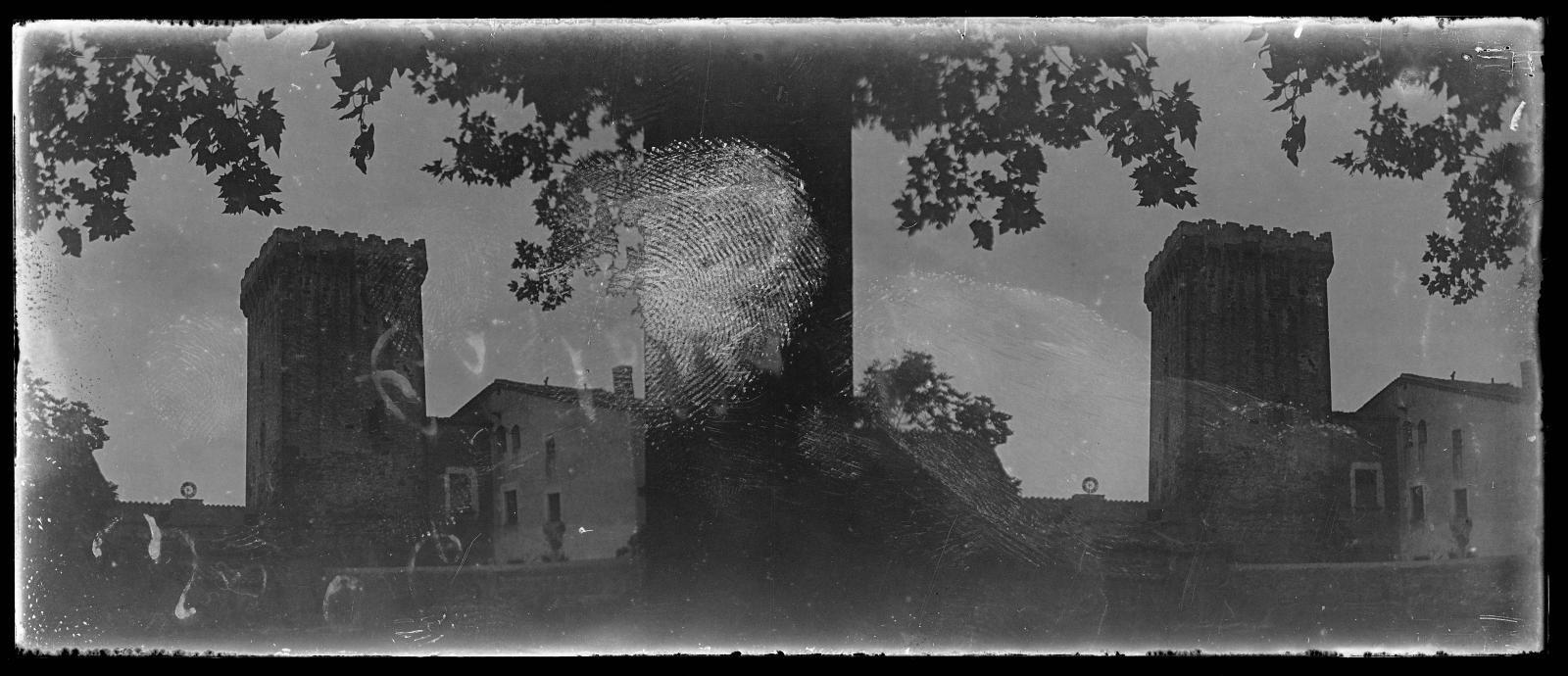
Castelldefels Castle
· Ajuntament de Girona (via Europeana)
Public domain
Nearby